
Jump to Recipe
Scialatielli is a short, thick, slightly rough pasta born in Amalfi in the late 1960s. The name comes from the Neapolitan dialect word for tousled or ruffled, which describes exactly how the strands look when freshly cut.
The dough uses semolina, whole milk, basil, and sometimes a little cheese, which gives it a richer, denser bite than egg tagliatelle. That texture is the whole point: the rough surface grips shellfish broth and olive oil far better than a smooth factory pasta.
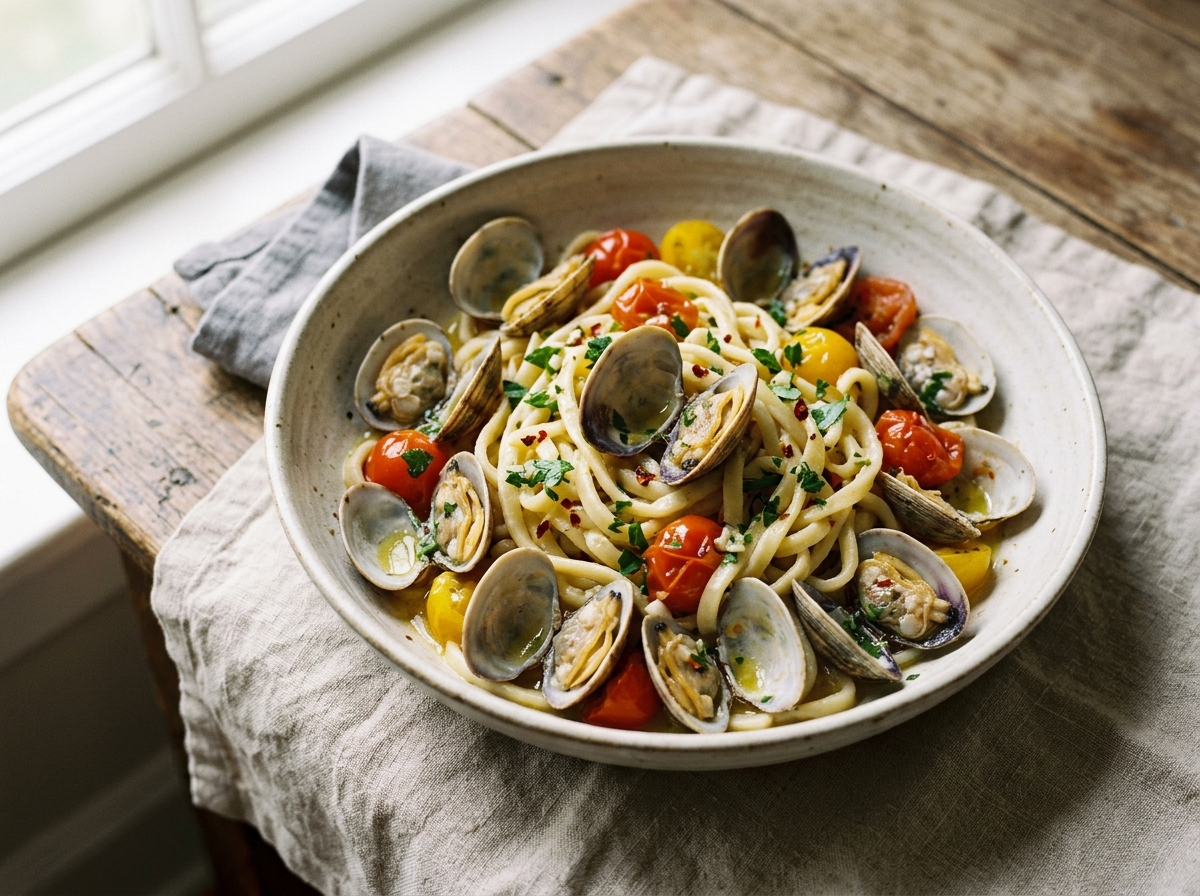
Paired here with vongole veraci and fresh cherry tomatoes, this is a dish from the Campanian coastline — much like the Campania tradition of simple ingredients handled with precision — straightforward in technique and very specific in ingredient quality. Good clams and ripe tomatoes do most of the work.
Why You’ll Love This Recipe
- Hand-cut dough ready to cook in under 45 minutes
- Rough texture grips the briny clam sauce perfectly
- Uses one pan for the sauce, minimal cleanup
- Tastes like southern Italian coastal cooking at home
Ingredient Notes
- Semolina flour (rimacinata): Use finely milled semolina rimacinata for a smooth but toothsome dough. Coarse semolina makes the texture gritty rather than pleasantly firm.
- 00 flour: Blending 00 with semolina softens the dough enough to roll by hand without a machine. All-semolina dough is harder to work if you’re new to fresh pasta.
- Whole milk: Milk replaces eggs here, giving scialatielli its distinctive pale color and slightly creamy chew. Don’t substitute water or the character of the pasta changes.
- Pecorino Romano: A couple of tablespoons of finely grated pecorino go directly into the dough, a traditional touch that adds a faint savory note. Parmigiano works but is milder.
- Vongole veraci (live clams): Small Manila clams or New Zealand cockles work well if vongole aren’t available. Purge them in cold salted water for at least 30 minutes before cooking.
- Cherry tomatoes: Datterini or Pachino tomatoes are the coastal Campanian choice. Standard cherry tomatoes are fine; just make sure they’re ripe and sweet, not mealy.
- Dry white wine: A crisp Falanghina or Greco di Tufo fits the regional spirit, but any dry white you’d drink will do. Avoid anything oaky.
- Fresh basil: Basil goes into the dough and over the finished plate. Dried basil in the dough produces a flat, dusty flavor rather than the bright herbal note you want.
Campania Scialatielli Pasta with Clams and Cherry Tomatoes
Ingredients
Method
- Combine both flours, pecorino, chopped basil, and salt in a large bowl and mix well.
- Add the olive oil and pour in the milk gradually, mixing with a fork until the dough starts to come together.
- Turn onto a lightly floured surface and knead for 8 to 10 minutes until the dough is smooth and firm, not sticky.
- Wrap the dough tightly in plastic wrap and rest at room temperature for 20 minutes.
- Lightly flour your work surface. Divide the dough into 4 portions and roll each one to a sheet about 3 to 4 mm thick.
- Cut each sheet into strips roughly 10 to 12 cm long and 5 to 6 mm wide using a sharp knife or fluted pastry wheel.
- Toss the cut pasta in a handful of semolina to prevent sticking and spread on a tray. Set aside.
- Heat the olive oil in a large wide pan over medium heat. Add the garlic and chili flakes and cook for 1 to 2 minutes until pale golden and fragrant.
- Add the cherry tomatoes, cut side down, and cook for 3 to 4 minutes until they begin to soften and release their juices.
- Raise the heat to high, pour in the white wine, and let it reduce by half, about 2 minutes.
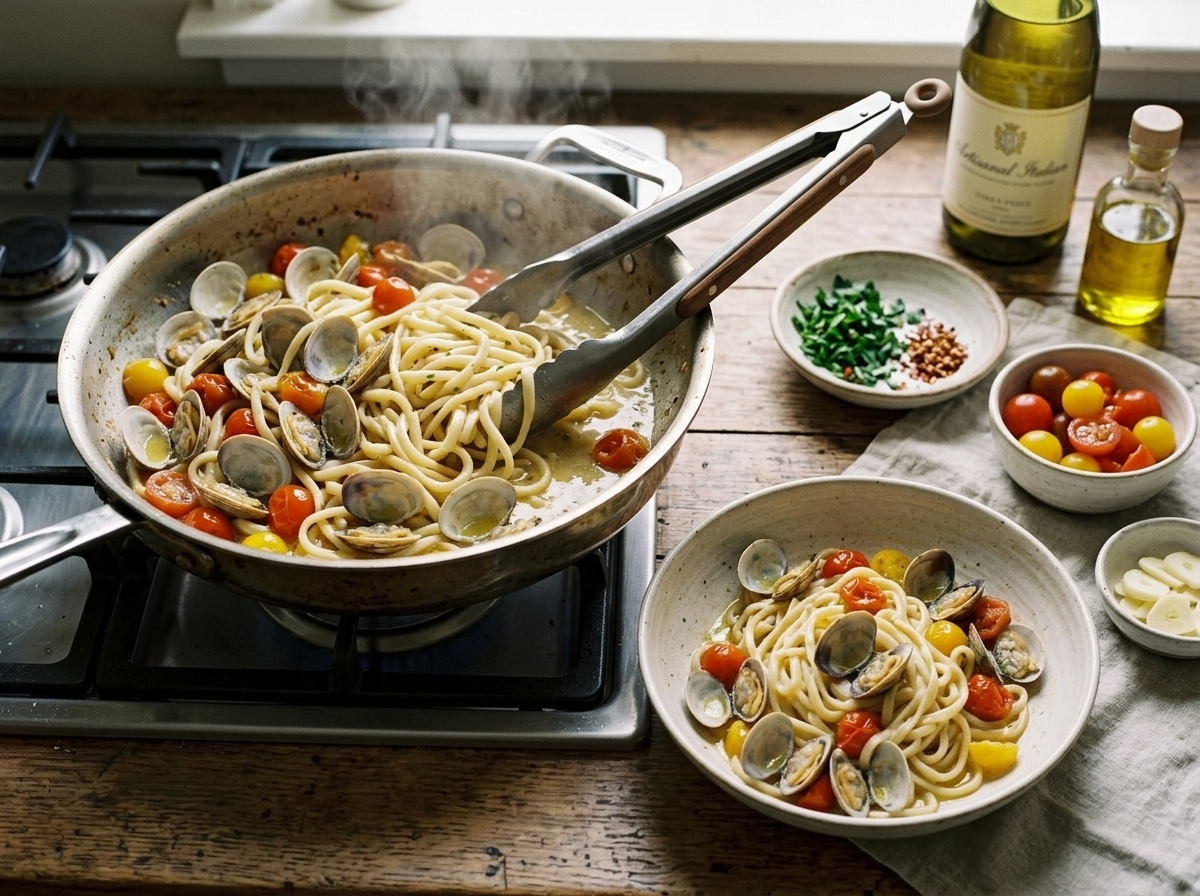
- Add the drained clams to the pan and cover immediately with a lid. Cook for 2 to 3 minutes, shaking the pan once, until all the shells have opened. Discard any that remain closed.
- Remove from the heat. Pull the meat from about half the clams and return it to the pan, leaving the rest in their shells for presentation.
- Bring a large pot of water to a boil and salt generously. Cook the scialatielli for 3 to 4 minutes until just tender with a slight chew at the center.
- Reserve a full ladle of pasta cooking water before draining.
- Transfer the drained pasta directly into the clam pan. Add the pasta water and toss everything over medium heat for 60 seconds until the sauce coats each strand and looks glossy.
- Remove from the heat, scatter over the parsley, and check for salt. Serve immediately in warm bowls.
Notes
Tips for Success
- Rest the dough wrapped in plastic for at least 20 minutes so the gluten relaxes and rolling becomes easier.
- Roll the sheet to about 3 to 4 mm thick, thicker than you think, because scialatielli should be chunky not delicate.
- Cut strips roughly 10 to 12 cm long and 5 to 6 mm wide using a sharp knife or pastry cutter, then toss in semolina to prevent sticking.
- Add clams to the pan only after the wine has reduced by half, then cover immediately so they steam open in 2 to 3 minutes.
- Finish the pasta in the clam pan with a ladle of pasta water, tossing for 60 seconds so the starch binds the sauce to every strand.
Variations
- Scialatielli with shrimp and zucchini: swap clams for prawns, add thin zucchini rounds, skip tomatoes.
- Vegetarian version with wild mushrooms, garlic, white wine, and a handful of chopped walnuts for texture.
- Scialatielli al ragù napoletano: serve with a slow-cooked Neapolitan pork and tomato ragù instead of seafood.
Storage and Reheating
Fresh uncooked scialatielli keeps on a semolina-dusted tray, loosely covered, in the fridge for up to 24 hours. For longer storage, freeze the cut pasta in a single layer on a tray, then transfer to a bag once solid. Cook from frozen directly in boiling water, adding an extra minute.
Cooked pasta with clam sauce doesn’t store well. The clams toughen and the sauce separates overnight. If you need to prep ahead, make the dough the day before and store it uncooked.
If you have leftover dressed pasta, reheat it gently in a wide pan with a splash of water over low heat, stirring constantly. Expect the texture to soften slightly.
Serving Suggestions
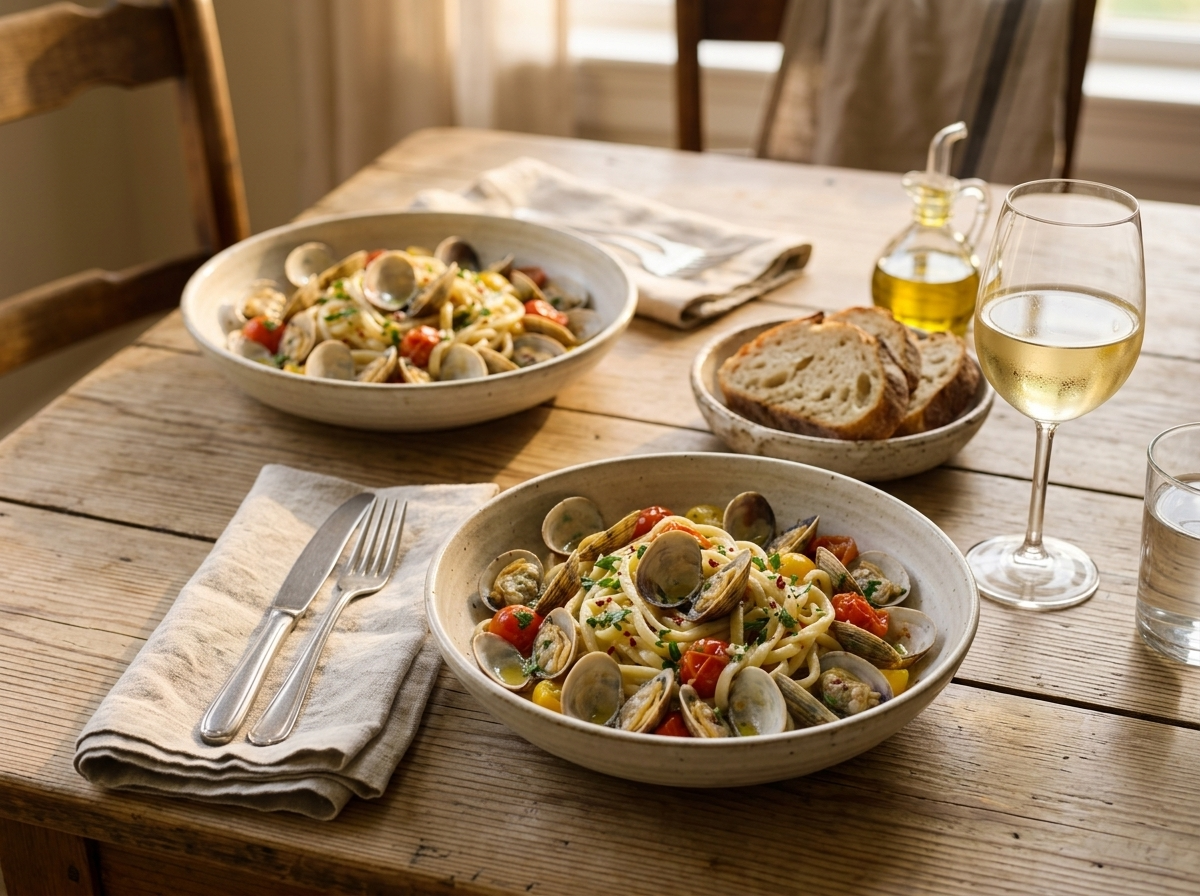
Scialatielli with clams is a first course in Campania, served before grilled fish or a simple seafood secondo. Keep portions measured at around 120 to 130 g of fresh pasta per person so it doesn’t overwhelm what follows.
A chilled glass of Falanghina or Fiano di Avellino alongside cuts through the brininess of the clams. Crusty bread on the table for the sauce left in the bowl is non-negotiable.
For a simpler weeknight setup, serve it as a standalone main with a green salad dressed in lemon and olive oil on the side.
FAQ
Why is my scialatielli dough cracking when I try to roll it?
The dough is too dry or hasn’t rested long enough. Add milk one teaspoon at a time, knead briefly, then let it rest another 10 minutes wrapped tightly before rolling again.
Can I use semolina only, without the 00 flour, for scialatielli?
You can, but the dough will be stiffer and harder to roll thin by hand. A 50-50 blend of semolina rimacinata and 00 gives a workable dough with the right firm bite.
How do I know when the clams are done and safe to eat in this sauce?
They’re done when the shells have opened fully, which takes about 2 to 3 minutes covered over high heat. Discard any clam that stays shut after that time.
Can I make the scialatielli dough the night before and cook it the next day?
Yes. Wrap the rested dough tightly in plastic and refrigerate for up to 24 hours. Take it out 15 minutes before rolling so it comes back to room temperature and relaxes.
What is the difference between scialatielli and spaghetti alle vongole?
Spaghetti alle vongole uses a dried factory pasta; scialatielli is a fresh, milk-based pasta with a thicker, rougher texture that holds the briny clam sauce differently. Scialatielli is specifically Campanian and predates the dish as a regional specialty from Amalfi.
Is scialatielli pasta dairy free?
Traditional scialatielli is not dairy free because the dough uses whole milk and pecorino cheese. You can substitute oat milk and omit the cheese, but the pasta will be lighter in color and slightly less rich in flavor.