
Jump to Recipe
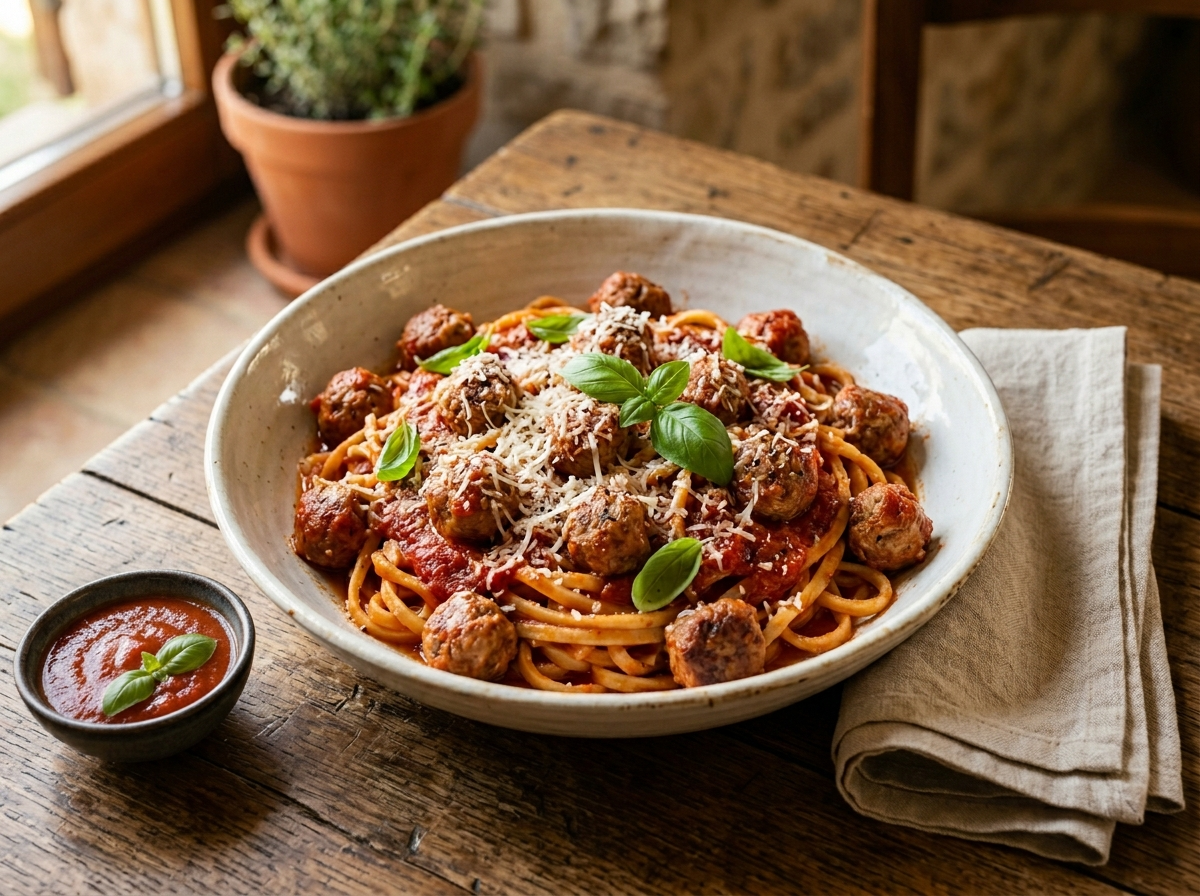
Maccheroni alla chitarra is the everyday pasta of Abruzzo, cut by pressing sheets of egg dough across the steel strings of a wooden frame called a chitarra. The strings give each strand a square cross-section, which holds thick sauces better than round spaghetti.
Pallottine are the defining companion, and the technique of rolling a seasoned meat mixture into small balls shares the same careful approach found in recipes like olive ascolane with a meat filling. The word means “little balls” and the size matters: these should be no bigger than a large marble, rolled from a mix of ground pork and veal seasoned with egg, Pecorino, and nutmeg. They finish cooking in the tomato sugo rather than in a separate pan, so they stay tender and absorb the sauce as it reduces.
This is a Sunday dish in most Abruzzese households, though it’s not complicated. The dough takes about ten minutes to mix, then rests while you make the pallottine and start the sugo.
If you don’t own a chitarra, a pasta machine set to the thickest setting and a sharp knife will get you close. The texture won’t be identical, but the dish still works.
Why You’ll Love This Recipe
- Pallottine cook in the sauce, staying juicy and well-seasoned
- Square-cut chitarra strands grip the sugo on every side
- Dough and meatballs can both be made the day before
- One pan for the sauce, one pot for pasta – minimal cleanup
Ingredient Notes
- 00 flour: Fine 00 flour gives the dough its characteristic smooth, pliable texture. All-purpose flour works as a substitute but produces a slightly stiffer dough – increase egg yolks by one if you swap.
- eggs: Use large eggs at room temperature. The Abruzzese standard is roughly one whole egg plus one yolk per 100 g of flour, which gives a rich, golden dough that rolls without cracking.
- ground pork: Choose pork with at least 20% fat for pallottine that stay soft after simmering. Leaner pork produces a drier meatball.
- ground veal: Veal lightens the meatball mix and keeps it delicate. Ground chicken or turkey thigh meat are reasonable swaps, though the flavor is milder.
- Pecorino Romano: Freshly grated Pecorino Romano goes into both the pallottine mix and finishes the dish. Parmigiano-Reggiano can substitute but gives a less sharp result.
- San Marzano tomatoes: Whole canned San Marzano tomatoes, crushed by hand, give a clean, low-acid sugo. Regular crushed tomatoes work but may need a pinch of sugar to balance acidity.
- dry white wine: A splash of white wine deglazes the soffritto before the tomatoes go in and adds brightness. Omit if cooking for children – add an extra tablespoon of tomato paste instead.
- nutmeg: A small grating of nutmeg in the pallottine mix is traditional and rounds out the meat flavor. Don’t skip it, but keep the quantity to a pinch – it should be background, not foreground.
Maccheroni alla Chitarra con Pallottine
Ingredients
Method
- Mound the 00 flour on a clean work surface and make a wide well in the center. Add the eggs, egg yolks, and salt to the well.
- Beat the eggs gently with a fork, then gradually draw in flour from the inner walls of the well until a shaggy dough forms.
- Knead the dough with the heel of your hand for 8 to 10 minutes until smooth and slightly elastic. The surface should feel like soft leather, not sticky.
- Wrap the dough tightly in plastic wrap and rest at room temperature for 30 minutes.
- Combine the ground pork, ground veal, egg, Pecorino, breadcrumbs, parsley, garlic, nutmeg, salt, and pepper in a large bowl. Mix with your hands until just combined - don't overwork the mixture.
- Roll the mixture into balls about 1.5 cm in diameter (roughly the size of a large marble). Place on a floured tray. You should get around 50 to 55 pallottine.
- Heat 2 tbsp olive oil in a 12-inch skillet over medium-high heat. Brown the pallottine in two or three batches, turning gently, for about 3 minutes per batch until lightly golden on most sides. Transfer to a plate. They will not be fully cooked at this stage.
- In the same skillet, reduce heat to medium. Add 3 tbsp olive oil and cook the onion for 6 to 7 minutes until soft and pale golden.
- Add the garlic and cook for 1 minute until fragrant but not browned.
- Pour in the white wine and stir, scraping up any browned bits from the pan. Let it bubble for 2 minutes until the sharp smell cooks off.
- Add the crushed tomatoes, basil, salt, and pepper. Stir and bring to a gentle simmer.
- Add the browned pallottine to the sugo. Simmer uncovered over low heat for 18 to 20 minutes, stirring occasionally, until the sauce has thickened and the pallottine are cooked through. Cut one open - it should be pale with no pink center.
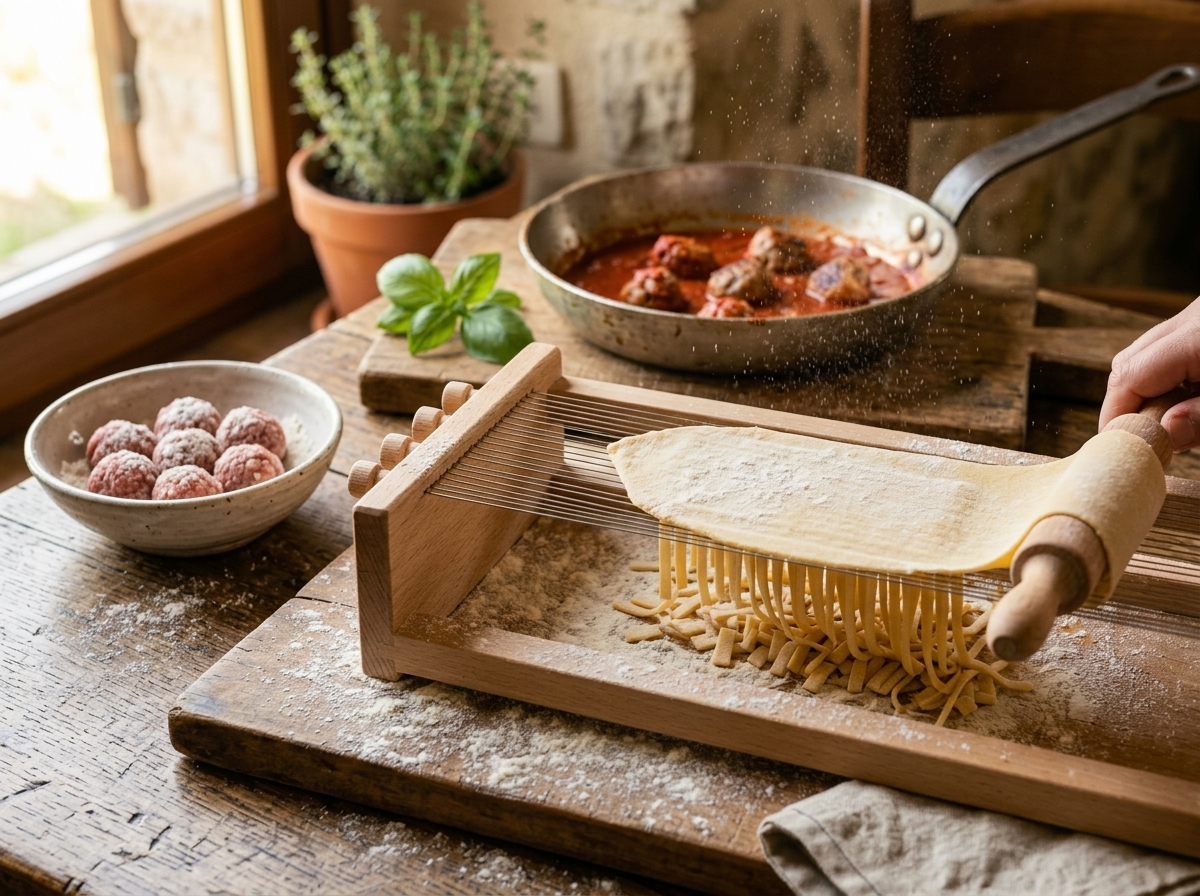
- Divide the rested dough into four pieces. Working with one piece at a time (keep the rest covered), roll on a lightly floured surface to a rectangle roughly 2 mm thick - about the width of your chitarra frame.
- Lay the sheet across the chitarra strings. Using a rolling pin, press firmly and evenly from one end to the other in one slow pass. The strings will cut the dough into square-section strands. Dust with flour and set aside on a floured tray. Repeat with remaining dough portions.
- Bring a large pot of water to a rolling boil. Add the coarse salt. Cook the chitarra for 2 to 3 minutes until al dente - they should have a slight bite at the center.
- Reserve 120 ml of pasta cooking water, then drain the chitarra.
- Add the chitarra to the sugo pan over low heat. Toss well, adding a splash of pasta water to loosen if needed. The pasta should be coated in a glossy, clingy sauce.
- Divide among four wide pasta bowls, distributing the pallottine evenly. Finish with freshly grated Pecorino Romano and a drizzle of raw extra-virgin olive oil.
Notes
Tips for Success
- Rest the chitarra dough wrapped in plastic for at least 30 minutes so gluten relaxes and rolling becomes easier.
- Roll pallottine to roughly 1.5 cm diameter – any larger and they won’t cook through in the sugo in time.
- Brown the pallottine in batches in a hot pan before adding to the sugo so they hold their shape during simmering.
- Cut chitarra strands by pressing the dough sheet firmly and evenly across all strings in one slow, steady push.
- Salt the pasta water generously and cook chitarra 2 to 3 minutes – it finishes briefly in the sugo pan and should arrive al dente.
Variations
- Use lamb mince instead of pork and veal for a more intense, traditional Abruzzese mountain version.
- Add a pinch of dried chili flakes to the sugo for the spicier Abruzzo coastal style called all’arrabbiata.
- Swap homemade chitarra for store-bought spaghetti alla chitarra to cut prep time on busy weeknights.
Storage and Reheating
Cooked chitarra con pallottine keeps in an airtight container in the refrigerator for up to 2 days. The pasta absorbs sauce as it sits, so it will be thicker when reheated.
Reheat gently in a wide skillet over low heat with 2 to 3 tablespoons of water or extra tomato sauce, stirring until hot through. Avoid the microwave if you can – the pallottine tend to toughen.
The pallottine and sugo freeze well separately for up to 2 months. Defrost overnight in the refrigerator and make fresh chitarra the day you want to serve them.
Serving Suggestions
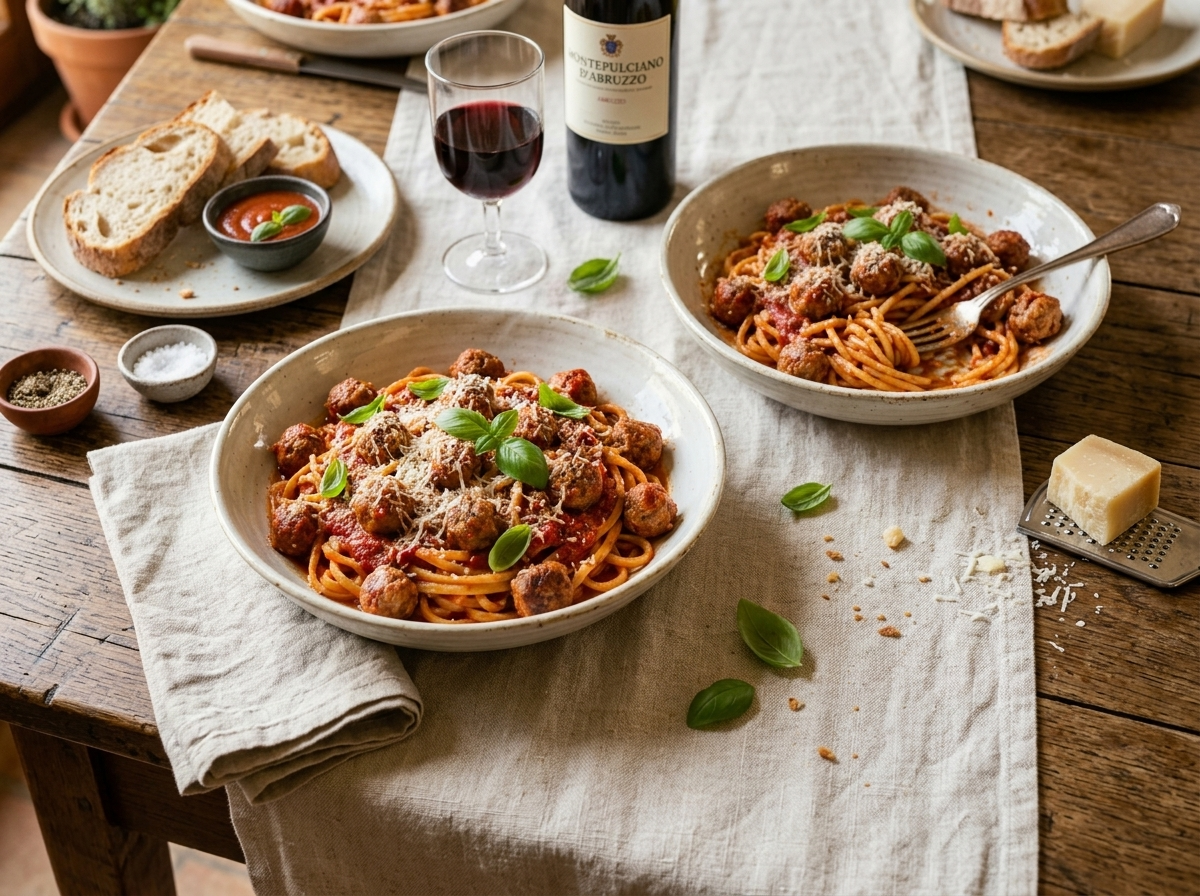
Serve in wide, shallow pasta bowls so the pallottine distribute evenly across the strands. Finish each portion with a grating of Pecorino Romano and a drizzle of raw extra-virgin olive oil added at the table.
In Abruzzo this is typically a first course, followed by roasted lamb or grilled pork ribs, much like the rich meat-forward plates covered in a red wine guide for Italian comfort foods. At home it works as a standalone main with a simple green salad dressed with lemon and olive oil on the side.
A medium-bodied Montepulciano d’Abruzzo is the obvious pairing – its soft tannins and red fruit don’t fight the tomato sugo, and the same logic behind pairing Italian wine with pasta applies here. A young Cerasuolo d’Abruzzo rosé works well in warmer months.
FAQ
Why are my pallottine falling apart in the sugo?
The most common reason is not browning them first. Sear the pallottine in a hot oiled pan until they hold a crust before adding them to the tomato sauce. Also check your meat mixture has enough egg and Pecorino to bind – one egg per 300 g of meat is the baseline.
Can I use a pasta machine instead of a chitarra to make the noodles?
Yes. Roll the dough to about 2 mm thick on your thickest setting, then cut into 2 to 3 mm wide strips with a sharp knife or pastry wheel. The strands will be flat rather than square, which changes the texture slightly but still works with the sugo.
Can I make the chitarra dough and pallottine the night before?
Both travel well to the next day. Wrap the rested dough tightly in plastic and refrigerate – bring it back to room temperature for 20 minutes before rolling. Keep the raw pallottine on a floured tray covered with plastic wrap in the fridge and brown them straight from cold.
What is the difference between maccheroni alla chitarra and spaghetti alla chitarra?
They are the same pasta cut on the same tool – the names are used interchangeably depending on the village and the cook. Some Abruzzesi reserve ‘maccheroni’ for the thicker cut (when the dough sheet is pressed through the wider-spaced string side of a double-sided chitarra) and ‘spaghetti’ for the narrower cut.
Is maccheroni alla chitarra con pallottine gluten-free?
No. The chitarra dough is made with wheat flour and is not gluten-free. You could substitute a blend of rice flour and tapioca starch for the pasta, but the dough handles differently and the texture will not be identical.
How do I know when the pallottine are cooked through in the sugo?
Cut one open after about 15 minutes of simmering – it should be uniformly pale inside with no pink center. At 1.5 cm diameter they are fully cooked in 15 to 18 minutes in a gently bubbling sauce.