
Jump to Recipe
Torta della nonna translates as ‘grandmother’s tart,’ and the name fits. It’s the kind of dessert that relies on good technique rather than unusual ingredients: a short, buttery pasta frolla crust, a pastry cream cooked until thick and pale, and a scatter of pine nuts pressed into the top before baking.
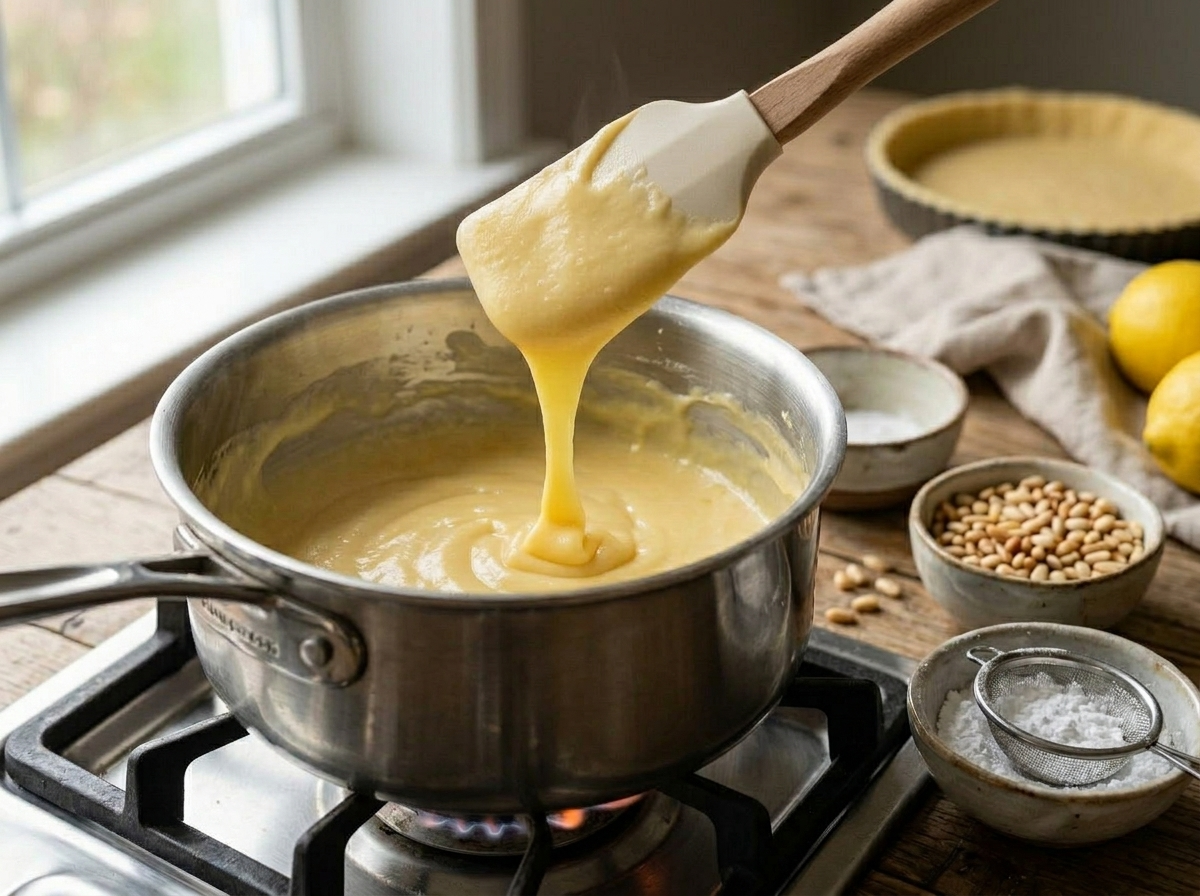
The pastry cream is the heart of the recipe. It needs to be cooked long enough to lose the raw flour taste but not so long that it turns grainy. You’re looking for a cream that falls slowly from a spoon and holds a soft mound.
The crust is a forgiving pasta frolla made with egg yolks, which keeps it tender and rich. Chilling the dough before rolling prevents shrinkage and makes it much easier to handle.
This tart is common across Tuscany and Liguria, with minor regional differences in the cream’s thickness or the use of lemon zest versus vanilla, much like how Italian alpine pastry traditions vary by region in their use of similar aromatics. My version leans Tuscan: a thicker cream, a generous dusting of powdered sugar, and pine nuts as the only topping.

Why You’ll Love This Recipe
- Pastry cream filling stays silky, never rubbery or watery
- Pasta frolla dough is forgiving and easy to patch
- Can be fully assembled the night before serving
- Pine nut topping adds subtle crunch without overpowering the cream
Ingredient Notes
- 00 flour (or all-purpose flour): Italian 00 flour gives the most tender pasta frolla. All-purpose flour works fine but produces a slightly sturdier crust.
- egg yolks (for pasta frolla): Yolks only make the pastry short and rich. Do not substitute whole eggs or the dough will be tough.
- whole milk: Full-fat milk gives the pastry cream the right body. Low-fat milk produces a thinner cream that may not hold during slicing.
- cornstarch (for pastry cream): Cornstarch sets the cream cleanly without a floury taste. Plain flour works as a substitute but requires a longer cooking time to cook out.
- lemon zest: Unwaxed lemon is best. The zest infuses the cream with a clean citrus note that keeps the filling from tasting heavy.
- pine nuts: Press them lightly into the top crust before baking so they stay in place. Blanched almonds are a reasonable substitute if pine nuts are unavailable.
- unsalted butter: Use cold butter cut into cubes for the pasta frolla. It should be rubbed into the flour quickly so it doesn’t melt.
Torta della Nonna Cream Tart (Italian Custard Pastry)
Ingredients
Method
- Combine the flour, powdered sugar, and salt in a food processor. Pulse briefly to mix.
- Add the cold cubed butter and pulse 8 to 10 times until the mixture resembles coarse breadcrumbs with no large butter chunks visible.
- Add the egg yolks, lemon zest, and vanilla extract. Pulse just until the dough comes together into a rough ball. Do not overwork it.
- Turn the dough onto a lightly floured surface, press into a flat disc, and divide into two pieces, one slightly larger than the other (60/40 split). Wrap each in plastic wrap and refrigerate for at least 1 hour.
- Pour the milk into a medium saucepan. Add the lemon zest and vanilla extract. Heat over medium until small bubbles appear at the edges, then remove from heat and let infuse for 5 minutes.
- Whisk the egg yolks and sugar in a bowl until pale and slightly thickened, about 2 minutes. Whisk in the cornstarch until no lumps remain.
- Slowly pour the warm milk into the egg mixture in a thin stream, whisking constantly. Pour everything back into the saucepan.
- Cook over medium-low heat, stirring constantly with a wooden spoon or silicone spatula, until the cream thickens visibly and falls slowly from the spoon in a ribbon, about 6 to 8 minutes. It will look lumpy briefly before it smooths out - keep stirring.
- Remove from heat. Stir in the butter until melted. Pass the cream through a fine-mesh sieve into a clean bowl. Press plastic wrap directly onto the surface and refrigerate until fully cold, at least 2 hours.
- Heat the oven to 175 C / 350 F. Butter and flour a 9-inch (23 cm) tart tin with a removable base.
- Remove the larger dough disc from the fridge. Roll it between two sheets of parchment to a circle about 3 mm thick and large enough to line the tin with a slight overhang.
- Carefully lift the dough into the tin, pressing it gently into the base and sides. Trim the overhang to about 1 cm above the rim. Refrigerate the lined tin for 15 minutes.
- Spoon the cold pastry cream into the crust and spread it evenly with a spatula, leaving a 1 cm border at the edge.
- Roll the smaller dough disc between two sheets of parchment to a circle that fits the top of the tart. Peel off the top sheet of parchment, flip the dough over the filled tart, and peel off the remaining parchment.
- Press the edges together firmly to seal. Trim any excess with a sharp knife. Brush the top crust with egg wash.
- Scatter the pine nuts evenly over the top and press them very lightly into the crust so they don't roll off.
- Bake for 35 to 40 minutes until the crust is pale gold and the pine nuts are lightly toasted. The center should feel just barely set when pressed.
- Transfer to a wire rack and cool completely at room temperature, at least 2 hours, before removing from the tin. Dust with powdered sugar just before serving.
Notes
Tips for Success
- Chill the pasta frolla dough for at least 1 hour before rolling to prevent it from cracking and shrinking in the tin.
- Cook the pastry cream over medium-low heat, stirring constantly, until it holds a soft ribbon when you lift the spoon.
- Press plastic wrap directly onto the surface of the warm pastry cream to stop a skin from forming as it cools.
- Roll the top crust between two sheets of parchment, then flip it over the filling to avoid tearing the dough.
- Dust with powdered sugar only after the tart has cooled completely or the sugar will melt into a wet glaze.
Variations
- Replace half the lemon zest with orange zest for a softer, warmer citrus flavor in the cream.
- Spread a thin layer of apricot jam on the bottom crust before adding the pastry cream for a Venetian-style variation.
- Use blanched, halved almonds instead of pine nuts and add 1 tsp of almond extract to the pasta frolla.
Storage and Reheating
Store the finished tart covered in the refrigerator for up to 3 days. The crust softens slightly after the first day, which many people prefer.
This tart does not reheat well. Serve it at room temperature, taken out of the fridge about 30 minutes before slicing. Warming it in the oven will melt the pastry cream and make the crust greasy.
Freezing is not recommended once the tart is assembled and baked. The pastry cream separates on thawing. You can freeze the unbaked pasta frolla dough, wrapped tight, for up to 1 month.
Serving Suggestions
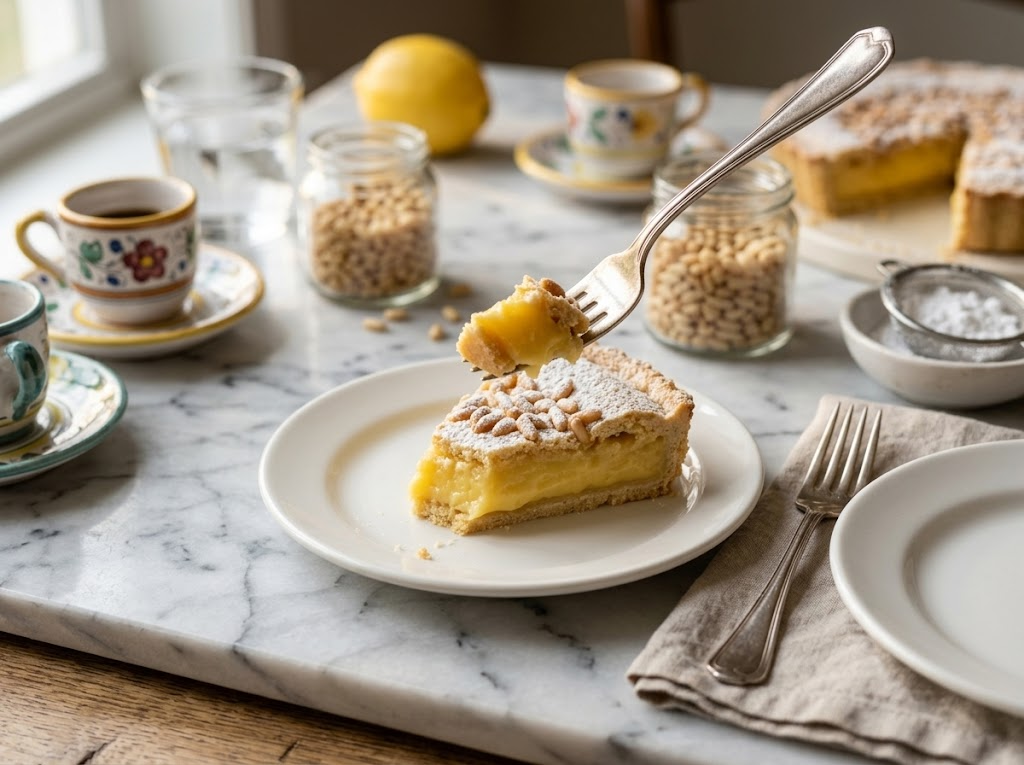
Serve torta della nonna at room temperature, dusted with powdered sugar just before it goes to the table. A slice pairs well with a small glass of Vin Santo or a short espresso.
For a light dessert spread, serve it alongside fresh berries or a light Italian ricotta dessert for a table that covers different textures without competing flavors. The cream in the tart is already rich, so you don’t need anything elaborate alongside it.
In Tuscany it often appears at the end of a Sunday lunch, after a pasta course and a roast. It works equally well as an afternoon cake with coffee.
FAQ
Why is my torta della nonna pastry cream runny after baking?
The cream was likely undercooked before it went into the tart. It needs to be thick enough to hold a soft mound on a spoon before you spread it into the crust. A cream that is too loose will turn liquid during baking and make the bottom crust soggy.
Can I use store-bought shortcrust instead of making pasta frolla?
You can, but the result will taste noticeably different. Pasta frolla is richer in egg yolks and sugar, which gives torta della nonna its characteristic crumbly, cookie-like texture. Store-bought shortcrust is more neutral and won’t hold up as well to the moist filling.
How do I know when the torta della nonna is done baking?
The top crust should be pale gold, not deep brown, and the pine nuts should be lightly toasted. The tart will still feel slightly soft in the center when you press it gently – that’s correct. It firms up as it cools.
Can I make the pastry cream for this tart the night before?
Yes, and it actually makes assembly easier. Make the cream, press plastic wrap directly onto the surface, and refrigerate it overnight. Take it out 15 minutes before spreading so it loosens slightly and is easier to work with.
Is torta della nonna gluten-free?
The traditional recipe is not gluten-free because both the pasta frolla and the pastry cream contain wheat flour or cornstarch alongside a wheat-based crust. You can adapt it by using a gluten-free flour blend for the pasta frolla and pure cornstarch in the cream, similar to the approach in a gluten-free Italian bread recipe, though the texture of the crust will be more crumbly.
What is the difference between torta della nonna and crostata di crema?
Crostata di crema is typically an open-face tart with a single layer of crust and a visible cream top. Torta della nonna has a full top crust that encloses the cream completely, giving it a more substantial texture and a longer shelf life. The pine nut topping is also specific to torta della nonna.