
Jump to Recipe
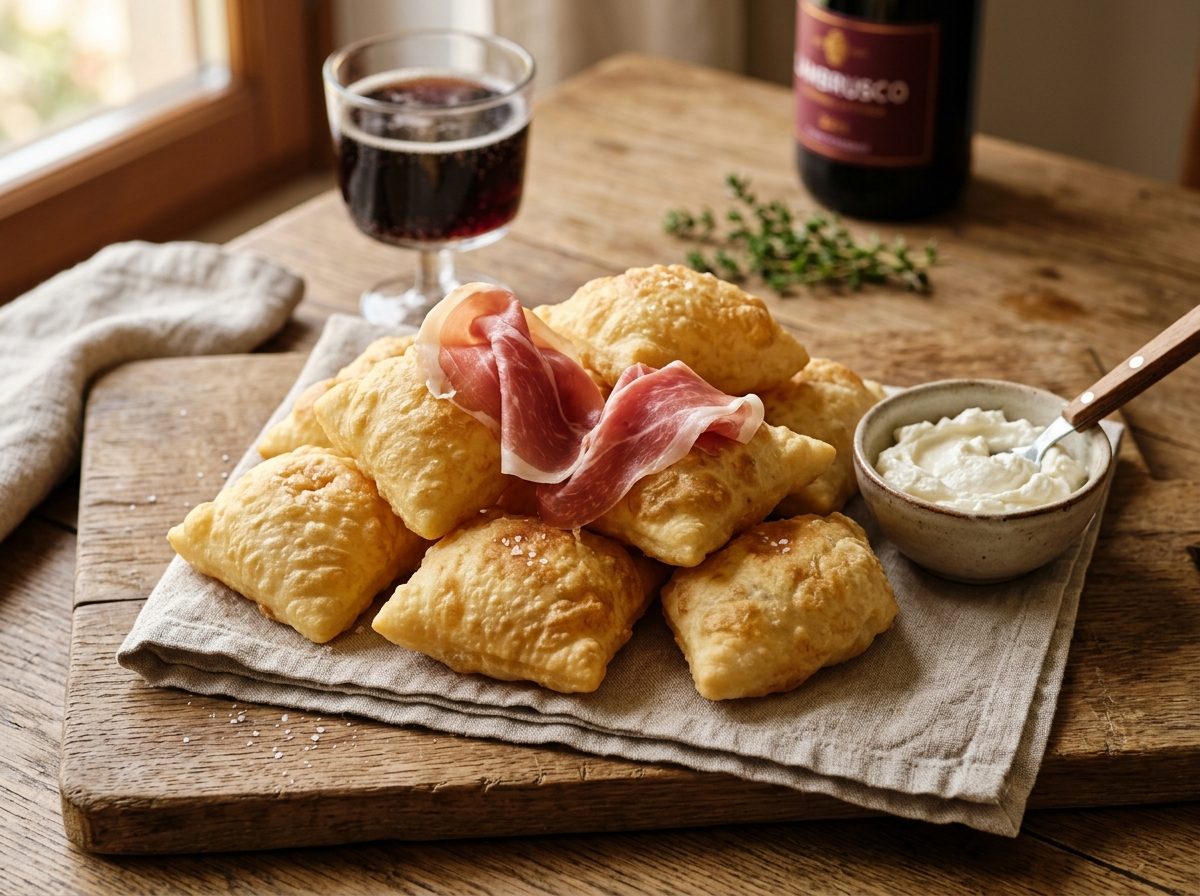
Gnocco fritto is street food and aperitivo food at the same time. In Emilia-Romagna, it shows up at salumerias, sagre, and kitchen tables equally, always alongside prosciutto or mortadella and something cold to drink — much like other Emilian savory classics built on lard-enriched dough and aged cheese.
The dough is simple – flour, water, lard, a little yeast, and salt. What matters is the rest time and the oil temperature. Get those right and the dough puffs into hollow, blistered pillows on contact with the oil.
I fry mine in sunflower oil at 180 C / 355 F. Lard is traditional and gives a slightly richer result, but sunflower oil is cleaner-tasting and easier to manage at home.
This recipe makes enough for four people as an antipasto. Scale up if you’re feeding a crowd – the dough holds well in the fridge for a day.
Why You’ll Love This Recipe
- Ready in 40 minutes including a short dough rest
- Only 6 pantry ingredients, no special equipment needed
- Dough can be made a day ahead and fried fresh
- Pairs with anything cured, creamy, or pickled
Ingredient Notes
- 00 flour: 00 flour gives the dough a smooth, extensible texture that fries evenly. All-purpose flour works fine – the result is slightly chewier but still good.
- lard (strutto): Traditional gnocco fritto uses strutto (rendered pork lard) for a richer, slightly savory dough. Cold butter cut into the flour is a workable substitute if lard is hard to find.
- instant yeast: Instant yeast goes straight into the flour. If using active dry yeast, dissolve it in the warm water first and let it sit for 5 minutes before mixing.
- warm water: Aim for 35-38 C / 95-100 F – warm to the touch but not hot. Too hot kills the yeast; too cold slows the rise.
- fine sea salt: Add salt directly to the flour, away from the yeast, to avoid inhibiting fermentation before mixing.
- sunflower oil (for frying): Sunflower or other neutral high-smoke-point oil works well. You can also use lard for a more traditional result – it fries at a slightly lower temperature and adds flavor.
Gnocco Fritto (Emilian Fried Dough)
Ingredients
Method
- Combine flour, instant yeast, and salt in a large mixing bowl. Whisk briefly to distribute the yeast evenly through the flour.
- Add the lard or cold butter pieces and rub into the flour with your fingertips until the mixture resembles coarse sand with no large fat lumps visible.
- Pour in the warm water and milk. Mix with a fork until a shaggy dough forms, then turn out onto a lightly floured surface.
- Knead for 5 to 6 minutes until the dough is smooth, elastic, and slightly tacky but not sticky. Shape into a ball.
- Place the dough back in the bowl, cover with a clean kitchen towel or plastic wrap, and rest at room temperature for 45 minutes until slightly puffed.
- Lightly flour your work surface. Divide the rested dough into two portions for easier handling.
- Roll each portion out to about 3 mm thickness. The dough should be smooth and easy to stretch without tearing after resting.
- Cut into rough rectangles or diamond shapes, approximately 8 cm x 5 cm. Irregular shapes are traditional and fine.
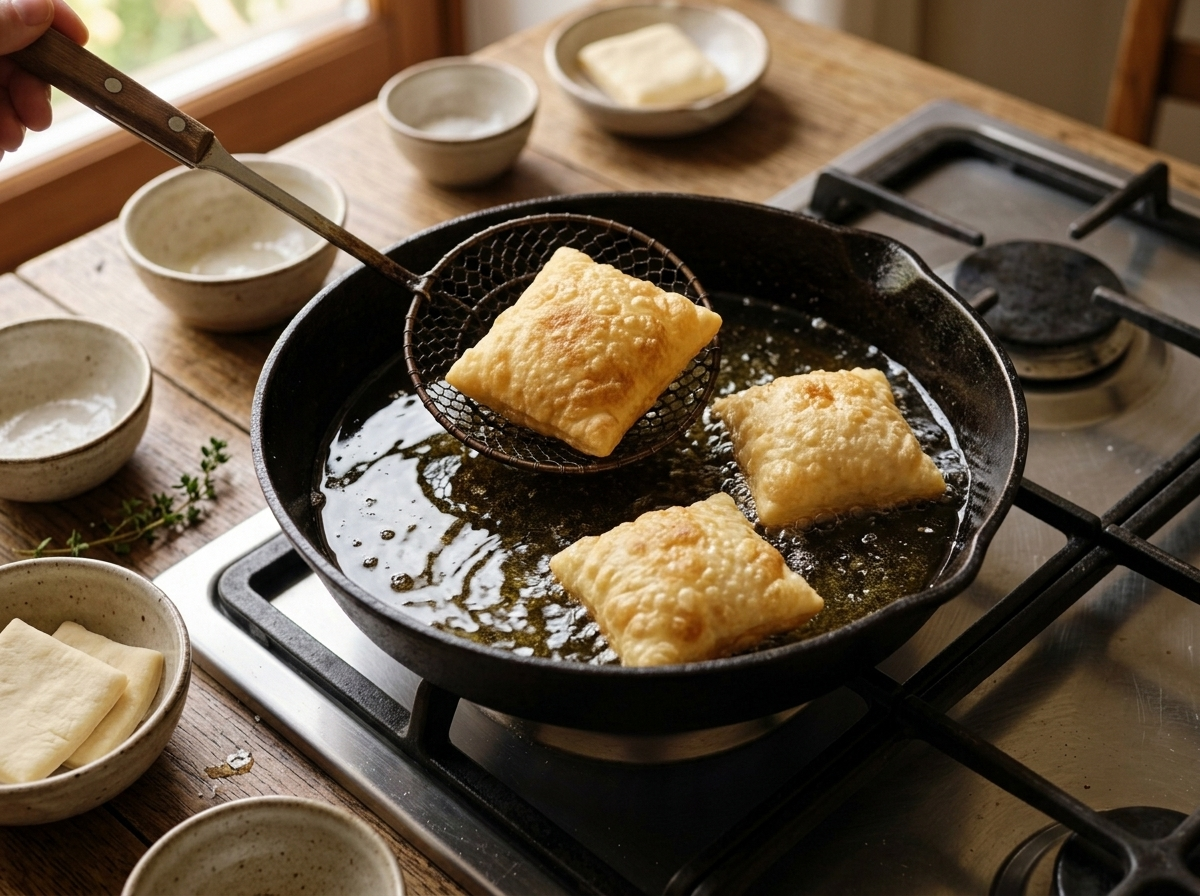
- Pour sunflower oil into a deep heavy-bottomed skillet to a depth of about 4 cm. Heat over medium-high until the oil reaches 180 C / 355 F on an instant-read thermometer.
- Carefully slide 3 to 4 pieces of dough into the hot oil. They should sizzle immediately and begin to puff within 20 to 30 seconds.
- Fry for 60 to 90 seconds per side, turning once with a slotted spoon, until both sides are pale golden and visibly blistered. Do not let them go deep brown.
- Lift out with a slotted spoon, drain briefly, and transfer to a wire rack. Wait for the oil to return to 180 C before frying the next batch.
- Repeat with remaining dough pieces. Serve immediately while still hot and airy.
Notes
Tips for Success
- Rest the dough for at least 45 minutes at room temperature so the gluten relaxes and the pieces stretch without springing back.
- Roll each piece to about 3 mm thickness – too thick and the center stays doughy; too thin and you lose the airy pocket.
- Use a thermometer to hold oil at 180 C / 355 F throughout frying – temperature drops kill the puff.
- Fry in small batches of 3 to 4 pieces so the oil stays hot and each piece browns evenly without sticking together.
- Drain on a wire rack rather than paper towels so the bottom stays crisp instead of steaming soft.
Variations
- Whole wheat swap: replace 30% of 00 flour with finely milled whole wheat for a nuttier, slightly denser gnocco.
- Herb dough: mix 1 tsp dried rosemary or 2 tsp fresh thyme into the flour for a fragrant variation that pairs well with fresh ricotta.
- No-yeast version: substitute 1 tsp baking powder for the yeast and skip the rest time – the puff is smaller but it works in a pinch.
Storage and Reheating
Uncooked dough keeps in the fridge for up to 24 hours, wrapped tightly. Bring it back to room temperature for 20 minutes before rolling and frying.
Fried gnocco fritto is best eaten within 10 minutes of coming out of the oil. If you must hold them, keep on a wire rack in a 100 C / 210 F oven for up to 20 minutes – they’ll stay acceptably crisp but won’t be as airy.
I don’t recommend freezing the fried pieces. Freeze uncooked dough portions instead, separated by parchment. Thaw overnight in the fridge.
Serving Suggestions
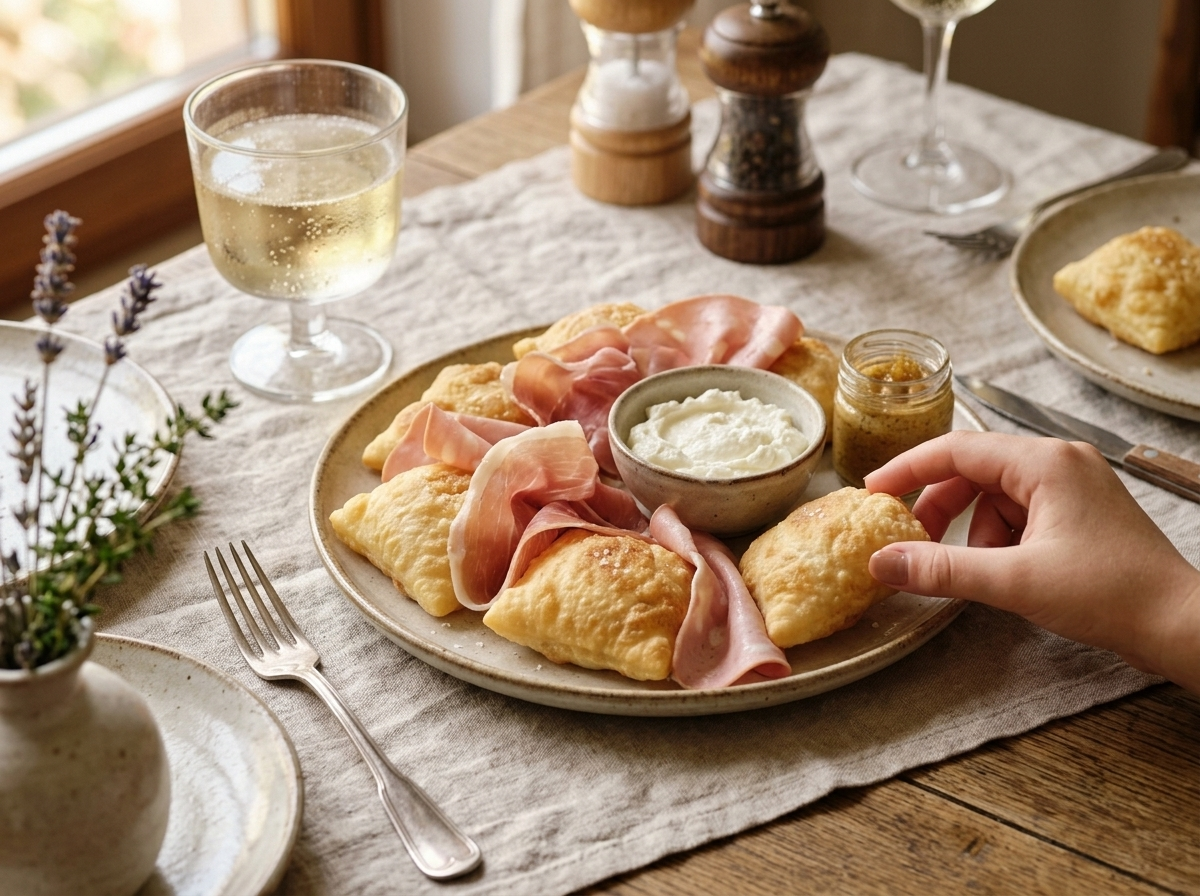
The classic pairing is thin-sliced prosciutto di Parma or mortadella, laid directly on the warm gnocco so the fat softens slightly from the heat. Stracchino or squacquerone – soft, spreadable fresh cheeses – are the other traditional accompaniment in Emilia-Romagna.
For a broader spread, add a few slices of salame, a bowl of tigelle-style accompaniments (lard creamed with rosemary, or a simple tomato bruschetta topping), and a cold glass of Lambrusco or Pignoletto alongside a classic Italian aperitivo. The slight sweetness of sparkling local wine cuts through the fried dough nicely.
Gnocco fritto also works as a side to soups or Italian pasta and lentil stews if you want something heartier.
FAQ
Why is my gnocco fritto not puffing up in the oil?
The most common cause is oil that’s not hot enough – below 175 C the dough absorbs oil instead of steaming from the inside. Check temperature with a thermometer before each batch and let the oil recover between rounds.
Can I use butter instead of lard in gnocco fritto dough?
Yes, cold unsalted butter rubbed into the flour gives a slightly flakier result. The flavor is milder than strutto but the dough handles and fries well. Use the same weight.
How do I know when the gnocco fritto dough has rested long enough?
Press a fingertip into the dough – it should spring back slowly and leave a slight indent rather than snapping back immediately. That tells you the gluten has relaxed enough to roll thin without tearing.
What is the difference between gnocco fritto and crescentine?
In Modena the fried dough is called gnocco fritto; in Bologna the same concept is often called crescentine. The recipes are nearly identical – the main difference is local name and sometimes a slightly higher lard content in the Bolognese version.
Can I make gnocco fritto dough ahead and refrigerate it overnight?
Yes, and it actually improves the flavor slightly. Shape the dough into a ball, wrap tightly in plastic, and refrigerate for up to 24 hours. Let it sit at room temperature for 20 minutes before rolling.
Is gnocco fritto vegetarian?
It depends on the fat you use. Made with butter or olive oil instead of lard, and served without cured meats, gnocco fritto is vegetarian. The dough itself contains no eggs or dairy, just flour, water, fat, yeast, and salt.