Jump to Recipe
Pasta alla Genovese is not from Genoa. Despite the name, this is a purely Neapolitan dish, a slow-cooked sauce built from an almost unreasonable quantity of white onions and a single piece of beef that braises quietly in its own moisture for two to three hours.
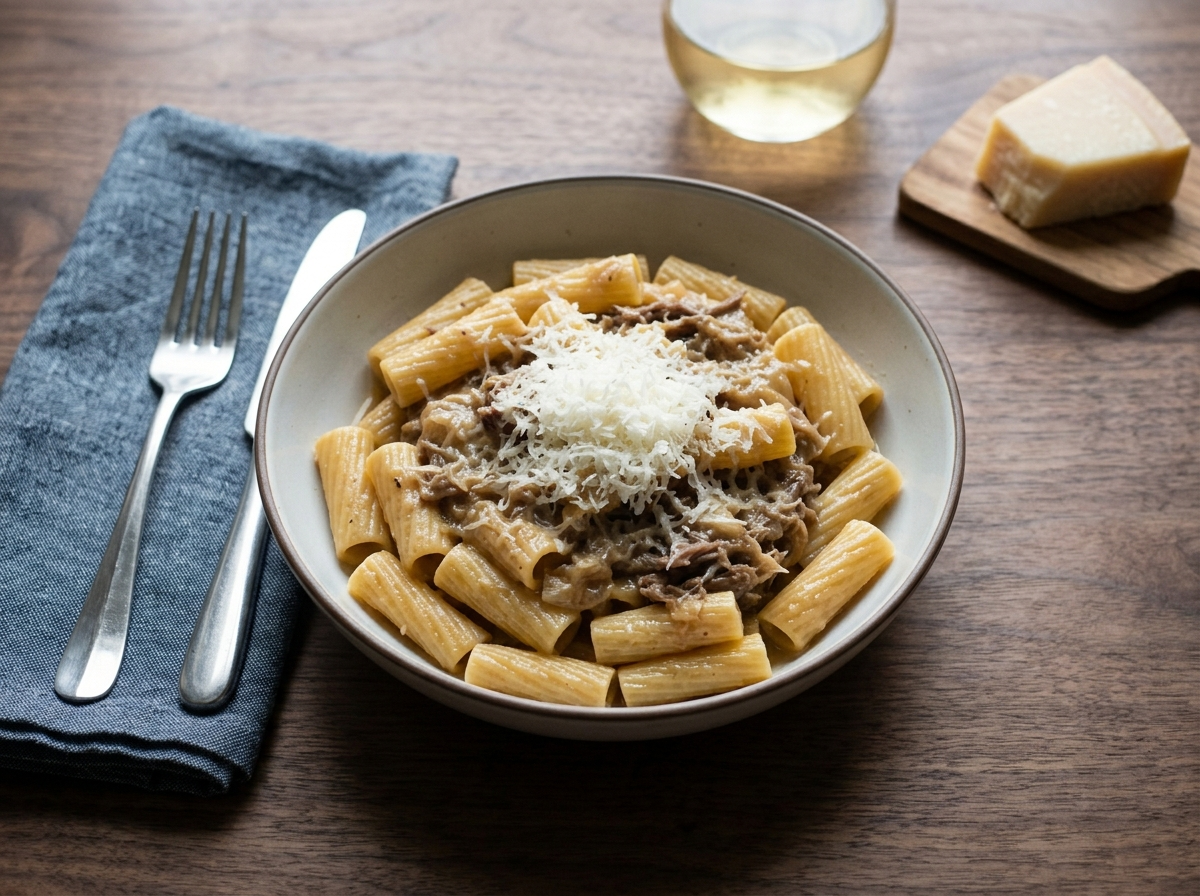
The result is nothing like a tomato ragu. The onions dissolve completely, turning golden and sweet, while the beef shreds into soft threads throughout. The color is a warm, tawny amber. The texture lands somewhere between a thick braise and a pasta sauce.
This is a Sunday dish. It rewards patience and punishes shortcuts. The only real skill involved is keeping the heat low enough that the onions soften without browning too fast.
Ziti or rigatoni are the traditional choices. Their hollow centers and ridged surfaces hold the sauce where a smooth pasta would let it slide off. A good shower of aged Parmigiano-Reggiano at the end is not optional.
Why You’ll Love This Recipe
- Two main ingredients, deeply complex flavor from long cooking
- Hands-off braising time frees you for other things
- Sauce and meat in one pot, no separate ragu needed
- Leftovers taste better the next day, straight from the fridge
Ingredient Notes
- White onions: You need about 1.5 kg of white onions for 4 servings – this seems excessive until you see how much they reduce. Yellow onions work, but white onions give a cleaner, less sharp flavor once cooked down.
- Beef chuck (manzo): A single piece of bone-in or boneless chuck around 600 to 700 g is ideal – it has enough connective tissue to stay moist through the long braise. Brisket or beef shin are close substitutes.
- Dry white wine: A dry Falanghina or any dry Italian white works well here. Avoid anything oaked or sweet, which throws the balance of the onions off.
- Lard or olive oil: Traditional versions use lard for the soffritto, which adds a subtle depth you don’t get from olive oil. Either works fine – use what you have.
- Ziti or rigatoni: Ziti spezzati (broken ziti) is the classic Neapolitan choice. Rigatoni is a practical substitute that’s easier to find outside Italy.
- Parmigiano-Reggiano: Grate it fresh at the table – pre-grated loses the granular texture that gives each bite contrast against the soft sauce. Pecorino Romano can replace up to half the Parmigiano for a sharper finish.
Pasta alla Genovese: The Neapolitan Onion and Beef Sauce Worth the Wait
Ingredients
Method
- Heat the lard or olive oil in a large, heavy-bottomed pot over medium heat until shimmering.
- Add the diced carrot and celery and cook for 5 minutes, stirring occasionally, until softened and lightly golden.
- Nestle the beef chuck into the pot in one piece and sear for 3 to 4 minutes per side until deeply browned on all surfaces. Remove and set aside.
- Add all the sliced onions to the pot along with 1 tsp of salt. Stir to coat them in the fat and any browned bits.
- Cover the pot and cook the onions over low to medium-low heat for 20 minutes, stirring every 5 minutes, until they begin to wilt and release their liquid.
- Return the seared beef to the pot, burying it in the onions. Add the Parmigiano rind if using.
- Pour in the white wine, stir gently, and let it bubble for 2 minutes until the sharp alcohol smell fades.
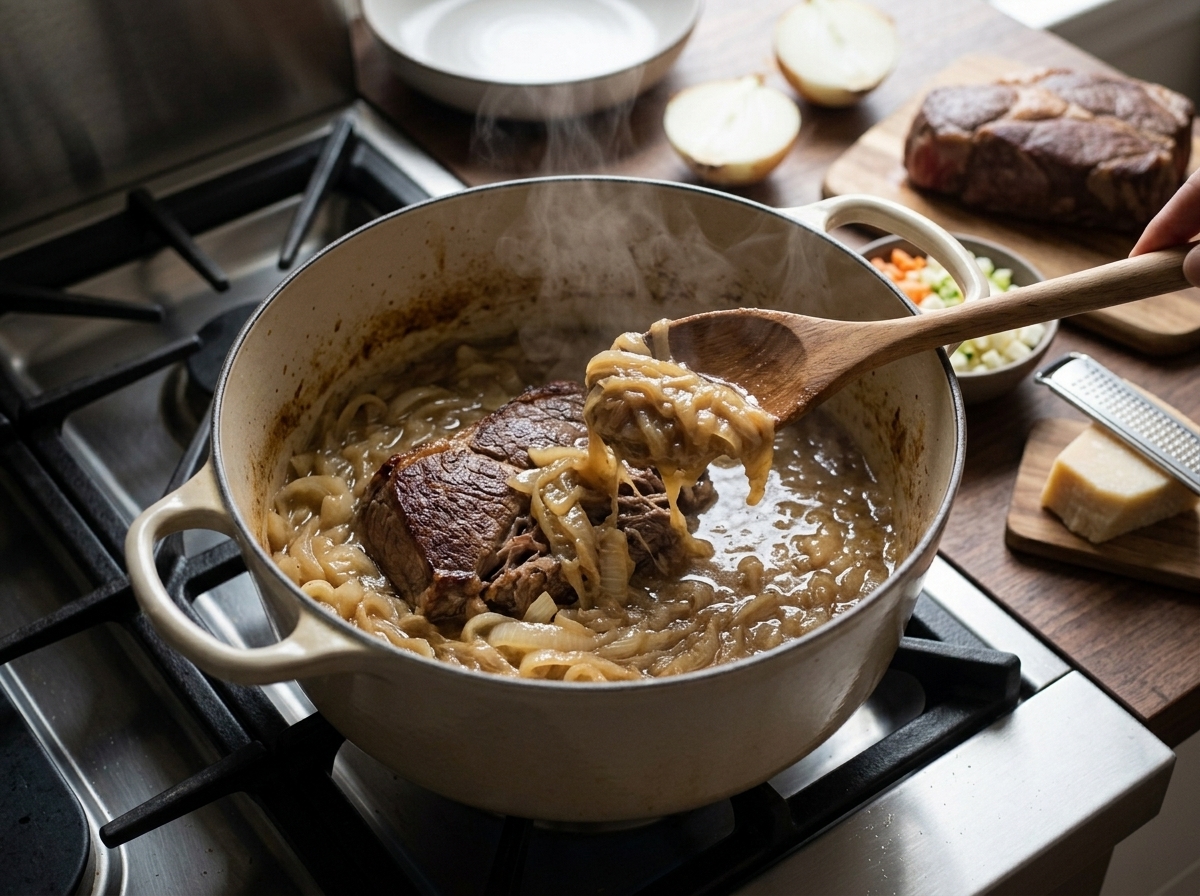
- Reduce heat to its lowest setting, set the lid ajar by about 2 cm, and braise for 2 hours, stirring every 20 to 30 minutes. The onions should slowly turn from white to pale gold to a warm amber. If the pot looks dry at any point, add 2 to 3 tablespoons of water.
- After 2 hours, remove the lid completely and cook for a further 20 to 30 minutes until the sauce is thick, glossy, and no longer watery. Season with the remaining salt and black pepper.
- Lift the beef out of the pot and place it on a cutting board. Remove any bones or large pieces of fat, then shred the meat by hand into rough, uneven threads.
- Stir the shredded beef back through the onion sauce. Remove and discard the Parmigiano rind if used. Taste and adjust seasoning.
- Bring a large pot of water to a rolling boil. Salt it generously - about 10 g of salt per liter of water.
- Cook the ziti or rigatoni until 1 minute short of al dente according to the package. Reserve 1 cup of pasta cooking water before draining.
- Drain the pasta and add it directly to the pot of Genovese sauce over low heat. Toss vigorously, adding the pasta water a few tablespoons at a time until the sauce coats every piece evenly and looks glossy rather than dry.
- Remove from heat, add half the grated Parmigiano-Reggiano, and toss again. Divide into deep bowls and finish with the remaining cheese. Serve immediately.
Notes
Tips for Success
- Slice onions to a uniform 3 to 4 mm thickness so they cook evenly and collapse at the same rate.
- Keep the lid slightly ajar for the last 45 minutes to let excess moisture evaporate and concentrate the sauce.
- Deglaze with white wine only after the onions have softened for at least 15 minutes, not before.
- Pull the beef out before tossing the pasta and shred it by hand – large uneven shreds give better texture than finely cut pieces.
- Reserve a full cup of pasta cooking water and add it gradually when tossing – the starch helps the sauce coat every piece of ziti.
Variations
- Add a small piece of pork rib alongside the beef for a richer, slightly fattier sauce common in older Neapolitan recipes.
- Stir in a tablespoon of tomato paste with the wine for a faint red hue and a rounder acidity without making it a tomato sauce.
- Use the leftover braised beef as a filling for crocchette or stuffed peppers the next day – nothing goes to waste.
Storage and Reheating
Store the sauce and meat separately from the cooked pasta in airtight containers in the fridge for up to 4 days. The sauce actually thickens and deepens overnight, making day-two portions noticeably better.
Reheat the sauce gently in a wide pan over low heat with a splash of water to loosen it, then cook fresh pasta to toss through. Reheating already-sauced pasta works in a pinch – add a little water and stir constantly over medium-low heat.
The sauce freezes well for up to 3 months. Freeze without the pasta. Thaw overnight in the fridge and reheat as above.
Serving Suggestions
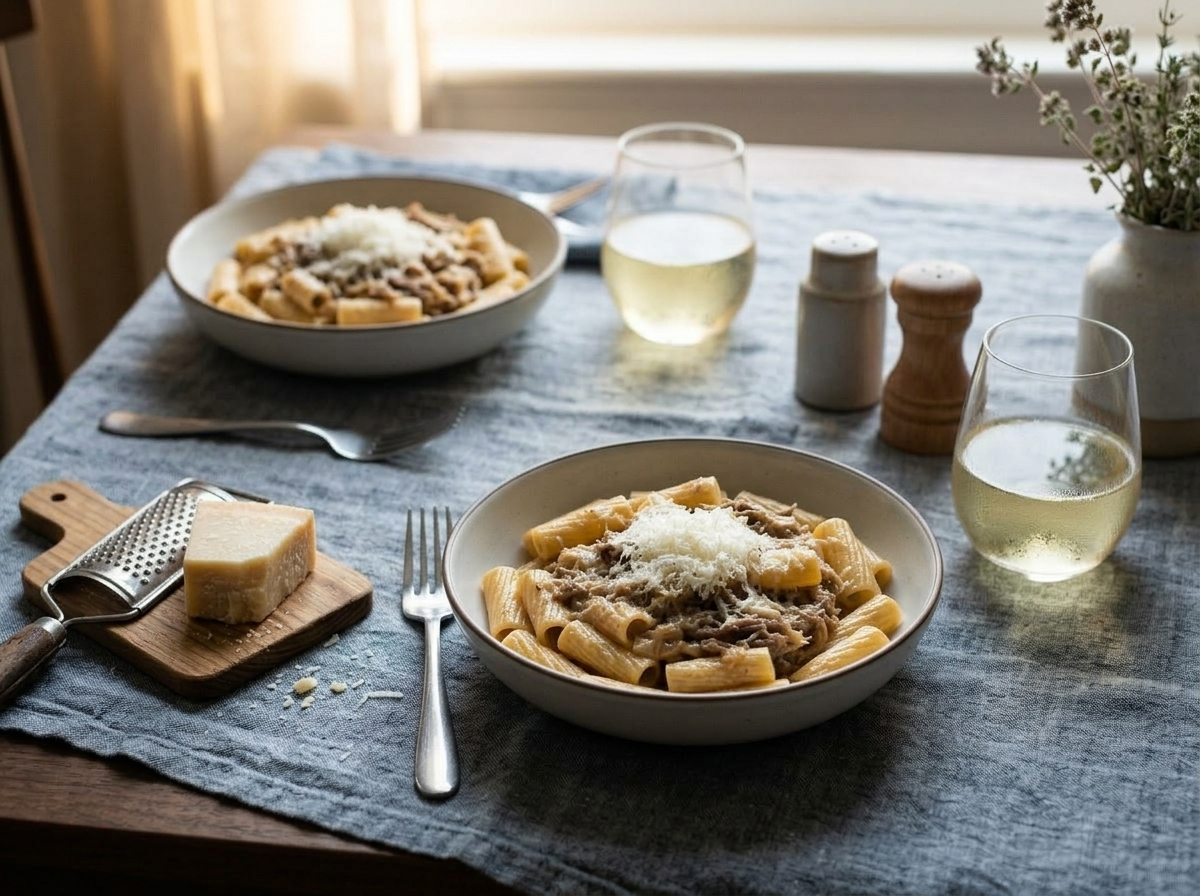
Serve in deep pasta bowls with a generous hand of freshly grated Parmigiano-Reggiano. Nothing else is needed on the pasta itself – the sauce is complete.
In Naples, the braised beef is often served as a separate second course (secondo) alongside the pasta, with a simple salad dressed with olive oil to cut the richness.
A chilled glass of Falanghina or a light Aglianico pairs cleanly with the sweet-savory depth of the onions, and an Italian wine pairing guide for pasta can help you choose between the two. Crusty bread on the side to mop the bowl is not optional in most Neapolitan households.
FAQ
Why are my Genovese onions browning instead of melting?
The heat is too high. Pasta alla Genovese requires a genuine low simmer – barely a bubble – for the onions to soften and collapse without caramelizing too fast. Drop the heat, add a small splash of water, and cover the pot until they relax.
Can I use red onions instead of white onions in Genovese sauce?
You can, but the flavor shifts noticeably – red onions are sharper and leave a slightly purple tint in the finished sauce. White or yellow onions give the cleaner, sweeter result the dish is built around.
Can I make Pasta alla Genovese in a slow cooker?
Yes. Soften the onions in a wide pan on the stovetop for 20 minutes first, then transfer everything to the slow cooker and cook on low for 6 to 8 hours. You’ll need to remove the lid for the last 30 minutes to thicken the sauce.
What is the difference between Pasta alla Genovese and a regular beef ragu?
Genovese has no tomatoes and uses a ratio of roughly 2 to 3 parts onions to 1 part beef – the onions are the sauce, not a background flavor. A traditional ragu is tomato-forward with the meat as the main feature, closer in spirit to the rich braised beef of Italian comfort cooking.
Is Pasta alla Genovese gluten-free?
The sauce itself contains no gluten – it’s just beef, onions, wine, and fat. To make the full dish gluten-free, swap the ziti for a certified gluten-free pasta made from corn or rice, and the result is nearly identical.
How much onion do I actually need for an authentic Genovese?
Traditional recipes use a 2:1 or even 3:1 ratio of onions to meat by weight – so for 600 g of beef, expect to peel and slice 1.2 to 1.5 kg of onions. That volume is not a mistake; they reduce by more than two-thirds during cooking.