
Jump to Recipe
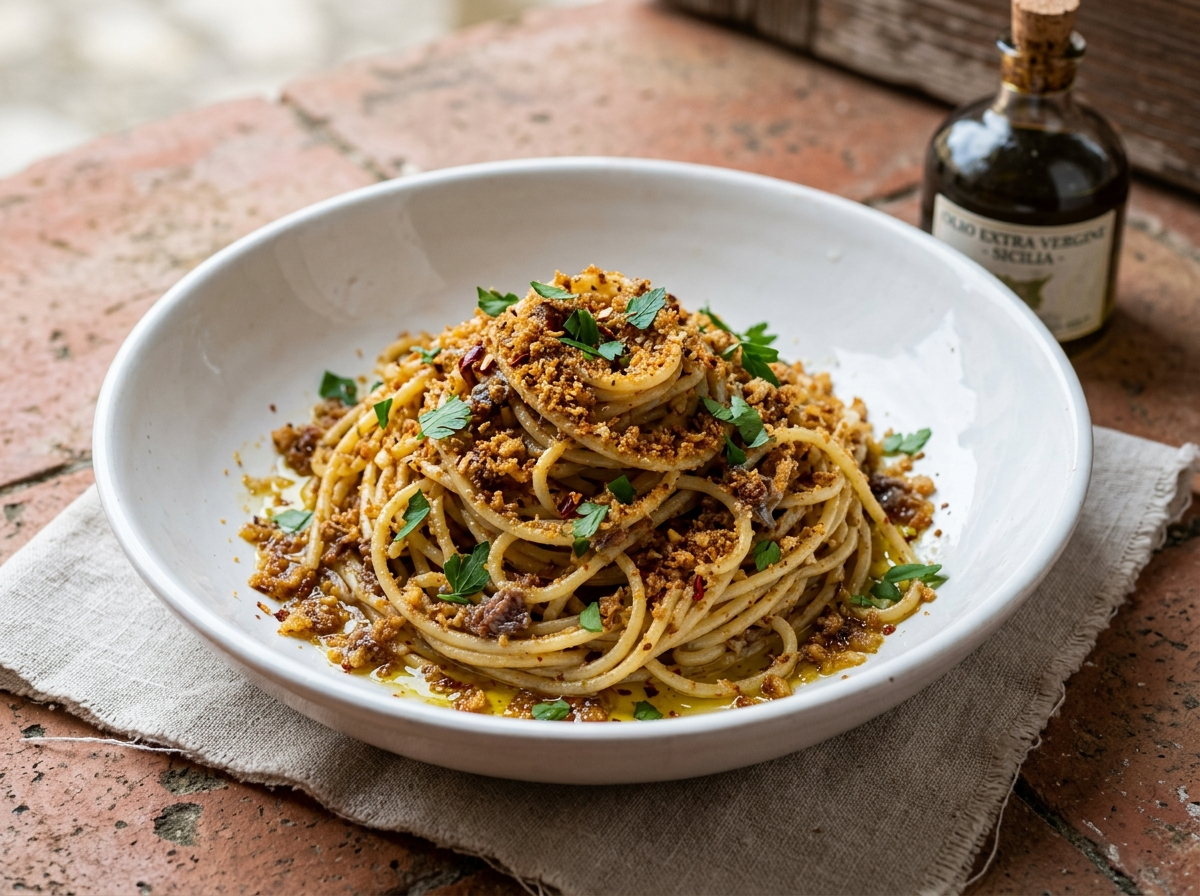
Pasta con la mollica atturrata comes from the cucina povera tradition of Sicily, where stale bread was never wasted. The name means roughly ‘pasta with toasted crumbs,’ and the dish was built for days when there was no cheese in the house.
The breadcrumbs are not a garnish. Toasted in olive oil until deep golden and mixed with anchovy paste, garlic, and sometimes a pinch of chili, they form a coarse, savory coating that clings to every strand of pasta.
This is a recipe about technique and patience with cheap ingredients. The crumbs need low heat and steady stirring. Rush them and they burn at the edges while staying pale in the middle.
Why You’ll Love This Recipe
- Uses stale bread instead of cheese – genuinely cheaper.
- Anchovy and garlic crumbs cling to pasta like a sauce.
- Ready from scratch in 40 minutes, mostly hands-off.
- Pantry ingredients you likely already have at home.
Ingredient Notes
- stale bread: Day-old or older crustless white bread gives the best coarse crumb texture. Sourdough works well and adds slight tang. Do not use pre-made fine breadcrumbs – they turn dusty instead of crunchy.
- anchovies in oil: Use good oil-packed fillets. They melt completely into the oil and you won’t taste ‘fishy’ at all. Anchovy paste works in a pinch – use about 1 teaspoon per 2 fillets.
- spaghetti or linguine: Long pasta is traditional. Spaghetti, spaghetti al dente, or bucatini all hold the crumbs well. Short pasta like rigatoni is less traditional but not wrong.
- extra virgin olive oil: Use a fairly fruity Sicilian or southern Italian oil if you have one. The oil is the cooking medium for the breadcrumbs, so a flat-tasting oil will show.
- garlic: Two cloves, sliced thin, cooked until pale gold, then removed before toasting the crumbs. Leaving it in risks burning and bitterness.
- dried chili flakes: Optional but traditional in many Sicilian versions. Start with a small pinch and add more at the table. Calabrian chili paste is a punchy substitute.
Pasta con la Mollica Atturrata (Sicilian Pasta with Toasted Breadcrumbs)
Ingredients
Method
- Tear the stale bread into chunks and pulse in a food processor until you have rough, uneven crumbs about 3-4 mm in size. Do not over-process to fine powder.
- Warm the olive oil in a wide, heavy-bottomed skillet over medium-low heat. Add the garlic slices and cook for 2 to 3 minutes until pale gold and fragrant.
- Add the anchovy fillets and press them with the back of the spoon for 1 to 2 minutes until they dissolve completely into the oil.
- Remove and discard the garlic slices. Add chili flakes if using and stir briefly.
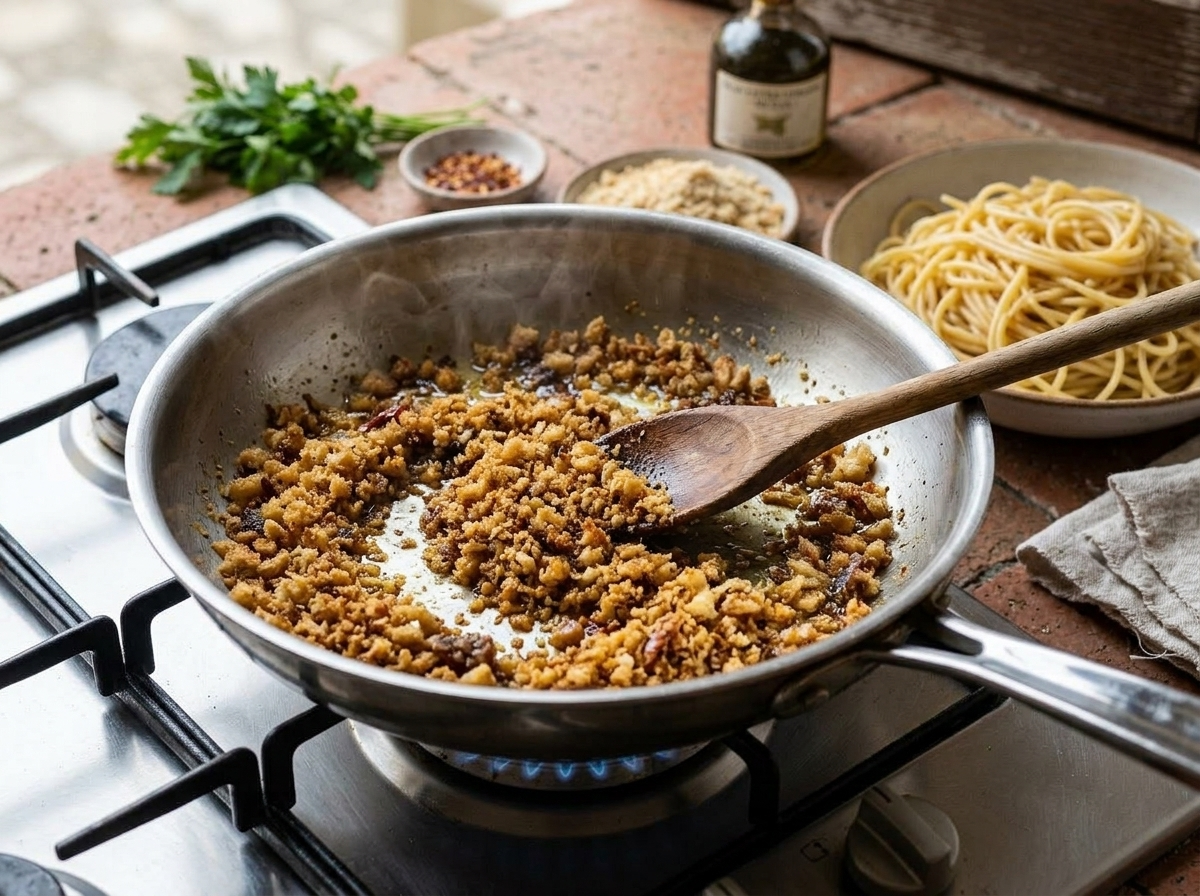
- Add the breadcrumbs to the pan in an even layer. Toast over medium-low heat, stirring constantly, for 8 to 12 minutes until uniformly deep golden and crisp. The crumbs should smell nutty, not sharp. Remove from heat and set aside.
- Bring a large pot of water to a rolling boil. Add the coarse salt and cook the spaghetti according to packet instructions until al dente.
- Before draining, ladle out about 120 ml of pasta cooking water and set it aside.
- Drain the pasta, then immediately return it to the pot or add it directly to the skillet with the breadcrumbs off the heat.
- Add the finishing olive oil and a splash of reserved pasta water (about 3 to 4 tbsp). Toss quickly and firmly for 1 minute until the crumbs coat every strand evenly. Add more pasta water if the mixture looks dry.
- Taste for salt, scatter parsley over the top if using, and serve immediately in warmed bowls with a final thin drizzle of raw olive oil.
Notes
Tips for Success
- Toast breadcrumbs over medium-low heat, stirring constantly, until uniformly deep golden – pale crumbs lack flavor and soggy texture.
- Remove garlic slices before adding breadcrumbs to the pan, or they will scorch before the crumbs finish toasting.
- Reserve at least 120 ml of pasta cooking water before draining – a splash loosens the crumbs and helps them coat the pasta evenly.
- Dress pasta immediately off the heat, tossing fast with a drizzle of raw olive oil so the crumbs stay crisp rather than steaming soft.
- Pulse stale bread in a food processor to coarse, uneven rubble, not fine powder – irregular texture gives the finished dish its characteristic bite.
Variations
- Add 2 tablespoons of sultanas and 1 tablespoon of pine nuts to the toasted crumbs for the agrodolce Sicilian version.
- Toss in 200 g of broccoli florets boiled in the pasta water for a more filling, vegetable-forward plate.
- Use colatura di alici (Italian fish sauce) instead of whole anchovies for a cleaner, more liquid umami hit.
Storage and Reheating
Store leftover dressed pasta in an airtight container in the fridge for up to 2 days. The breadcrumbs will soften overnight, which is unavoidable.
Reheat in a dry skillet over medium heat for 3 to 4 minutes, tossing often. The pan heat dries out some moisture and partially revives the crumb texture. A splash of water prevents sticking.
Keep toasted breadcrumbs separate if you plan ahead. Stored in a jar at room temperature, they stay crisp for up to 5 days and can be used to freshen up leftover pasta.
Serving Suggestions
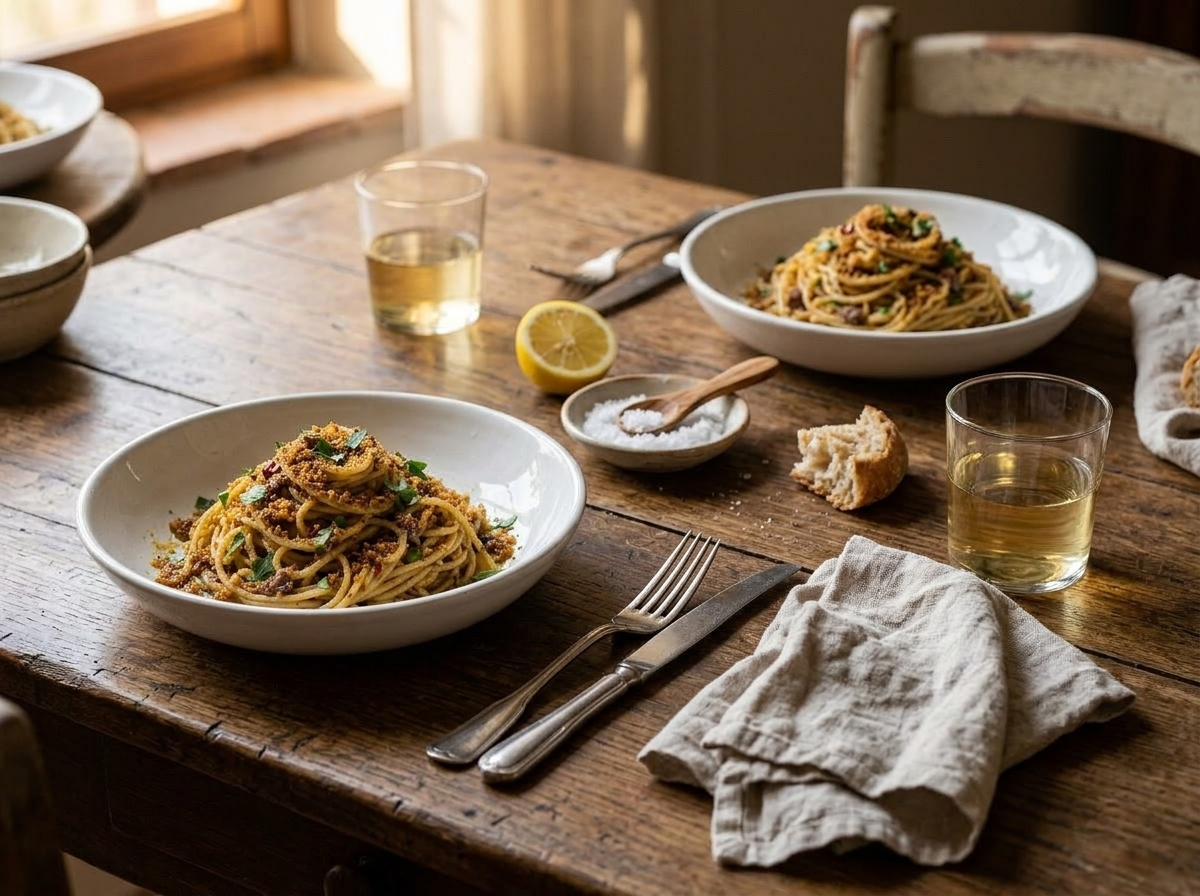
Serve straight from the pan into warmed shallow bowls. A thin drizzle of raw olive oil over the top and a light scatter of extra toasted crumbs is all the garnish this dish needs.
A crisp, dry white wine works well alongside – a Sicilian Grillo or Catarratto cuts through the anchovy richness cleanly, and an Italian wine pairing guide for pasta can help you choose the right bottle. Sparkling water with lemon is fine if you want to skip wine.
For a fuller meal, start with a plate of marinated olives or a Sicilian orange and fennel salad, both of which echo the Sicilian flavors without competing with the pasta.
FAQ
Why do my breadcrumbs turn out unevenly toasted in some spots and burnt in others?
The pan is probably too hot. Mollica atturrata needs medium-low heat and constant stirring for even color. A wide, heavy skillet spreads the crumbs in a thin layer so they toast uniformly without hot spots.
Can I use fresh bread instead of stale bread for the mollica?
Fresh bread has too much moisture and the crumbs tend to clump and steam rather than toast. Spread fresh crumbs on a baking sheet and dry them in a 120 C / 250 F oven for 15 minutes before using.
Is pasta con la mollica atturrata traditionally eaten without any cheese at all?
Yes, in its original Sicilian form the toasted breadcrumbs replace cheese entirely – that is the whole point of the dish. Some modern versions add a little pecorino, but purists skip it, and the anchovy crumbs genuinely do not need it.
What is the difference between mollica atturrata and plain pangrattato?
Pangrattato is a broader Italian term for any toasted breadcrumb topping. Mollica atturrata specifically refers to the Sicilian technique of slow-frying coarse crumbs in olive oil with anchovies and garlic until deeply golden. The Sicilian dialect word ‘atturrata’ means toasted or burnt-golden.
Can I make pasta con la mollica dairy-free and is it naturally so?
Yes, the traditional recipe contains no dairy at all – the breadcrumbs stand in for cheese by design. Just check your dried pasta brand has no egg if you also need this egg-free.
What pasta shape holds the toasted breadcrumbs best in this recipe?
Spaghetti or linguine are the classic choices because the crumbs wrap around long strands as you toss. Bucatini works especially well since the hollow center traps a little of the anchovy-infused oil.