Jump to Recipe
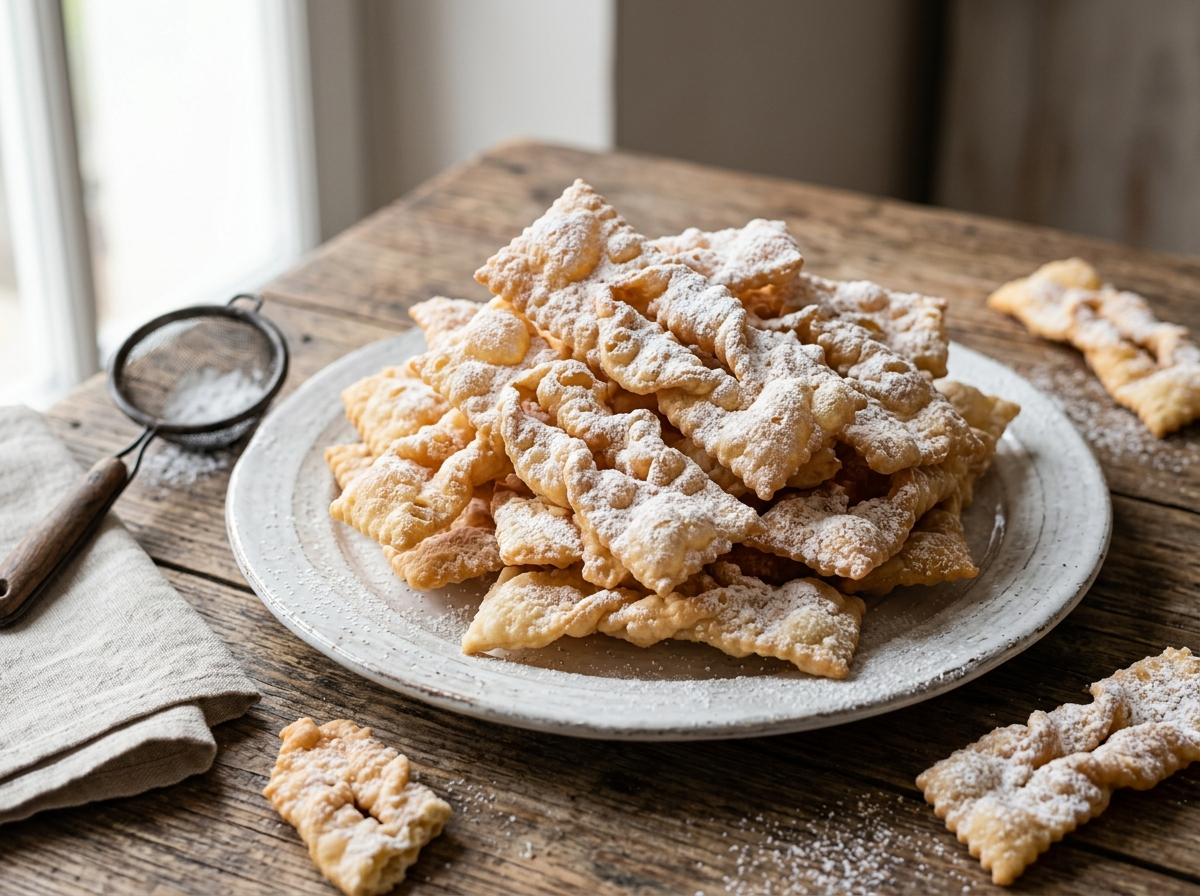
Chiacchiere are the fried pastry ribbons Italians make every year for Carnevale, the weeks-long celebration before Lent. Every region has a different name for them: frappe in Rome, crostoli in the northeast, galani in Venice, bugie in Liguria. The dough and technique are essentially the same.
The dough is simple: flour, eggs, a little fat, sugar, and a splash of grappa or white wine to prevent gluten tightening and help the ribbons blister in hot oil. Blistering is the goal. A pale, smooth chiacchiera means the dough was too thick or the oil not hot enough.
Once fried and cooled, a heavy snowfall of powdered sugar is the only finish they need. You can make a full batch in about an hour, and they disappear fast.
Why You’ll Love This Recipe
- Shatters like a crisp chip, not a soft doughnut
- One dough, under an hour, no yeast needed
- Uses pantry staples plus one splash of grappa
- Scales easily for a crowd or a small batch
Ingredient Notes
- 00 flour: Italian 00 flour gives the smoothest, most extensible dough. Plain all-purpose flour works fine, just knead a minute longer.
- grappa: Grappa is traditional and adds a faint anise warmth. Dry white wine, brandy, or even vodka are solid substitutes.
- eggs: Use large eggs at room temperature. Cold eggs make the dough stiffer and harder to roll thin.
- butter: Softened unsalted butter enriches the dough and keeps the texture tender. Lard is the traditional fat and gives a slightly crisper result.
- sunflower oil for frying: Neutral high-smoke-point oil is essential. Sunflower, peanut, or refined coconut oil all work. Olive oil smokes too easily at the required temperature.
- powdered sugar: Dust generously just before serving. If you dust too early, the sugar dissolves into the pastry.
Chiacchiere di Carnevale: Crispy Italian Fried Pastry Ribbons
Ingredients
Method
- Combine flour, sugar, and salt in a large mixing bowl and make a well in the center.
- Add the eggs, egg yolk, softened butter, grappa, and vanilla extract into the well.
- Mix with a fork until the dough starts to come together, then turn it out onto a lightly floured surface.
- Knead for 8-10 minutes until the dough is smooth, firm, and no longer sticky. It should feel like firm pasta dough.
- Wrap the dough tightly in plastic wrap and rest at room temperature for 30 minutes. This step is not optional - resting relaxes the gluten so rolling is manageable.
- Divide the rested dough into 4 portions. Keep unused portions wrapped while you work.
- Using a pasta machine, pass each portion through progressively thinner settings from 1 down to 5 or 6, dusting lightly with flour as needed. If rolling by hand, roll to approximately 1 mm thickness - you should almost see your hand through the sheet.
- Using a pastry wheel (fluted or straight) or a sharp knife, cut the sheets into rectangles roughly 10 cm x 5 cm (4 x 2 inches).
- Cut a 3 cm slit lengthwise down the center of each rectangle. This is traditional and helps them puff and blister evenly.
- Lay the cut pieces on a lightly floured tray in a single layer while you heat the oil.
- Pour oil into a deep heavy saucepan to a depth of at least 6 cm. Heat over medium-high to 175-180 C / 347-356 F. Check with a thermometer.
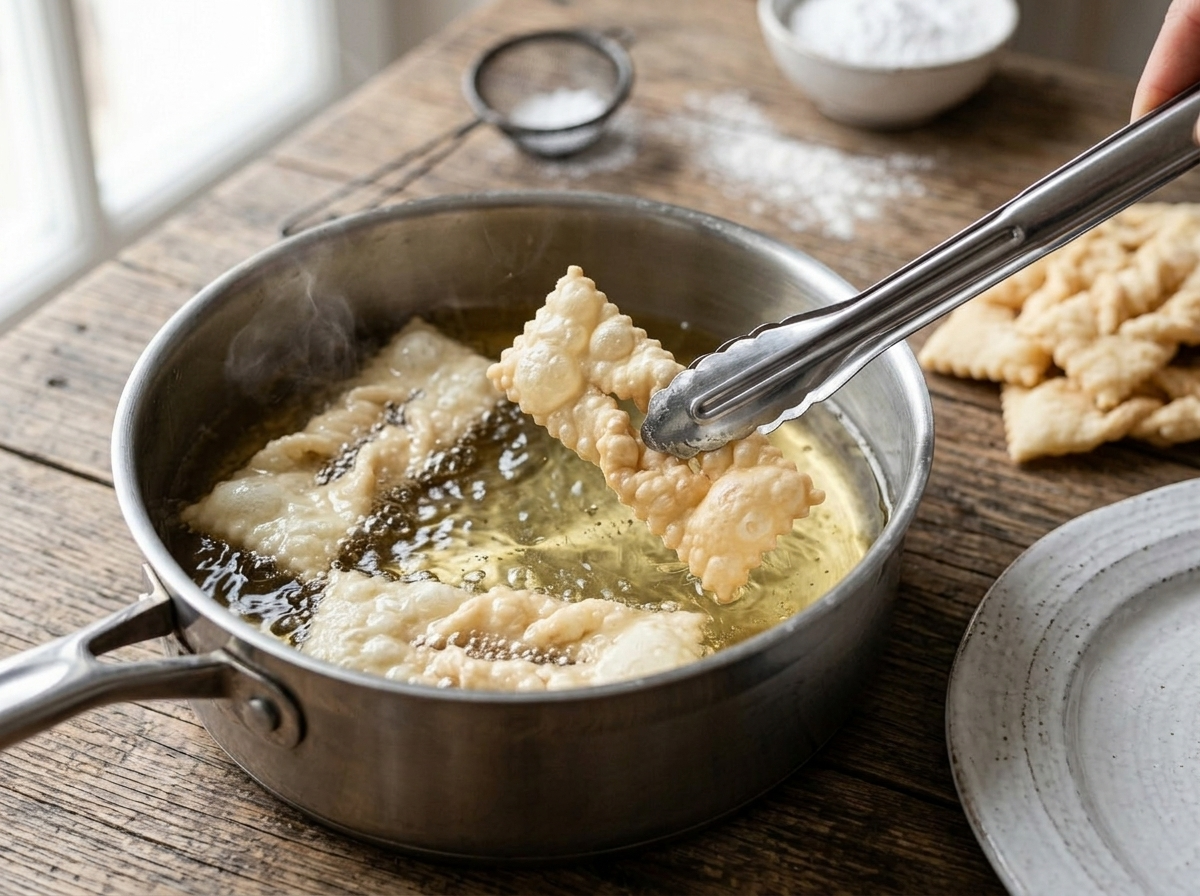
- Working in batches of 2-3, lower chiacchiere gently into the oil using tongs or a skimmer.
- Fry for 45-60 seconds per side, turning once with tongs, until pale golden with visible bubbles and blisters on the surface. They color quickly so watch them.
- Lift out with a slotted spoon or spider and transfer to a wire rack. Let the oil return to temperature between batches before adding the next.
- Allow all fried chiacchiere to cool completely on the rack, about 10-15 minutes.
- Once cool, transfer to a serving platter in a loose pile.
- Sift powdered sugar generously over the top just before serving. Add a second layer of sugar if they look pale - they should look well snowed on.
Notes
Tips for Success
- Roll the dough to 1 mm thickness or thinner – hold it up to the light and you should see your hand through it.
- Keep oil at 175-180 C / 347-356 F throughout frying; use a kitchen thermometer to monitor between batches.
- Fry in small batches of 2-3 ribbons so the oil temperature doesn’t drop, which causes greasy rather than blistered pastry.
- Rest the dough wrapped in plastic for at least 30 minutes so gluten relaxes and rolling becomes easier.
- Drain chiacchiere on a wire rack instead of paper towels so steam doesn’t soften the undersides — the same technique used for Italian mixed fried fish.
Variations
- Add 1 tsp finely grated lemon zest and 1 tsp vanilla extract to the dough for a citrus-scented version.
- Bake at 200 C / 390 F on a lined tray for 10-12 minutes for a lighter, less oily result, though less blistered.
- Dust with unsweetened cocoa powder mixed into the powdered sugar for a darker, bittersweet finish.
Storage and Reheating
Store chiacchiere in a single layer in an airtight tin or container at room temperature for up to 3 days. Do not stack them while warm or they’ll steam and lose their crispness.
They do not reheat well in a microwave. If they soften, spread them on a baking sheet and put them in a 170 C / 340 F oven for 4-5 minutes to restore some snap.
Freezing is not recommended. The texture becomes leathery once thawed.
Serving Suggestions
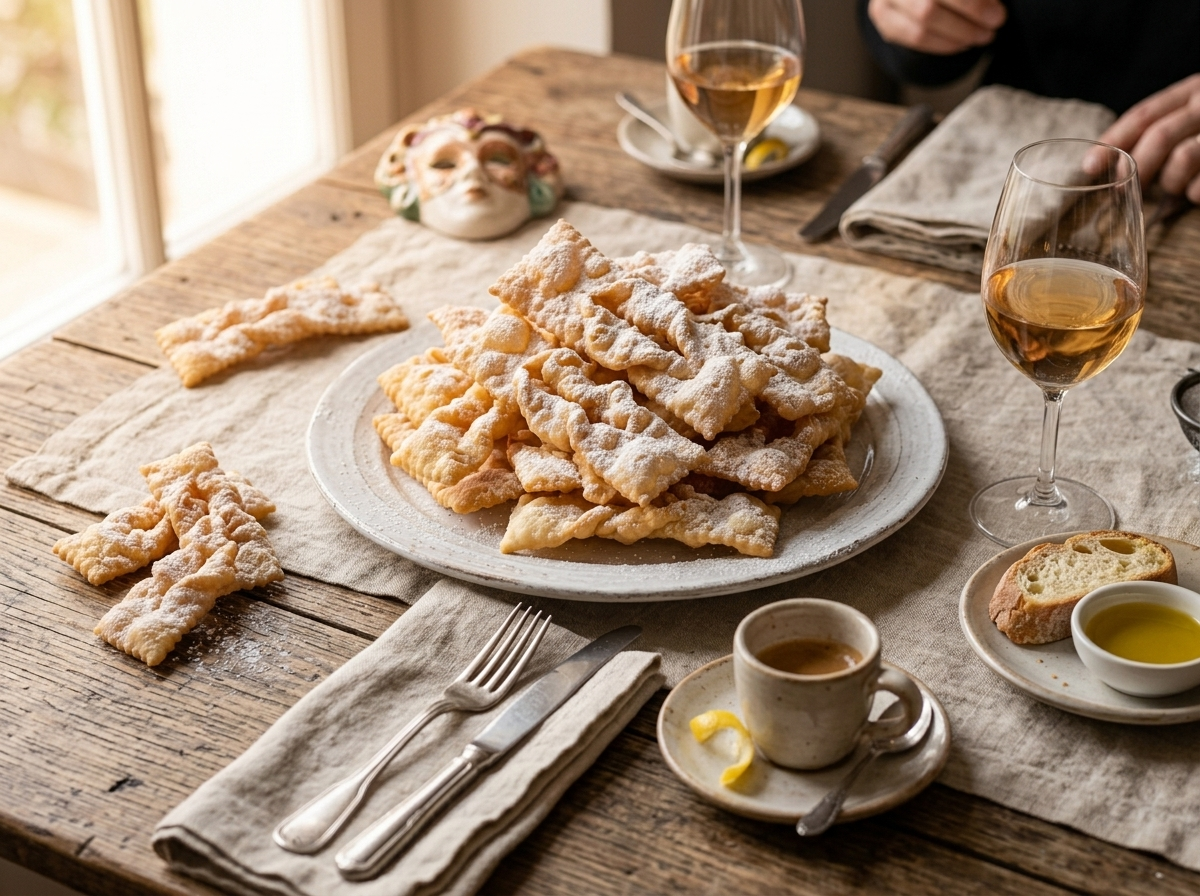
Serve chiacchiere piled loosely on a large platter or wooden board, dusted with a last shower of powdered sugar right before bringing them to the table. The casual pile is traditional.
They work alongside a cup of strong espresso or a small glass of Moscato d’Asti, and pair just as naturally with a classic Italian aperitivo if you’re serving a crowd. At Carnevale parties in northern Italy you’ll often see them next to castagnole, the fried dough balls, so guests can have both.
For a fuller dessert course, serve them alongside something like a rum-soaked Neapolitan yeast cake, or simply set out a bowl of pastry cream or a jar of Nutella for dipping. It’s not traditional but it’s popular with children and nobody complains.
FAQ
Why are my chiacchiere soft instead of crispy?
The most common cause is oil that wasn’t hot enough, usually below 170 C / 338 F. The second cause is dough rolled too thick. Aim for near-translucent sheets and keep your thermometer in the oil.
Can I use white wine instead of grappa in chiacchiere dough?
Yes, dry white wine is the most common household substitute and works just as well. The alcohol tightens gluten development and creates steam in the hot oil, which is what causes blistering.
How far ahead can I make chiacchiere for a Carnevale party?
You can fry them up to 2 days before the party and store them in an airtight tin at room temperature without powdered sugar. Dust them right before serving so the sugar stays dry and visible.
What is the difference between chiacchiere, frappe, and crostoli?
They are the same pastry with regional names. Chiacchiere is used in Lombardy and the south, frappe in Rome and central Italy, crostoli or grostoli in Friuli and Trentino, galani in Venice. The dough recipes vary slightly by fat and flavoring.
How do I know when the oil is ready to fry chiacchiere without a thermometer?
Drop a small scrap of dough into the oil. It should sink briefly, then rise immediately and start sizzling vigorously within 2-3 seconds. If it sinks and sits, the oil is too cold.
Are chiacchiere di Carnevale suitable for a vegetarian diet?
Yes, they contain no meat or fish. They do contain eggs and butter, so they’re vegetarian but not vegan. A vegan version can be made by replacing eggs with aquafaba and butter with coconut oil, though the texture differs.