
Jump to Recipe
Pandolce genovese is a dense, lightly spiced sweet bread from Liguria, studded with candied fruit, raisins, and pine nuts and scented with fennel seed, Marsala, and orange flower water. Genoese families bake it around Christmas, and it keeps for days.
This version uses instant yeast and no starter. You mix and knead for about 30 minutes, let the dough rise twice for a total of 2 hours 15 minutes, then bake one 1 kg loaf for 40 minutes at 180 C / 350 F.
The crumb is closer and more tender than panettone, with a thin golden crust and fruit in every slice. It’s a good make-ahead bake because the fennel and citrus settle in by day two.
Practical note: look for candied citron and orange peel that’s soft and glossy, not hard and sugar-crusted.
Why You’ll Love This Recipe
- Instant yeast and no starter, so it’s done in one afternoon
- Dense, tender crumb that tastes better on day two
- Slices toast well and freeze for up to 2 months
- Fennel, Marsala, and orange flower water give real Genoese flavor
Ingredient Notes
- candied citron and orange peel: Buy whole pieces and dice them to 5 mm yourself. If you can’t find citron, use 130 g candied orange peel in total.
- Marsala: Dry or semi-dry Marsala works best. Dry sherry or dark rum are fair substitutes, and orange juice works if you skip alcohol.
- orange flower water: Look for it at Italian or Middle Eastern grocers. In a pinch, use the finely grated zest of 1 orange.
- pine nuts: They’re the priciest item here. Chopped blanched almonds make a budget swap with similar crunch.
- fennel seeds: Crush them lightly in a mortar or under the flat of a knife so they release aroma without leaving hard bits.
- bread flour: Its protein gives the dough enough structure to carry the heavy fruit. All-purpose flour works, but the loaf bakes up softer and a little flatter.
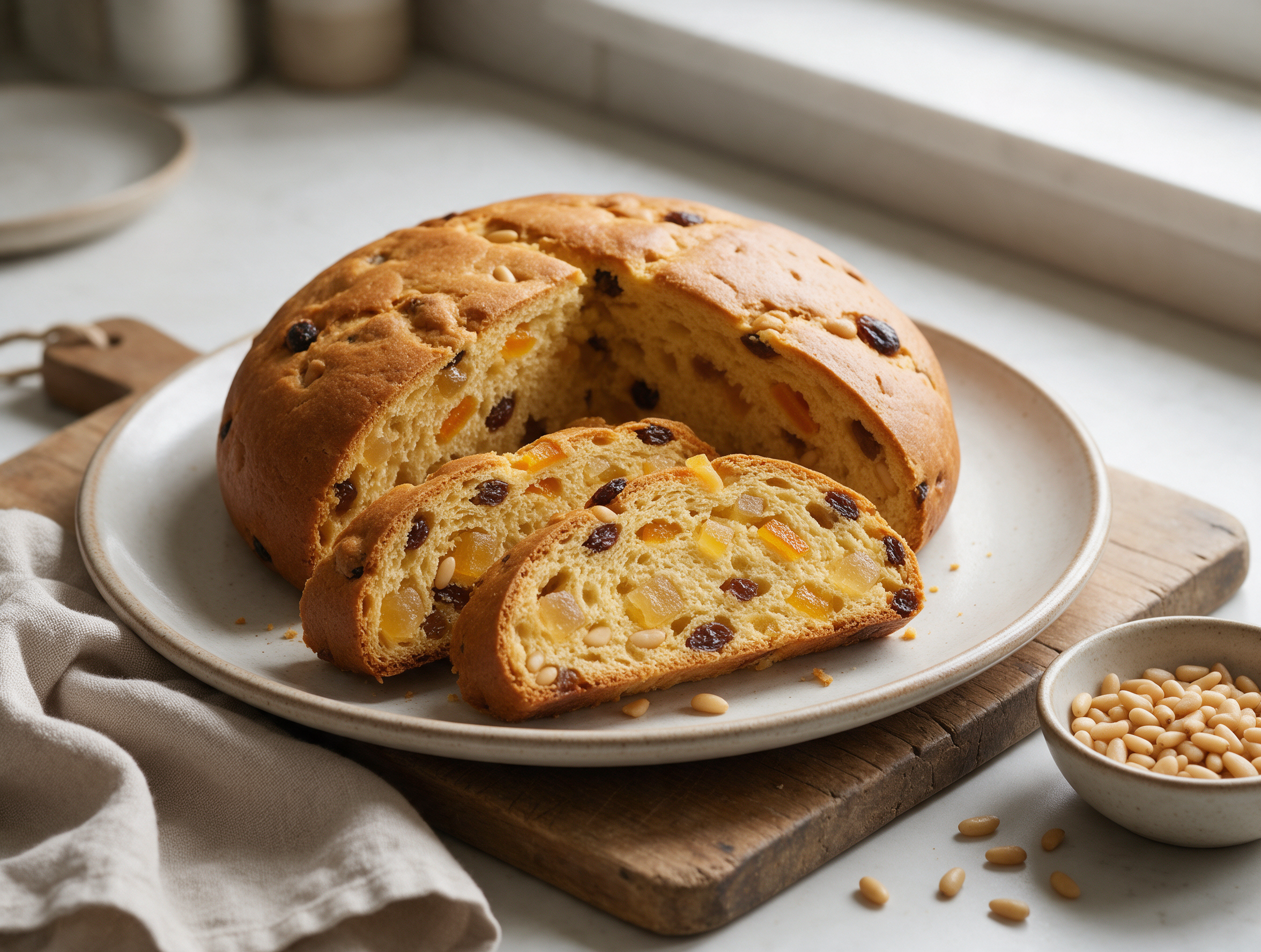
Homemade Pandolce Genovese with Candied Fruit and Pine Nuts
Ingredients
Method
- Pour 60 ml hot water over the raisins and leave them for 15 minutes. Meanwhile, whisk the flour, yeast, sugar, salt, and crushed fennel seeds in the bowl of a 5-quart / 4.7 L stand mixer. Add the warm milk, Marsala, orange flower water, and egg, then mix with the dough hook on low for 2 minutes until a shaggy dough forms.
- Add the softened butter in three pieces, mixing 1 minute after each. Knead on medium-low for 8 minutes until the dough is smooth, slightly tacky, and pulls cleanly from the sides of the bowl. To knead by hand, work it on a lightly floured counter for about 12 minutes.
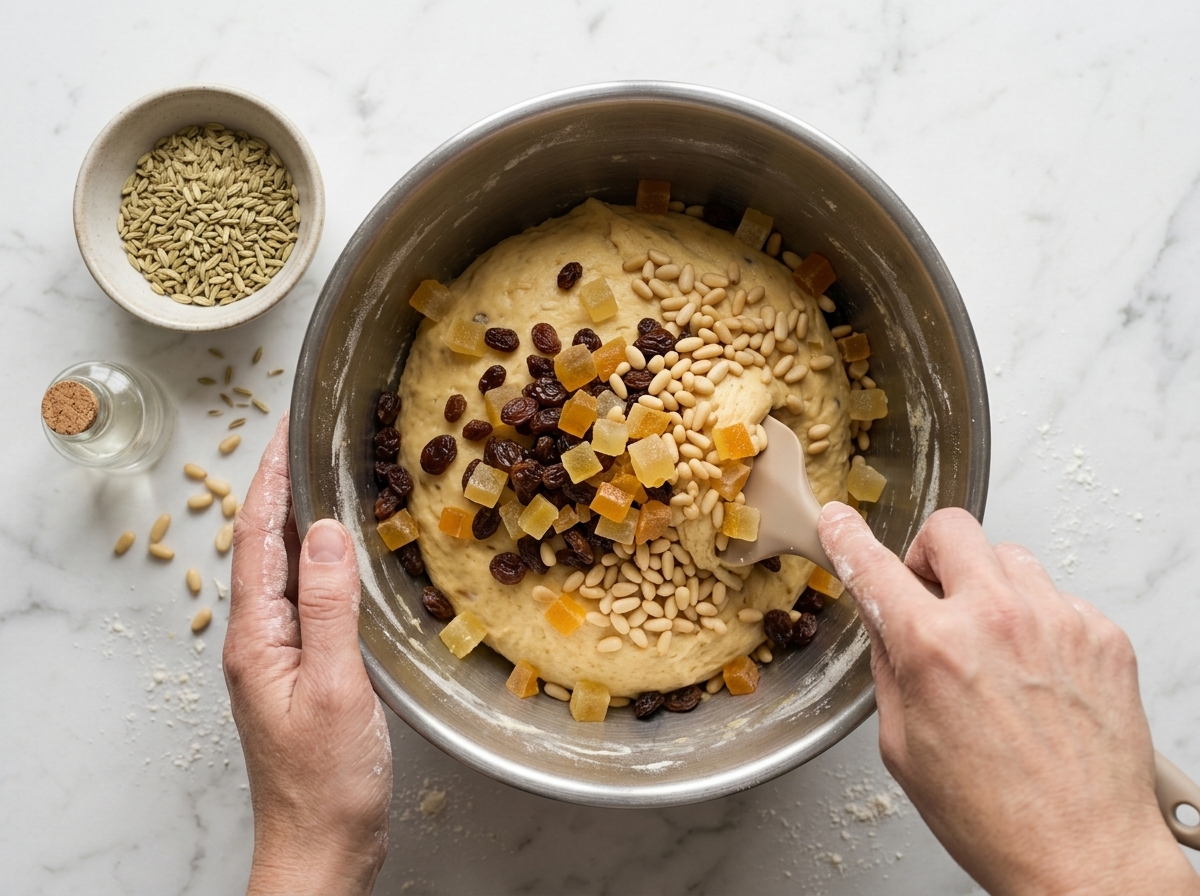
- Drain the raisins and pat them dry with a towel. Toss them with the candied citron, candied orange peel, and pine nuts, then knead them in on low speed for 1 minute, or fold them in by hand, until evenly spread. Transfer the dough to a bowl brushed with the oil, cover, and let it rise at about 24 C / 75 F for 90 minutes until puffy and close to doubled.
- Line a 33 x 46 cm / 13 x 18 inch sheet pan with parchment. Press the dough down gently, shape it into a tight round, and set it seam-side down on the pan. Flatten it to a dome about 22 cm / 9 inches wide, cover loosely, and let it rise for 45 minutes. Go by the dough, not the clock: when a floured fingertip leaves a dent that springs back slowly, it's ready. An under-proofed loaf bakes up tight and heavy, and in a cool kitchen the rise takes longer.
- Heat the oven to 180 C / 350 F during the last 20 minutes of rising. Beat the egg yolk with 1 tablespoon milk and brush it over the loaf. With a sharp knife, cut three shallow slashes about 1 cm deep, forming a triangle across the top.
- Bake for 40 minutes, rotating the pan after 25 minutes, until the crust is deep gold and an instant-read thermometer in the center reads 93 C / 200 F. Tent the loaf loosely with foil once the top reaches deep gold, usually around minute 25.
- Slide the loaf onto a wire rack and cool for 30 minutes before slicing. Serve warm or at room temperature.
Notes
- Dice candied fruit to about 5 mm so it spreads evenly through the dough.
- Bake until the center reads 93 C / 200 F, not by crust color alone.
- Keep the loaf wrapped at room temperature, since the fridge dries the crumb.
- Let the loaf rest a full 30 minutes on a rack before slicing.
Tips for Success
- Dice the candied fruit to about 5 mm so every slice holds fruit and the crumb doesn’t tear around big chunks.
- Pat drained raisins dry on a towel before adding them, so extra water doesn’t loosen the dough or smear the fruit.
- Soften the butter to a cool room temperature, about 18 to 20 C / 64 to 68 F, so it blends in without melting.
- Tent the loaf loosely with foil once the top reaches deep gold, usually around minute 25, because the sugar browns fast.
- Wait the full 30 minutes before slicing so the crumb sets and the fruit and nuts stay in place.
Variations
- Swap the pine nuts for 60 g chopped blanched almonds, a cheaper option that still adds crunch.
- Replace the Marsala with dark rum and add the zest of 1 orange for a deeper, more citrus-forward aroma.
- Divide the dough into two loaves of about 550 g for gifting and bake 28 to 30 minutes, until 93 C / 200 F.
Storage and Reheating
Pandolce genovese keeps for 4 to 5 days at room temperature, wrapped tightly in foil or a bread bag. Skip the fridge, since cold air dries the crumb faster, and the sugar-preserved fruit helps the loaf stay moist on the counter.
For longer storage, freeze the cooled loaf or individual slices, wrapped in plastic and then foil, for up to 2 months. Thaw overnight at room temperature, still wrapped.
To reheat, warm slices in a 160 C / 325 F oven for 5 minutes, or toast them lightly. A whole thawed loaf wrapped in foil takes about 15 minutes at the same temperature.
Serving Suggestions
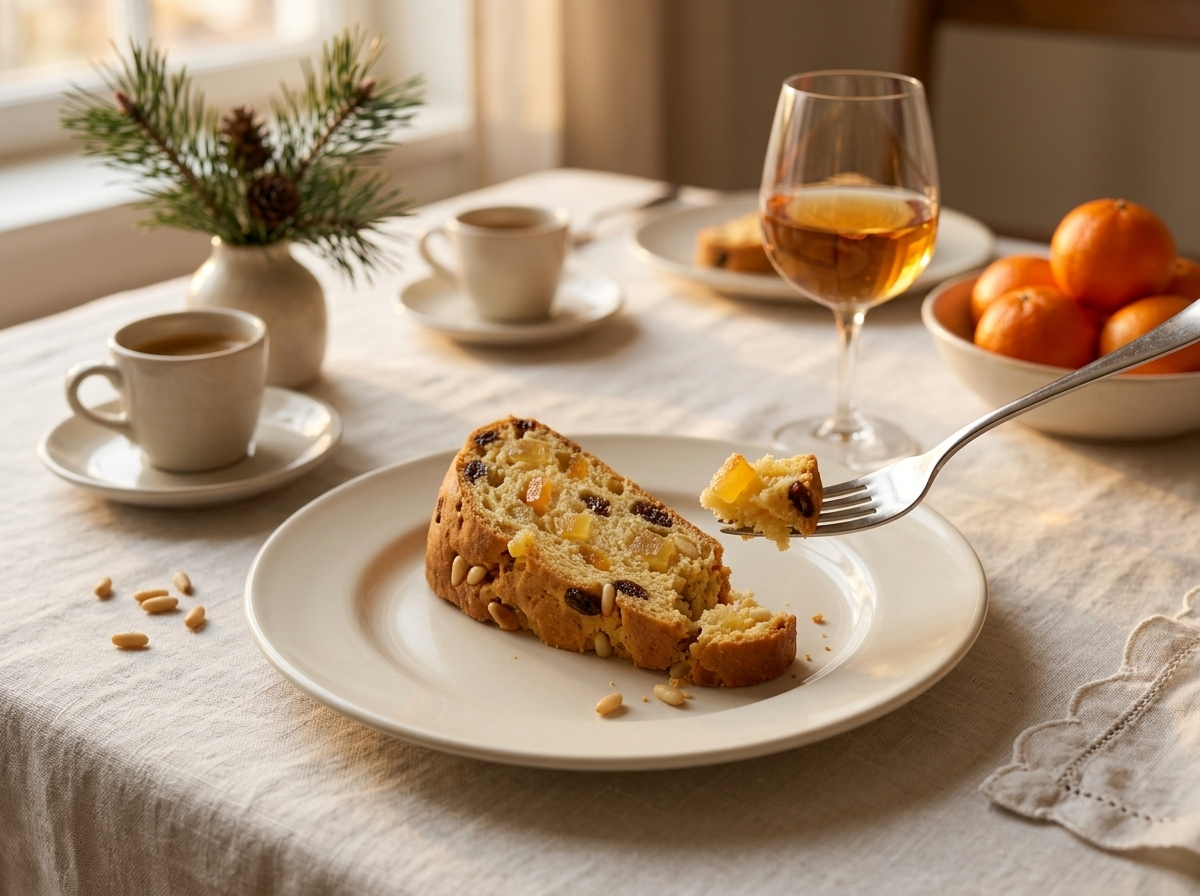
Cut pandolce genovese into 1.5 cm slices and serve at room temperature with espresso or a small glass of Moscato or Marsala. In Genoa it’s a fixture of the Christmas table, much as hard almond roccocò rings are in Naples.
For breakfast, toast a slice and spread it with butter or mascarpone. The fennel and citrus also work with fresh ricotta and a drizzle of honey.
FAQ
Why is my pandolce genovese dense instead of soft?
Under-proofing is the usual cause. The fruit and pine nuts weigh the dough down, so it needs the full 90-minute first rise and 45-minute second rise at about 24 C / 75 F, and in a cool kitchen it needs longer. Judge by the dough: a floured fingertip should leave a dent that springs back slowly.
Can I use orange zest instead of orange flower water in pandolce?
Yes, use the finely grated zest of 1 orange plus 1 teaspoon of the juice in place of the 1 tablespoon of orange flower water. You’ll lose the faintly floral note that marks Genoese baking, but the loaf still tastes clearly of citrus. Add the zest with the sugar so it perfumes the dry mix.
Can I freeze pandolce genovese with the candied fruit in it?
Yes, it freezes well for up to 2 months. Cool the loaf completely, slice it or leave it whole, wrap tightly in plastic and then foil, and thaw overnight at room temperature still wrapped. The fruit and pine nuts hold their texture because the crumb is dense and the fruit is already preserved in sugar.
What goes well with pandolce genovese besides coffee?
A small glass of Moscato or Marsala goes well with it. For breakfast, toast a slice and spread it with butter or mascarpone. Cut slices about 1.5 cm thick so the fruit and pine nuts stay in the crumb. Dessert wines pick up the fennel and citrus.
What is the difference between pandolce genovese and panettone?
Pandolce genovese is flatter and denser, and it’s flavored with fennel seeds, pine nuts, and Marsala, while panettone is a tall, airy loaf built on a long-fermented sourdough starter. Pandolce uses commercial yeast and two rises totaling 2 hours 15 minutes, so it’s far quicker at home. Expect a closer crumb and a slightly floral flavor.
Can I make pandolce genovese without Marsala?
Yes, replace the 30 ml of Marsala with orange juice or extra milk. The loaf will taste a little less rounded and winey, but the fennel, citron, and orange flower water carry most of the flavor. Soak the raisins in hot water as written either way.