
Jump to Recipe
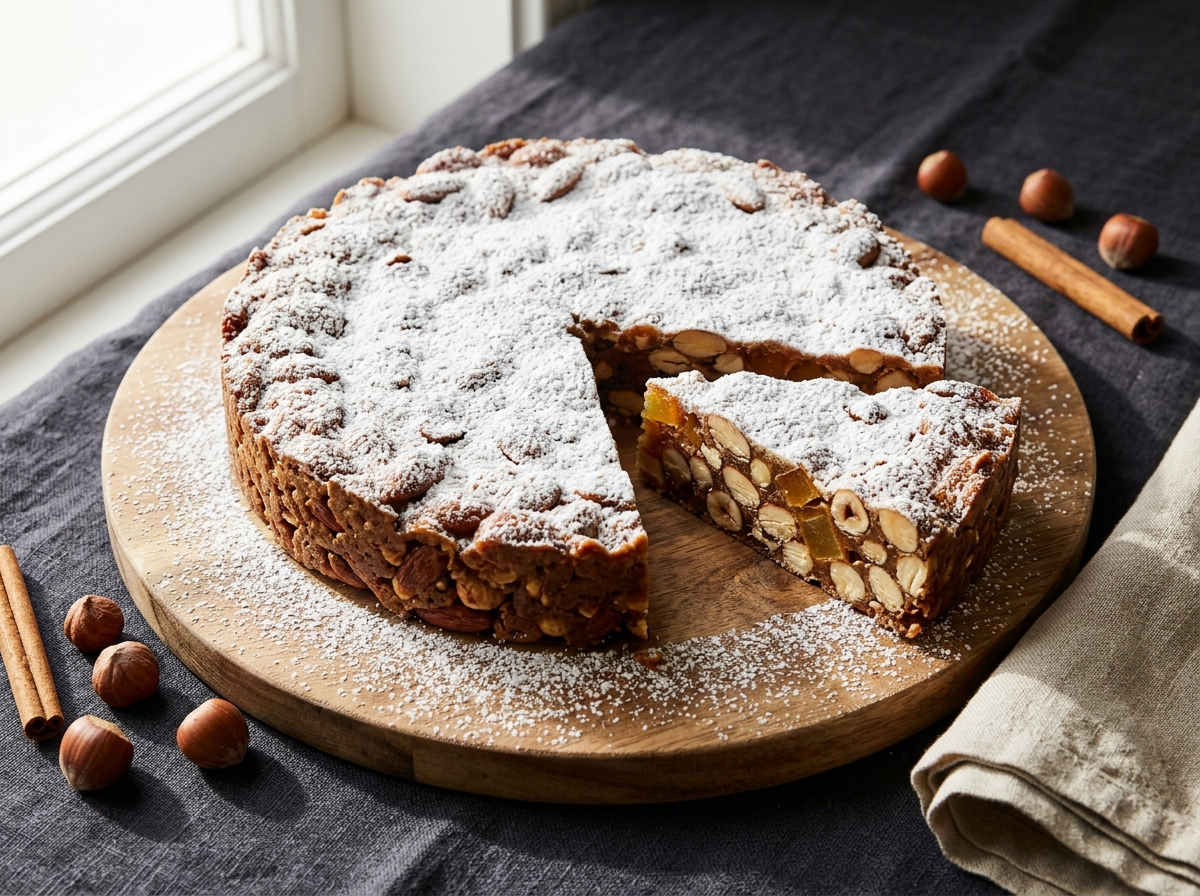
Panforte is not a cake in the soft, crumbed sense. It’s a firm, dense confection from Siena, made with honey, sugar, nuts, candied fruit, and a blend of warm spices, pressed into a round and baked until just set.
The name means ‘strong bread’, and the flavor lives up to it. The spice mix, historically called ‘spezie forti’, gives the finished panforte a low, warming heat that sits underneath the sweetness of the candied orange and the richness of the nuts.
I’ve made this many times for Christmas, and the version I keep coming back to uses both almonds and hazelnuts, a good amount of candied orange peel, and coriander alongside the more expected cinnamon and cloves.
It keeps for weeks and actually improves after two or three days. That makes it one of the more practical things to bake in December.
Why You’ll Love This Recipe
- Keeps for up to 4 weeks wrapped at room temperature
- Authentic Sienese spice balance with coriander and black pepper
- No special equipment beyond a saucepan and a round cake tin
- Makes a practical, gift-worthy holiday bake with minimal hands-on time
Ingredient Notes
- Blanched whole almonds: Toast them in a dry pan until pale gold before adding. Raw almonds give a flat, starchy texture in the finished panforte.
- Blanched hazelnuts: Toast and rub off the skins. If you can only find skin-on hazelnuts, toast them in the oven at 180 C / 350 F for 10 minutes, then roll in a clean towel.
- Candied orange peel: Buy it in pieces and chop it yourself rather than using the pre-chopped tubs, which tend to be dry and sugary. You can substitute candied citron or a mix of orange and lemon peel.
- Honey: A mild, runny honey works best here. Strong honeys like buckwheat can overpower the spices. Acacia or orange blossom honey are good choices.
- Caster sugar: Used with honey to make the binding syrup. Do not substitute brown sugar, which adds moisture and changes the set.
- Ground coriander: This is the spice that marks out a traditional Sienese formula from tourist-shop versions. Don’t skip it. It gives a floral, citrus-edged warmth.
- Plain flour (type 00 or all-purpose): The flour acts as a stabilizer, not a structural base. Measure carefully. Too much flour dulls the fruit-and-nut flavor.
- Wafer paper (ostia): The traditional lining for the base and top of panforte. You can find it online or in Italian delis. Baking parchment works as a substitute, though it won’t stick to the surface in the same way.
Panforte Sienese Recipe: The Real Tuscan Spiced Fruit and Nut Cake
Ingredients
Method
- Heat the oven to 160 C / 320 F. Line the base and sides of a 20 cm round tin with wafer paper or baking parchment.
- Toast the almonds in a dry skillet over medium heat for 4 to 5 minutes, stirring often, until pale gold and fragrant. Set aside.
- Toast the hazelnuts the same way for 5 minutes, then tip onto a clean kitchen towel and rub firmly to remove the skins. Leave a few spots of skin on is fine.
- In a large mixing bowl, whisk together the flour, cinnamon, coriander, cloves, black pepper, and nutmeg.
- Add the toasted almonds, hazelnuts, and candied orange peel to the bowl. Toss until the nuts and fruit are well coated in the spiced flour.
- Put the honey and caster sugar in a heavy-bottomed saucepan over medium heat. Stir once to combine, then stop stirring and let the mixture come to a boil.
- Cook until the syrup reaches 115 C / 239 F on a sugar thermometer. This is the soft-ball stage and usually takes 4 to 6 minutes from boiling.
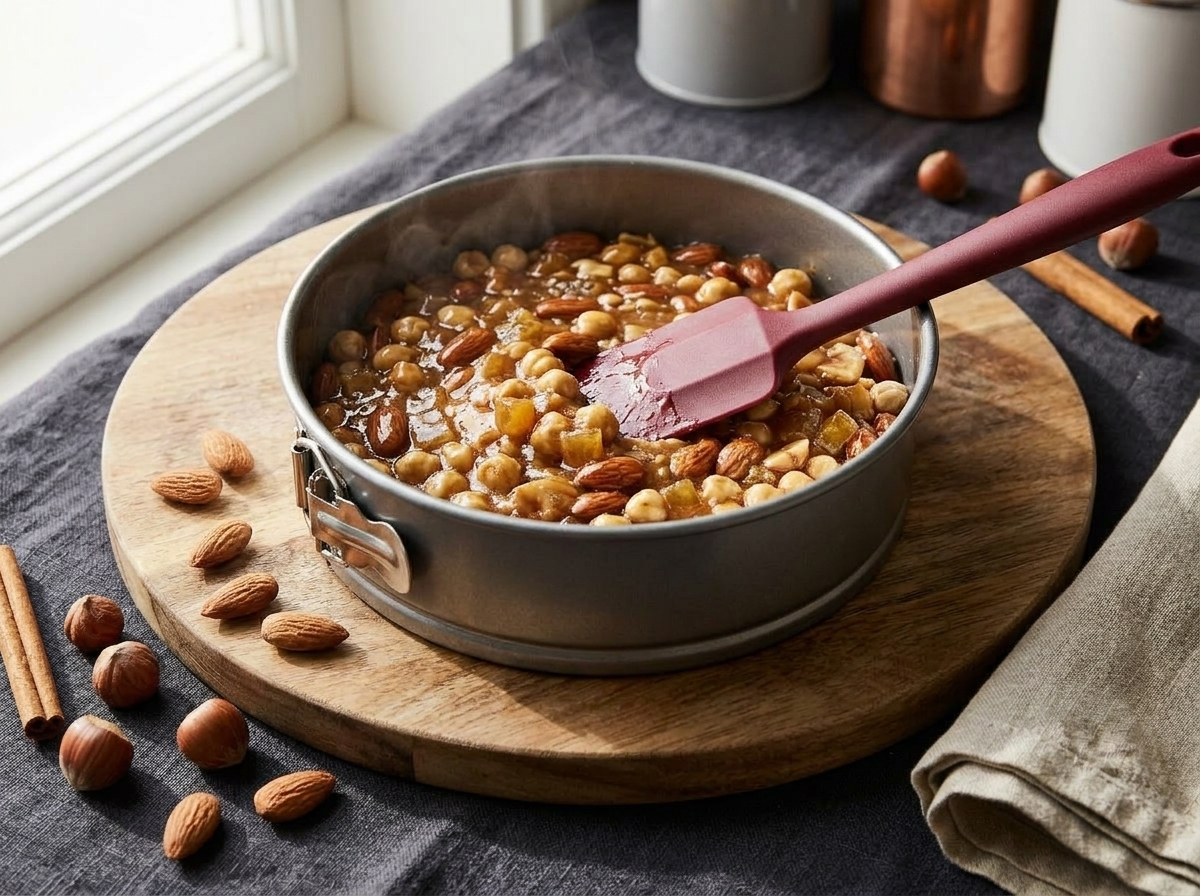
- Immediately pour the hot syrup over the nut and fruit mixture. Stir quickly with a wooden spoon or spatula until everything is evenly coated. The mixture will stiffen fast, so work without pausing.
- Tip the mixture into the lined tin. Press it down firmly with wet hands or a damp spatula to form a flat, even disc with no air pockets.
- Lay a second sheet of wafer paper on top and press lightly to smooth.
- Bake at 160 C / 320 F for 30 to 35 minutes, until the surface looks dry and matte and the edges just begin to pull from the tin sides.
- Remove from the oven and leave in the tin for 10 minutes. The panforte will still feel soft at this point but firms as it cools.
- Unmold while still warm. Dust generously with icing sugar through a fine-mesh sieve. Leave on a wire rack to cool fully before wrapping.
Notes
Tips for Success
- Toast nuts separately before mixing so both almonds and hazelnuts reach the same golden color.
- Use a sugar thermometer and cook the honey-sugar syrup to 115 C / 239 F for a firm but chewy set.
- Work quickly once the syrup hits temperature, as the mixture stiffens fast when it contacts the cool nut mixture.
- Press the panforte into the tin firmly with wet hands or a damp spatula to avoid air pockets inside the disc.
- Dust the finished panforte with icing sugar through a fine sieve immediately after unmolding while still warm.
Variations
- Panforte Margherita: replace black pepper and coriander with more cinnamon and vanilla for a milder, ivory-topped version.
- Dark chocolate panforte: add 30 g unsweetened cocoa powder to the flour mix and fold in 50 g chopped dark chocolate.
- Gluten-free version: swap plain flour for the same weight of rice flour, which holds without affecting texture noticeably.
Storage and Reheating
Wrap the cooled panforte tightly in baking parchment and then in foil. Store at room temperature in a cool, dry place for up to 4 weeks. The spice flavor deepens noticeably after 3 to 4 days.
For longer storage, wrap the same way and freeze for up to 3 months. Defrost at room temperature still wrapped, for at least 4 hours before serving.
Do not refrigerate panforte. The cold makes the sugar crystallize and the texture turns gritty rather than chewy.
Serving Suggestions
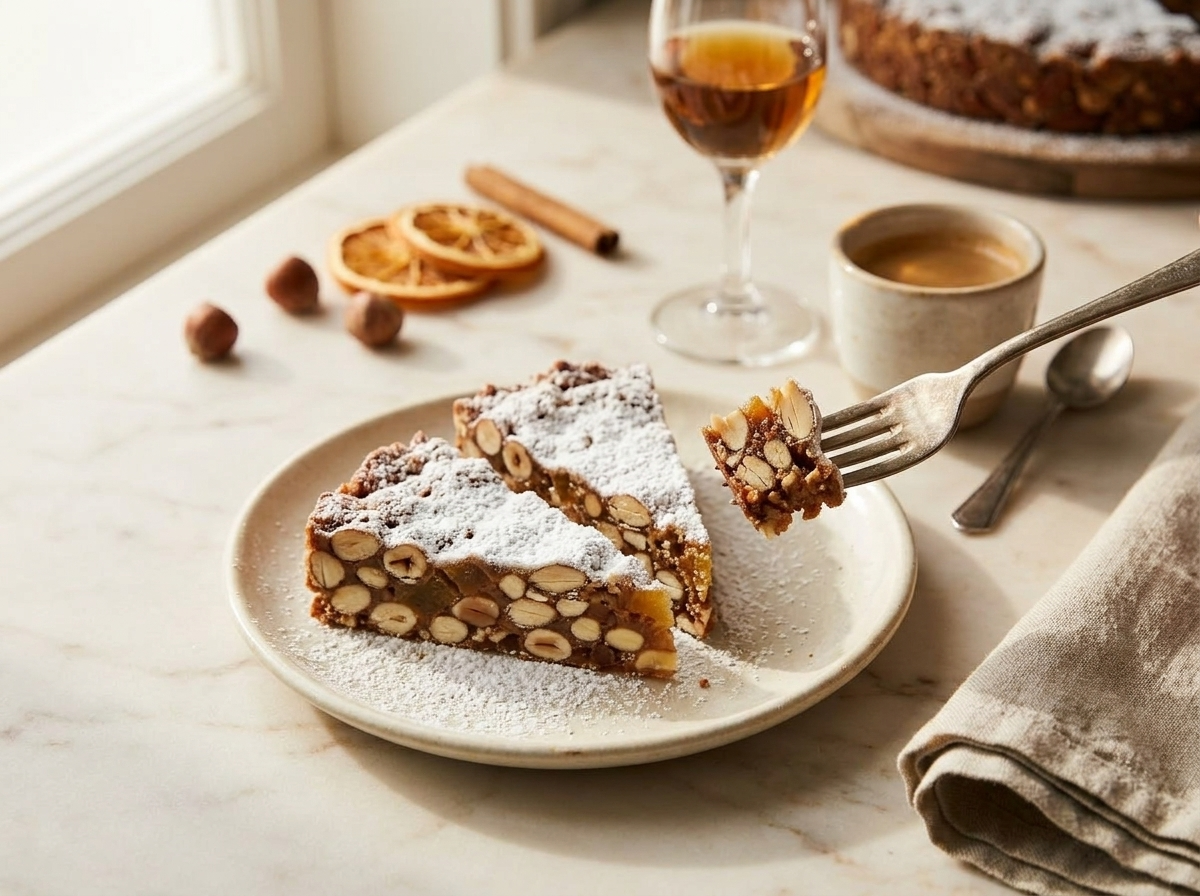
Cut panforte into thin wedges, no more than 1 cm thick. It’s rich, so small slices are the right portion. Serve it alongside a glass of Vin Santo, a small espresso, or a shot of grappa for a traditional Sienese finish to a meal.
For a cheese course approach, place thin slices next to a wedge of aged Pecorino and some shelled walnuts, finishing the meal the way a light Italian ricotta cheesecake might close a lighter spread. The salt of the cheese cuts through the sweetness in a way that works well at the end of a dinner.
At Christmas, panforte travels well and holds its shape, so it’s a practical choice for a gift box alongside amaretti or cantucci, much like a Trentino apple strudel makes an equally giftable Italian bake.
FAQ
Why is my panforte too soft and sticky after baking?
The syrup didn’t reach a high enough temperature. You need to cook the honey and sugar to 115 C / 239 F (soft-ball stage) for the panforte to set firm. If it’s already baked and still soft, leave it uncovered at room temperature overnight and it will firm up as the sugar sets.
Can I use mixed peel from a jar instead of candied orange peel in panforte?
You can, but commercial mixed peel is often drier and less flavorful than good candied orange peel bought in pieces. If that’s what you have, soak it briefly in a tablespoon of orange juice to soften it before adding to the nut mix.
Can panforte Sienese be frozen whole and cut later?
Yes. Wrap the whole disc in parchment and then foil before freezing for up to 3 months. Defrost fully at room temperature before slicing, because cutting it while partially frozen can crack the disc.
What is the difference between panforte Sienese and panforte Margherita?
Panforte Sienese, also called panforte nero, uses black pepper and strong spices, giving it a darker, more intense flavor. Panforte Margherita was created in 1879 for a royal visit and uses a softer spice blend with more cinnamon and vanilla, topped with white icing sugar rather than mixed into the dough.
Is panforte Sienese gluten-free?
Traditional panforte contains a small amount of plain wheat flour, so it’s not gluten-free as written. You can substitute an equal weight of rice flour and the texture holds well, making it suitable for those avoiding gluten.
How do I know when panforte is done baking?
The surface will look dry and matte rather than wet, and the edges will just start to pull slightly from the tin. The center may still feel soft when you press it gently, but it firms up completely as it cools, so don’t overbake it.