
Jump to Recipe
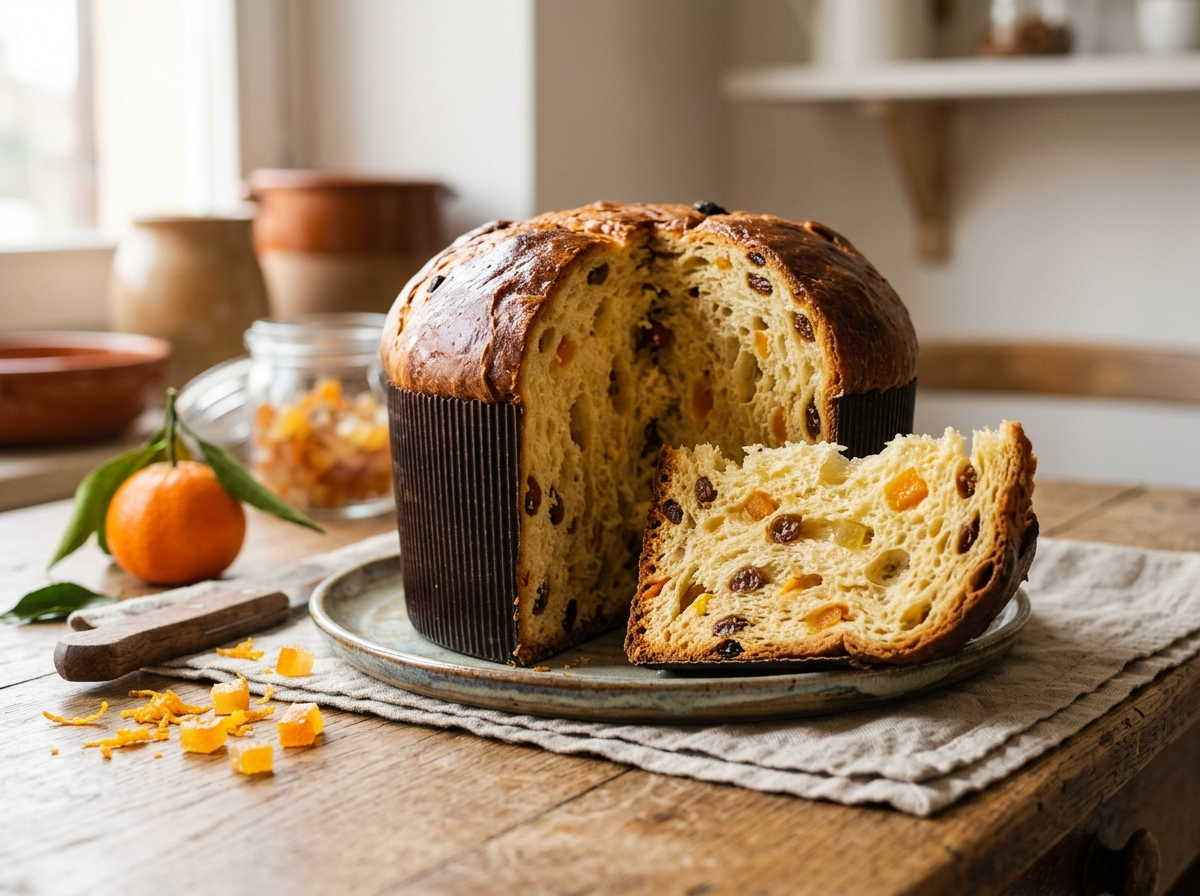
Panettone made at home is a different thing from the foil-wrapped discs on the supermarket shelf. The crumb pulls apart in soft, buttery threads, the orange and lemon notes are clean, and the whole loaf smells like a Milanese pasticceria at six in the morning.
The process takes two days, but most of that time is waiting. Active hands-on work is roughly 40 minutes spread across two sessions. You don’t need a professional oven or a planetary mixer, though a stand mixer helps with the extended kneading.
The method here uses a biga-style first dough left overnight in the fridge. That cold fermentation builds the gluten structure that keeps the loaf tall and stops the butter-heavy second dough from turning dense.
One thing to get right early: use a proper paper panettone mold. It holds the shape during baking and the upside-down cooling that stops the loaf from sinking.
Why You’ll Love This Recipe
- Thread-pulling soft crumb from a slow overnight first dough
- Real candied peel and raisins, no artificial flavoring needed
- Stays fresh and moist for up to five days after baking
- Paper mold means no special tin to buy or store
Ingredient Notes
- Farina manitoba (Manitoba flour): High-protein flour (around 14g protein per 100g) is essential for the long kneading and enriched dough. In the US, King Arthur bread flour is the closest swap.
- Lievito di birra fresco (fresh yeast): Fresh yeast gives a cleaner, slightly milder fermentation. If you use active dry yeast, use about 40% of the fresh yeast weight and dissolve it in warm milk first.
- Burro (unsalted butter): Use European-style butter with at least 82% fat. It goes in soft but not melted – add it in small cubes while the dough is still mixing.
- Tuorli d’uovo (egg yolks): Yolks only, not whole eggs. They give richness and color without tightening the crumb the way egg whites would.
- Scorza candita di arancia e cedro (candied orange and citron peel): Buy good candied peel in chunks, not the pre-chopped tub of mixed peel. The flavor difference is significant. Dice it yourself into 1 cm pieces.
- Uvetta sultanina (golden raisins): Soak in warm water for 20 minutes, then dry thoroughly on a cloth. Wet raisins release steam and create gummy patches in the crumb.
- Miele d’acacia (acacia honey): Honey adds moisture retention and a subtle floral note. Mild-flavored honey works best here – buckwheat or chestnut honey would overpower the citrus.
- Estratto di vaniglia (vanilla extract): Pure extract or the seeds from half a vanilla pod. Avoid artificial vanilla flavoring, which turns sharp after baking.
Panettone Fatto in Casa
Ingredients
Method
- Dissolve the fresh yeast in the warm milk in the bowl of a stand mixer and let it stand for 5 minutes until slightly foamy.
- Add the flour and sugar to the yeast mixture and begin kneading on medium speed with the dough hook for 3 minutes until a rough dough forms.
- Add the egg yolks one at a time, waiting for each to incorporate before adding the next.
- Add the softened butter in three additions, kneading on medium-high speed for 8 to 10 minutes total until the dough is smooth, slightly tacky, and pulls away cleanly from the bowl sides.
- Shape the dough into a ball, place in a lightly oiled bowl, cover with plastic wrap, and refrigerate overnight for 10 to 12 hours.
- Take the first dough out of the fridge and let it come to room temperature for 1 hour - it should have roughly doubled in size.
- Place the first dough back in the stand mixer bowl. Add the flour, warm milk, sugar, honey, vanilla, and salt. Knead on medium speed for 5 minutes until combined.
- Add the egg yolks one at a time, incorporating each fully before the next.
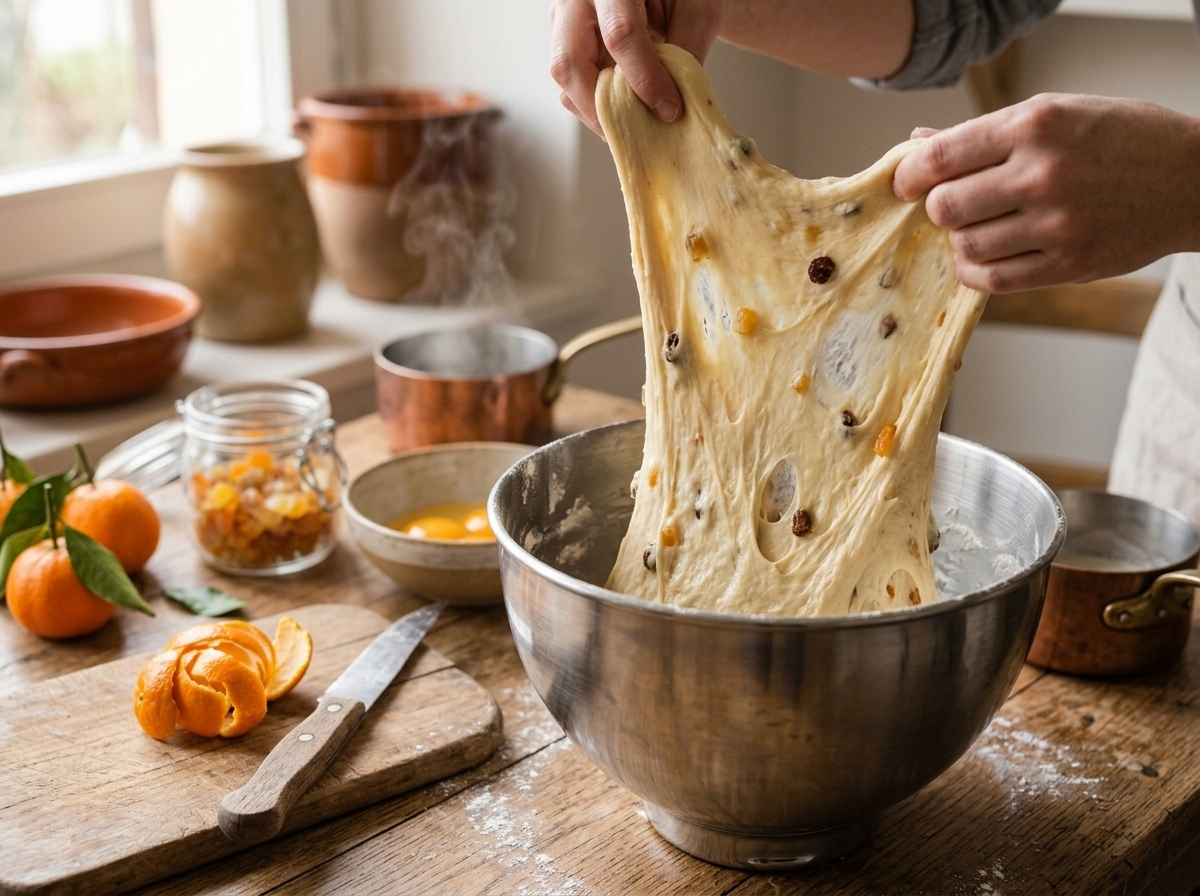
- Add the softened butter in five or six small additions on medium-high speed. Take your time - each addition should disappear into the dough before the next goes in. Knead for 10 to 12 minutes total until the dough passes the windowpane test.
- Reduce the mixer to low and fold in the drained raisins, candied peels, and citrus zests. Mix only until evenly distributed, about 1 to 2 minutes.
- Cover the bowl with plastic wrap and leave at room temperature (around 24 to 26 C) for 1 hour as a short bench rest.
- Turn the dough onto a lightly floured surface. Fold the edges toward the center three or four times to build surface tension, then flip the dough and roll it gently against the work surface using cupped hands until you have a smooth, taut ball.
- Place the dough ball seam-side down into the 1 kg paper panettone mold.
- Cover loosely with plastic wrap and leave to proof at room temperature (24 to 26 C) for 4 to 6 hours, until the dough has domed 2 to 3 cm above the rim of the mold. Do not rush this step.
- Heat the oven to 180 C / 355 F (conventional, not fan). Place a rack in the lower third.
- Using a sharp, lightly oiled blade, score a shallow X across the top of the panettone. Place the 10 g cold butter knob in the center of the X.
- Bake for 40 to 45 minutes until deep golden brown and a probe thermometer inserted into the center reads 93 to 95 C. If the top colors too quickly after 20 minutes, tent loosely with foil.
- Remove the panettone from the oven. Immediately push two long metal skewers through the base of the mold in a cross, just above the bottom. Invert the panettone and suspend it upside-down between two tall pots or heavy books, allowing it to hang freely. Leave it inverted for at least 3 hours or until fully cool.
- Remove the skewers, wrap in plastic wrap, and store at room temperature.
Notes
Tips for Success
- Add butter to the second dough in five or six small additions, waiting for each to fully absorb before adding the next.
- Test gluten development with the windowpane test – stretch a small piece of dough until you can see light through it without tearing.
- Cool the baked panettone upside-down by skewering the base with two long metal skewers and suspending it between two tall pots for at least 3 hours.
- Score the top with an X just before baking and place a small knob of butter in the center for a glossy, cracked top.
- Do not rush the second proof – the dough should dome 2 to 3 cm above the paper mold rim before it goes into the oven.
Variations
- Cioccolato e arancia: replace raisins with chopped dark chocolate and add extra candied orange peel.
- Pistacchio e limone: use pistacchio paste in the second dough and swap candied citron for candied lemon peel.
- Panettone al cioccolato: add 30g of good cocoa powder to the second dough and fold in chocolate chips instead of dried fruit.
Storage and Reheating
Wrap the cooled panettone tightly in plastic wrap, then in foil, and store at room temperature. It stays soft for 4 to 5 days. Do not refrigerate – the cold dries the crumb out fast.
For longer storage, slice and freeze individual portions in zip-lock bags. Thaw at room temperature for 1 hour or toast lightly from frozen.
To refresh a day-old panettone, wrap a slice in foil and warm in a 150 C / 300 F oven for 8 minutes. The butter in the crumb re-melts and the texture comes close to fresh-baked.
Serving Suggestions
The classic Milan way is a thick slice alongside a glass of cold Moscato d’Asti or a small cup of strong espresso. No plates, no ceremony – just panettone and something to drink.
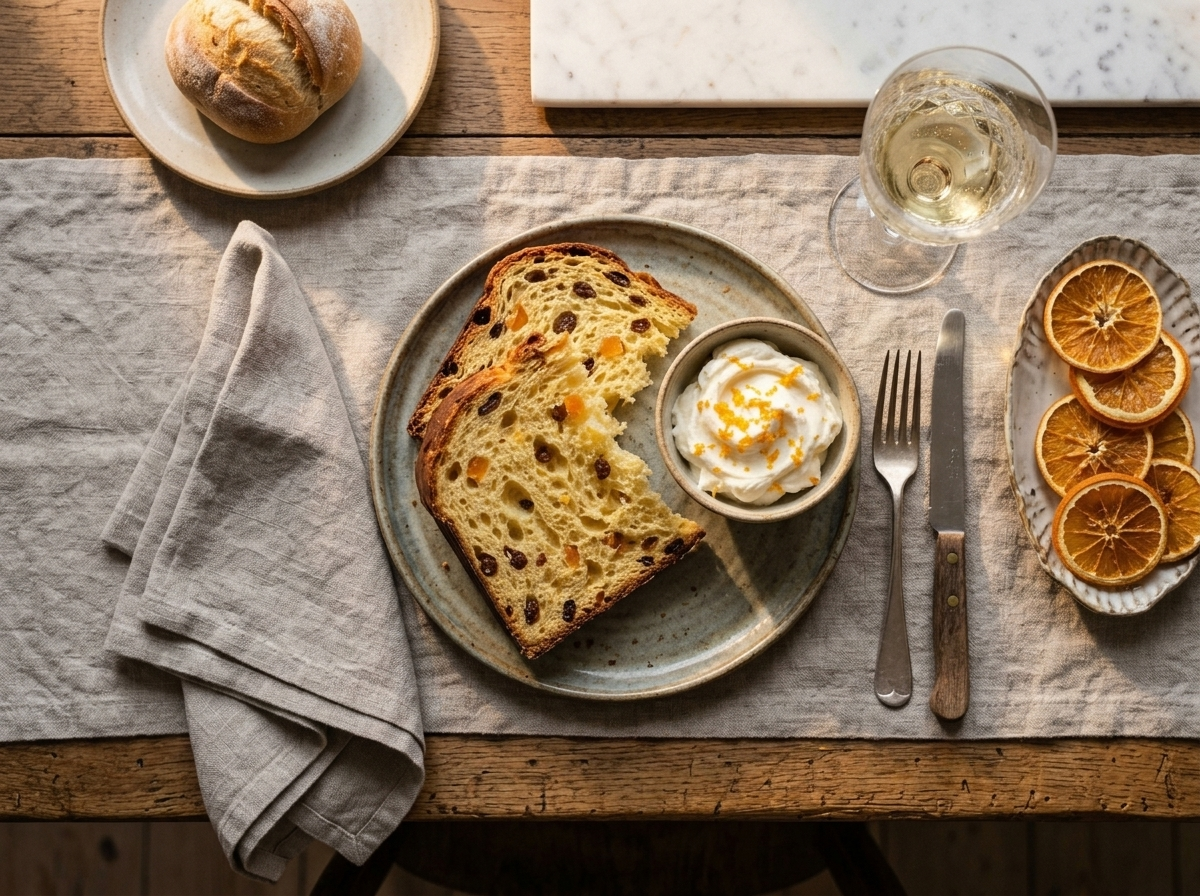
For a more laid-out table, serve slices with mascarpone whipped with a little honey and orange zest. A small dish of candied chestnuts on the side works well at Christmas.
Leftover panettone makes an excellent base for a baked bread pudding. Cube it, soak in a custard of eggs, cream, and a splash of rum, and bake at 170 C for 35 minutes.
FAQ
Why did my panettone fatto in casa collapse after baking?
The most common cause is cutting the upside-down cooling short. The crumb needs at least 3 hours suspended inverted to set its structure – if you lay it flat too soon, the weight of the enriched dough pulls the center down. Under-proofing before baking can also cause the same problem.
Can I use 00 flour instead of Manitoba flour for homemade panettone?
00 flour has too little protein to support the long kneading and the weight of the butter and yolks. Your loaf will likely collapse or come out dense. Bread flour or Manitoba flour is the right choice here – protein content around 13 to 14g per 100g.
How do I know when the second proof of the panettone dough is ready?
The dough should rise until it sits 2 to 3 cm above the rim of the paper mold. Gently press the surface with one finger – it should spring back slowly rather than immediately. If it springs back fast, it needs more time.
Can I freeze a whole homemade panettone before or after baking?
Freeze it after baking, not before. Wrap the fully cooled loaf in two layers of plastic wrap and one layer of foil, then freeze for up to 2 months. Thaw overnight at room temperature, still wrapped, to prevent condensation from making the crust soggy.
What is the difference between panettone and pandoro?
Panettone is a Milanese loaf with candied peel and raisins baked in a cylindrical paper mold. Pandoro is from Verona – star-shaped, plain inside with no fruit, and dusted with powdered vanilla sugar. The dough methods are similar but pandoro contains more eggs and no dried fruit.
Is homemade panettone suitable for a nut-free diet?
This recipe contains no nuts, so it’s naturally nut-free as written. Check your candied peel packaging though – some commercial brands are produced in facilities that handle tree nuts.