
Jump to Recipe
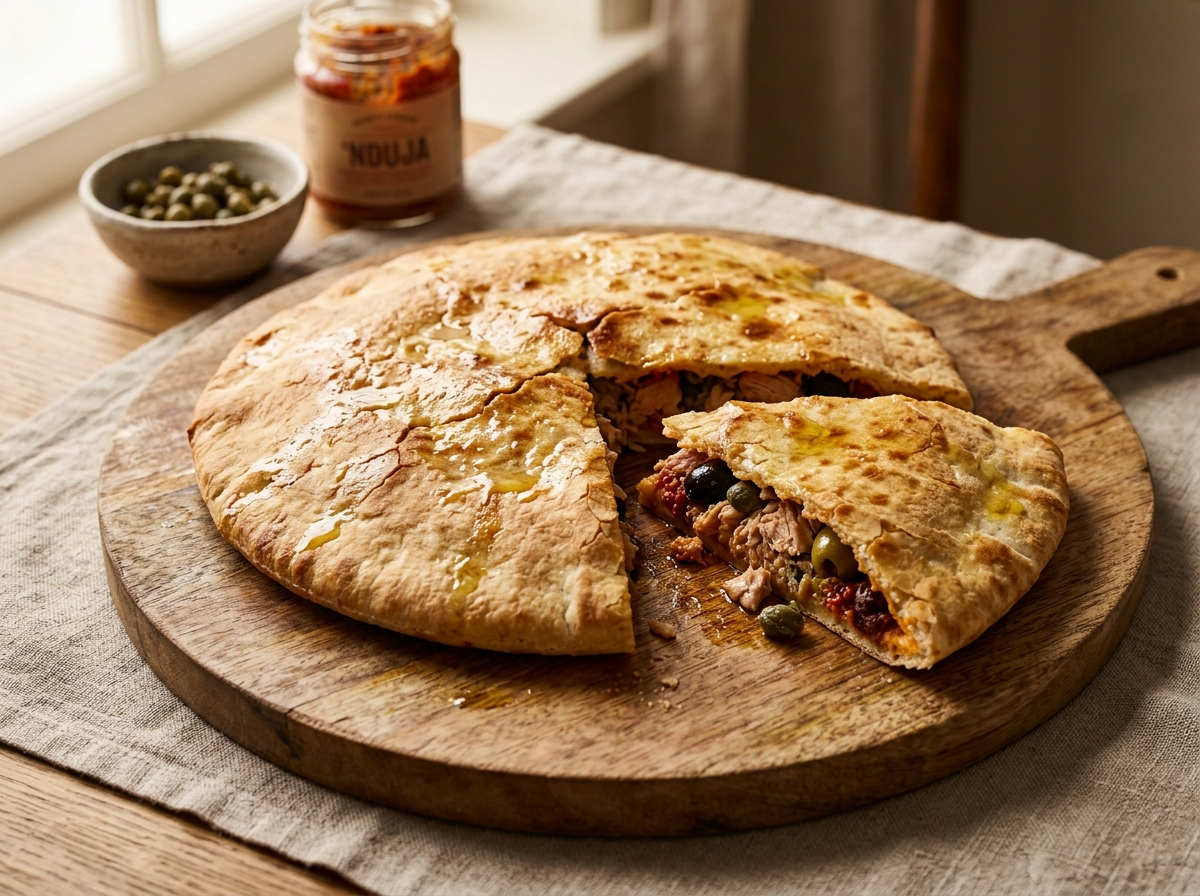
Pitta calabrese is a double-layered savory bread from the toe of Italy’s boot. Two thin rounds of olive oil dough sandwich a filling of canned tuna, pitted olives, capers, and nduja, then bake until the crust is firm and blistered — a structure not unlike a baked calzone with layered filling.
It’s street food, party food, and a practical packed lunch all at once. In Calabria you’ll find it at festivals and in home kitchens with slight variations in every household – some add anchovies, some swap nduja for soppressata, some press in sun-dried tomatoes.
The dough uses olive oil rather than butter, which keeps the crumb tender but not rich. A short rest is enough – you don’t need a long proof. The whole process, dough to table, sits comfortably under two hours.
Why You’ll Love This Recipe
- Bakes in one pan with no special equipment needed
- Filling uses pantry staples – no fresh meat required
- Holds well for hours, great for picnics or parties
- Nduja gives heat and depth without overpowering the tuna
Ingredient Notes
- 00 flour: Gives a pliable, easy-to-roll dough. All-purpose flour works fine as a substitute with no changes to quantities.
- nduja: This soft, spreadable Calabrian salami is what gives the filling its characteristic heat. If you can’t find it, use a pinch of Calabrian chili flakes mixed with a little soft chorizo.
- canned tuna in olive oil: Oil-packed tuna has better flavor and holds moisture during baking. Drain well but not bone-dry – a little oil in the filling helps the texture.
- black olives: Use pitted Calabrian or Gaeta olives if you can find them. Plain pitted Kalamata olives are a reliable substitute.
- capers in brine: Rinse them before adding to the filling. Salt-packed capers work too – soak for 10 minutes and rinse twice.
- active dry yeast: Instant yeast works at the same quantity without pre-activating in water. Fresh yeast can be used at double the weight.
Pitta Calabrese: The Stuffed Bread from Calabria You Need to Know
Ingredients
Method
- Dissolve the sugar and yeast in the warm water and let it stand for 5 minutes until foamy.
- Combine the flour and salt in a large bowl. Pour in the yeast mixture and olive oil.
- Knead by hand for 8 to 10 minutes, or with a dough hook on medium speed for 6 minutes, until the dough is smooth and slightly tacky.
- Shape into a ball, place in a lightly oiled bowl, cover with a clean towel, and rest at room temperature for 60 minutes until doubled in size.
- Drain the tuna over a fine-mesh sieve for at least 5 minutes, pressing lightly to remove oil.
- In a bowl, combine the tuna, chopped olives, capers, drained tomatoes, and oregano. Season with black pepper and mix gently with a fork.
- Keep the nduja separate - you'll spread it directly on the dough.
- Heat the oven to 200 C / 390 F. Lightly oil a 30 cm round baking pan.
- Divide the risen dough into two portions, one slightly larger than the other.
- Roll the larger portion into a circle about 3 mm thick and large enough to cover the pan base with a small overhang. Lay it in the pan.
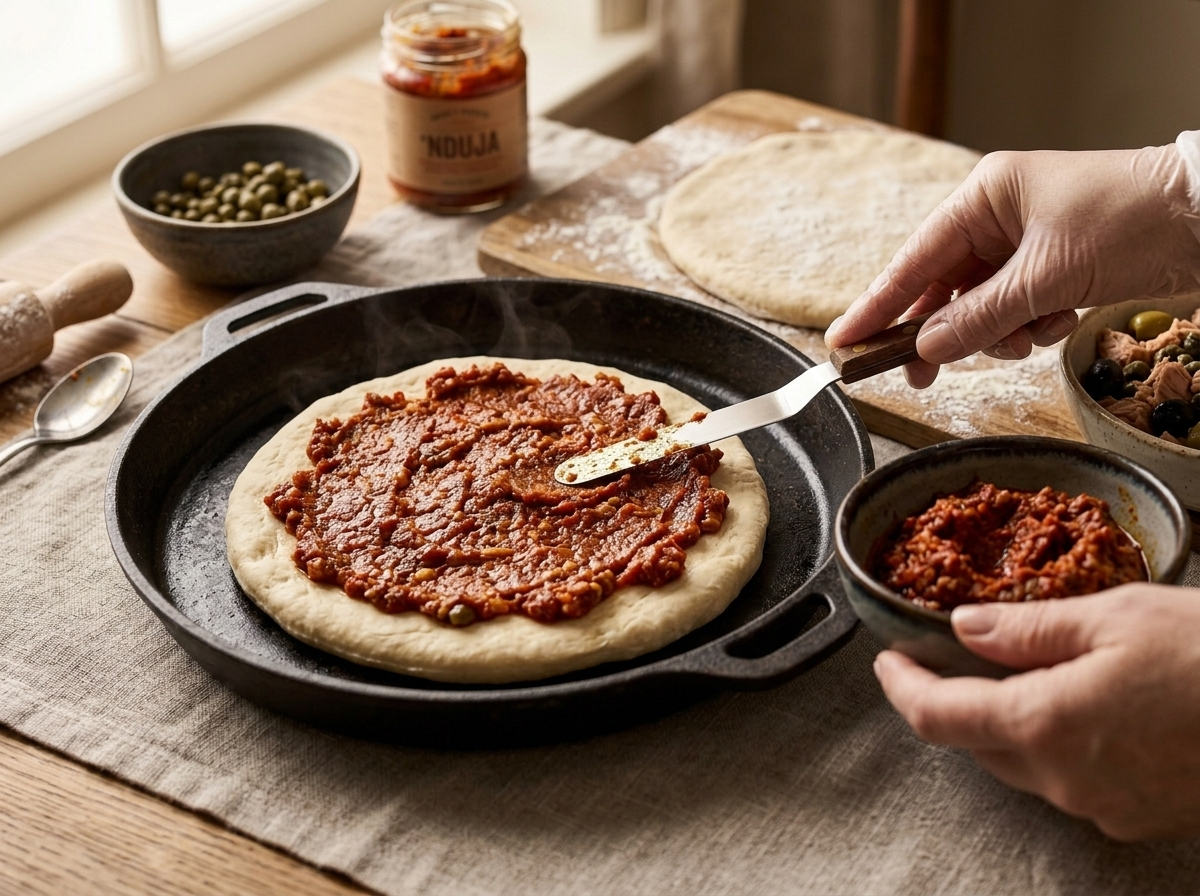
- Spread the nduja over the dough base in a thin, even layer, leaving a 1.5 cm border around the edge.
- Spoon the tuna filling over the nduja and spread it evenly.
- Roll the second dough portion into a circle the same diameter as the pan. Lay it over the filling.
- Fold the overhanging edge of the bottom layer up and over the top layer, pressing firmly to seal all around.
- Dock the top with a fork in 10 to 12 places. Brush the surface with olive oil and scatter a pinch of coarse salt.
- Bake for 30 to 35 minutes until the top is golden with light blistering and the crust sounds hollow when tapped.
- Remove from the oven and rest in the pan for 10 minutes before slicing into wedges.
Notes
Tips for Success
- Roll the bottom layer slightly thicker than the top so it holds the filling without tearing.
- Spread nduja directly on the dough before adding other filling ingredients to distribute heat evenly.
- Dock the top layer with a fork in several places to let steam escape and keep the crust flat.
- Brush the top with olive oil just before baking for a glossy, blistered crust.
- Let the pitta rest 10 minutes after baking before slicing – cutting too soon tears the crust.
Variations
- Replace tuna with sauteed broccoli rabe, smoked scamorza, and Calabrian chili for a vegetarian version.
- Use soppressata and roasted red peppers instead of nduja for a milder, sweeter filling.
- Add anchovy fillets and sun-dried tomatoes to the standard filling for a more intense umami hit.
Storage and Reheating
Store leftover pitta calabrese at room temperature, wrapped in foil, for up to 24 hours. The crust stays reasonably crisp and the filling holds without drying out.
For longer storage, wrap tightly and refrigerate for up to 3 days. Reheat in a 180 C / 355 F oven for 8 to 10 minutes directly on the rack – this revives the crust better than a microwave, which makes it soft.
Pitta calabrese freezes well. Slice into portions, wrap individually in cling film, and freeze for up to 2 months. Thaw overnight in the fridge and reheat in the oven as above.
Serving Suggestions
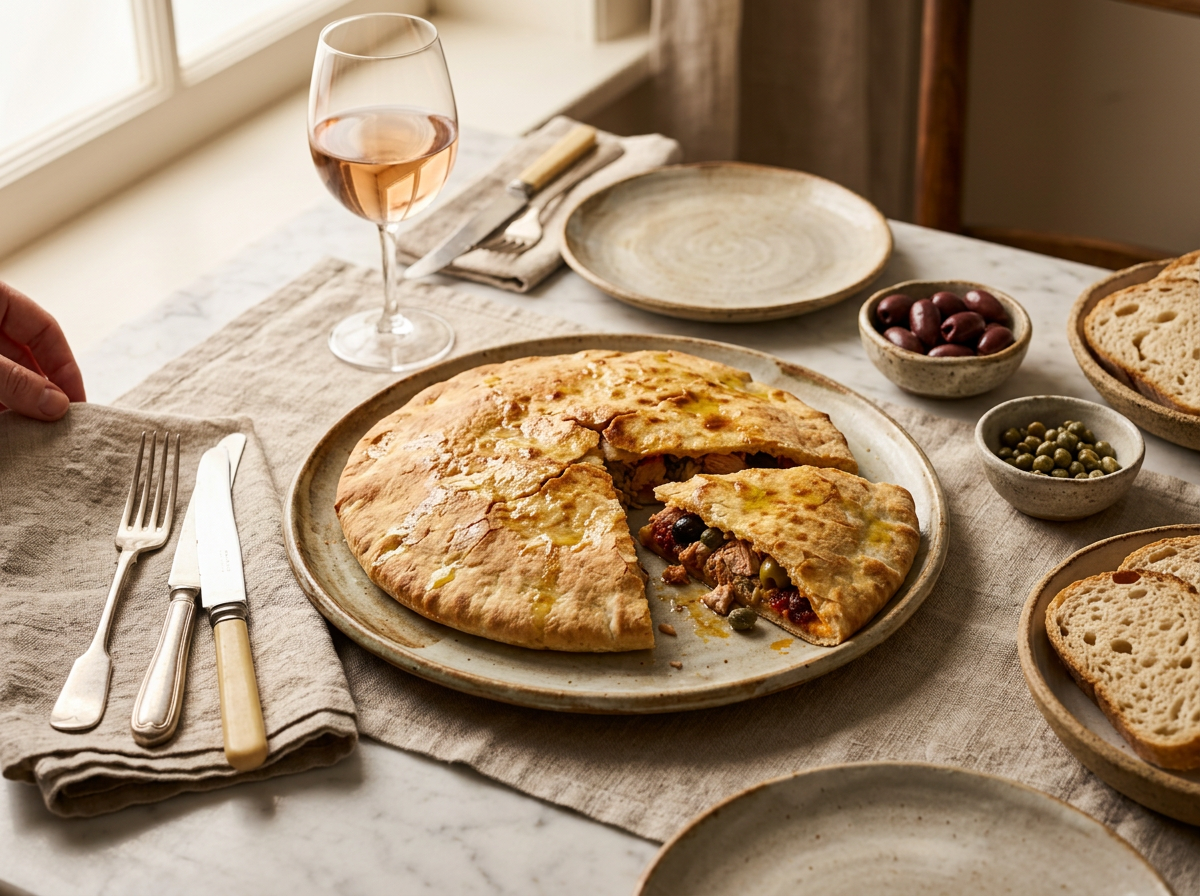
Pitta calabrese is substantial enough to serve as a main with a simple green salad dressed with lemon and olive oil. Cut it into wedges at the table like a pizza.
For a spread, serve smaller slices alongside a plate of sliced cured meats, pickled vegetables, aged pecorino, and a simple Italian seafood salad. A cold Calabrian rosato or a light Cirò rosso from the same region pairs naturally.
It’s also one of the best picnic or packed-lunch options you can make. It travels well, doesn’t need refrigeration for a few hours, and gets better as the filling settles into the dough.
FAQ
Why is the bottom of my pitta calabrese soggy?
The most common cause is wet filling. Drain the canned tuna and capers very well, and pat the olives dry before adding them. Also make sure the oven is fully preheated before the pitta goes in – a cold oven steams the base instead of crisping it.
Can I use fresh yeast instead of active dry yeast in the pitta dough?
Yes, use about 12 g of fresh yeast in place of 7 g active dry yeast. Crumble it directly into the warm water before adding flour. The dough behavior will be the same.
How do I know when the pitta calabrese is fully baked?
The top should be evenly golden with a few darker blistered spots, and the crust should sound hollow when you tap it lightly with a knuckle. If the edges are browning faster than the center, cover loosely with foil for the last 5 minutes.
Can I make the pitta calabrese dough the night before?
Yes. After the first knead, place the dough in a lightly oiled bowl, cover, and refrigerate overnight. Bring it to room temperature for 30 minutes before rolling – cold dough is harder to stretch thin.
What is the difference between pitta calabrese and pitta ‘mpigliata?
They share the same Calabrian flatbread base but are completely different dishes. Pitta ‘mpigliata is a sweet Christmas pastry filled with figs, honey, and nuts, while pitta calabrese is a savory stuffed bread eaten year-round.
Is pitta calabrese gluten-free?
No, the standard recipe uses wheat flour. You could try a gluten-free bread flour blend, but the dough will be less elastic and harder to roll thin without tearing. The texture of the crust will differ noticeably.