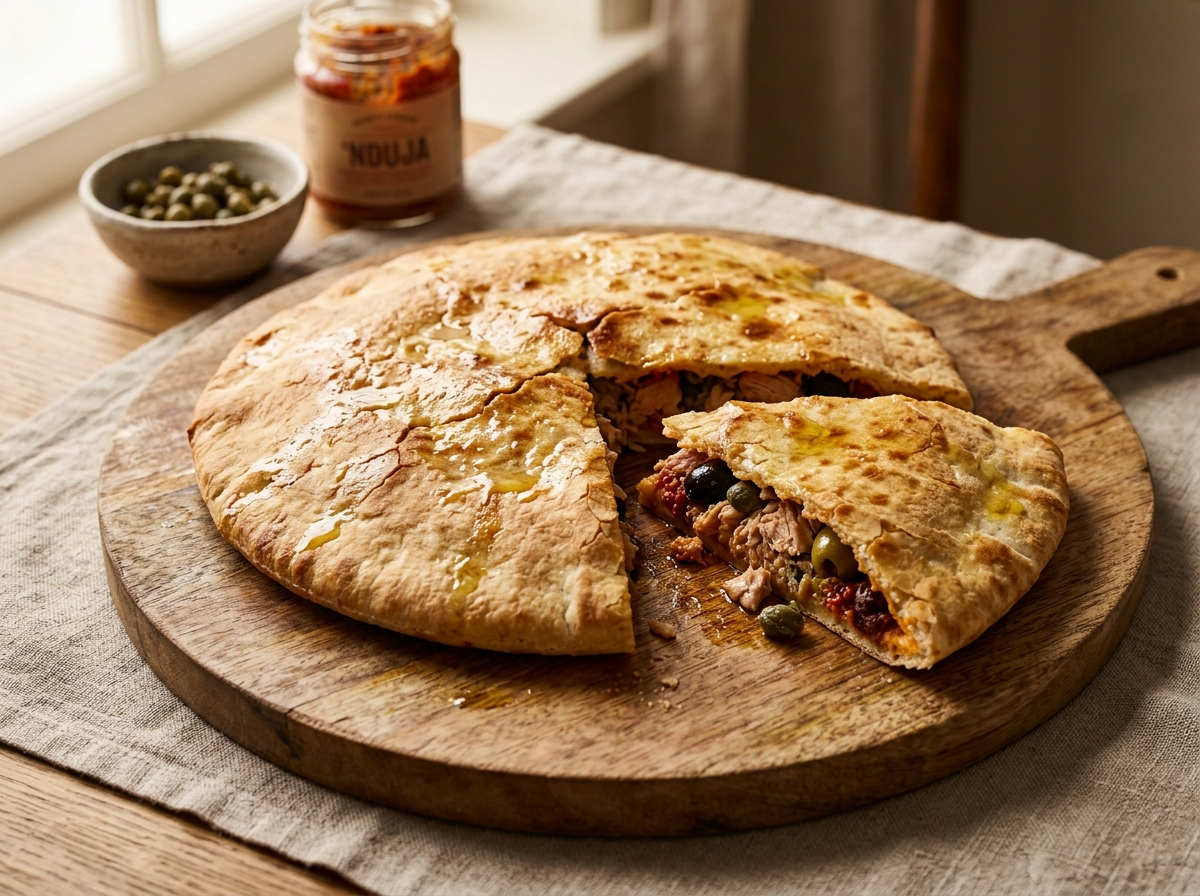
Ingredients
Method
Make the dough
- Dissolve the sugar and yeast in the warm water and let it stand for 5 minutes until foamy.
- Combine the flour and salt in a large bowl. Pour in the yeast mixture and olive oil.
- Knead by hand for 8 to 10 minutes, or with a dough hook on medium speed for 6 minutes, until the dough is smooth and slightly tacky.
- Shape into a ball, place in a lightly oiled bowl, cover with a clean towel, and rest at room temperature for 60 minutes until doubled in size.
Make the filling
- Drain the tuna over a fine-mesh sieve for at least 5 minutes, pressing lightly to remove oil.
- In a bowl, combine the tuna, chopped olives, capers, drained tomatoes, and oregano. Season with black pepper and mix gently with a fork.
- Keep the nduja separate - you'll spread it directly on the dough.
Assemble and bake
- Heat the oven to 200 C / 390 F. Lightly oil a 30 cm round baking pan.
- Divide the risen dough into two portions, one slightly larger than the other.
- Roll the larger portion into a circle about 3 mm thick and large enough to cover the pan base with a small overhang. Lay it in the pan.
- Spread the nduja over the dough base in a thin, even layer, leaving a 1.5 cm border around the edge.
- Spoon the tuna filling over the nduja and spread it evenly.
- Roll the second dough portion into a circle the same diameter as the pan. Lay it over the filling.
- Fold the overhanging edge of the bottom layer up and over the top layer, pressing firmly to seal all around.
- Dock the top with a fork in 10 to 12 places. Brush the surface with olive oil and scatter a pinch of coarse salt.
- Bake for 30 to 35 minutes until the top is golden with light blistering and the crust sounds hollow when tapped.
- Remove from the oven and rest in the pan for 10 minutes before slicing into wedges.
Notes
Pitta calabrese is best eaten the day it's baked when the crust is at its crispest. If making ahead for a party, bake it fully and reheat uncovered at 180 C for 8 minutes before serving.