
Jump to Recipe
Fritto misto alla piemontese is Piedmont’s mixed fry, a platter that pairs veal, sausage, and garden vegetables with a sweet course of semolina squares, apple, and amaretti, everything dipped in flour, egg, and breadcrumbs and fried until deep golden and crisp.
It’s a dish built on contrast. Savory meat and vegetables come first out of the oil, then sweet bites finish the plate, a structure that goes back to old Piedmontese banquets where nothing at the table was wasted.
I make my version with veal and mild sausage, but rabbit or chicken thigh work too if that’s what your butcher has. The semolina squares take the most patience since the custard needs a full 2 hours to firm up in the fridge before you can cut and fry it.
Fry everything at 170C / 340F, in batches, and you’ll get a crust that stays crisp instead of greasy. The sausage needs to reach 71C / 160F internal, and the veal should be opaque with no pink left.
Why You’ll Love This Recipe
- One oil, three courses: savory, vegetable, and sweet
- Semolina squares add a custardy contrast to the crunch
- Works with chicken or rabbit if veal isn’t available
- A shareable platter built for a table, not a plate
Ingredient Notes
- veal scaloppine: Thin veal cutlets work best here. Pounded chicken thigh or rabbit loin are common substitutes if veal isn’t available.
- Italian sausage: Use a mild fresh sausage, not a cured salami, since it needs to cook through fully while frying.
- fine semolina: Fine semolina (semolino) gives the custard its structure. Coarse semolina turns the texture grainy instead of smooth.
- amaretti cookies: Use the hard, crunchy Italian almond cookies, not soft amaretti morbidi, they hold their shape better in hot oil.
- apple: A firm, tart apple like Golden Delicious holds its shape in the oil instead of turning mushy.
- fresh sage leaves: Whole leaves fry in seconds and turn brittle. They’re meant to be eaten whole as a crisp garnish bite.
- fine dry breadcrumbs: Dry, fine breadcrumbs coat evenly and crisp up. Fresh breadcrumbs go soft instead of golden.
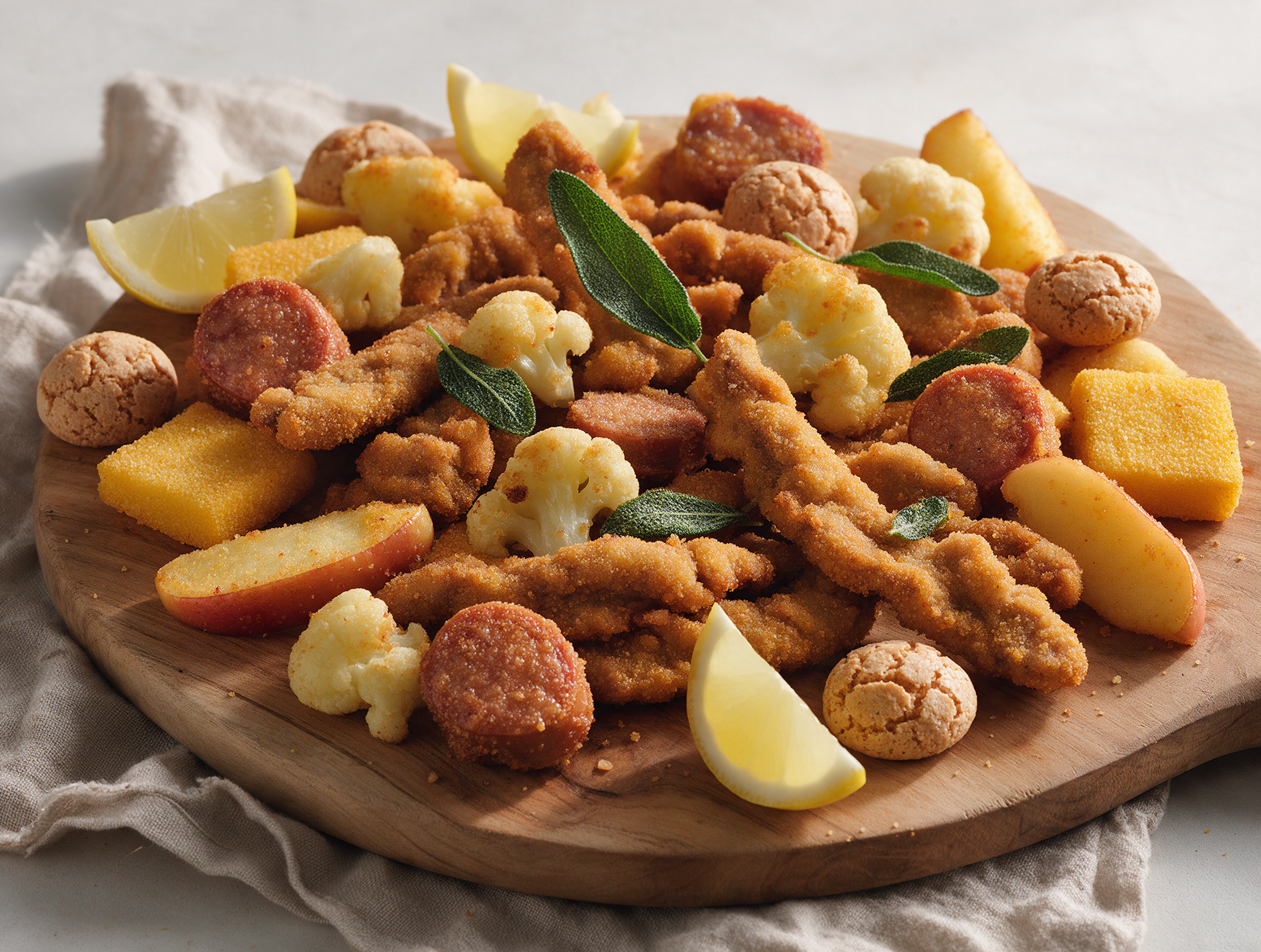
Fritto Misto alla Piemontese with Semolina and Apple
Ingredients
Method
- Whisk the milk, semolina, sugar, lemon zest, and a pinch of salt in a saucepan over medium heat. Cook, stirring constantly, for 5 to 6 minutes until the mixture is as thick as loose polenta and pulls from the sides of the pan.
- Take the pan off the heat and whisk in the egg yolks quickly so they don't scramble. Pour into a 20 x 20 cm / 8 x 8-inch dish, spread to about 1 cm / 0.4-inch thick, and chill for 2 hours until firm. Cut into 4 cm / 1.5-inch squares.
- Pat the veal, sausage, zucchini, cauliflower, and sage completely dry with paper towels. Season the veal and sausage with salt and pepper.
- Set up a dredging station: flour in one shallow bowl, the beaten eggs in a second, and the breadcrumbs in a third.
- Coat the veal, sausage, zucchini, cauliflower, sage, semolina squares, apple wedges, and amaretti one piece at a time: flour first, then egg, then breadcrumbs, pressing gently so the crumbs stick. Line them up on a sheet pan, keeping each type separate.
- Heat the sunflower oil in a 26 cm / 10-inch deep skillet or Dutch oven to 170C / 340F, checking with a deep-fry thermometer.
- Fry the cauliflower and zucchini first, in batches, for 2 to 3 minutes until golden. Lift out with a slotted spoon and drain on a wire rack.
- Fry the veal and sausage next, in small batches so the pan isn't crowded, for 3 to 4 minutes until deep golden and crisp, with the sausage cooked through to 71C / 160F internal and the veal opaque with no pink.
- Fry the sage leaves for 20 to 30 seconds until crisp and drain immediately, they burn fast.
- Fry the semolina squares, apple wedges, and amaretti last, in one or two batches, for 2 to 3 minutes until golden, so the oil stays clean for the sweet course.
- Season everything with a little extra salt while it's still hot from the oil. Pile onto a warm platter with lemon wedges and serve right away.
Notes
- Chill the semolina custard a full 2 hours before cutting, it needs to set firm.
- Pat every piece dry before dredging or the coating won't stick.
- Fry sweet items last so the oil doesn't carry savory flavors over.
- Don't crowd the pan, fry meat and vegetables in small batches.
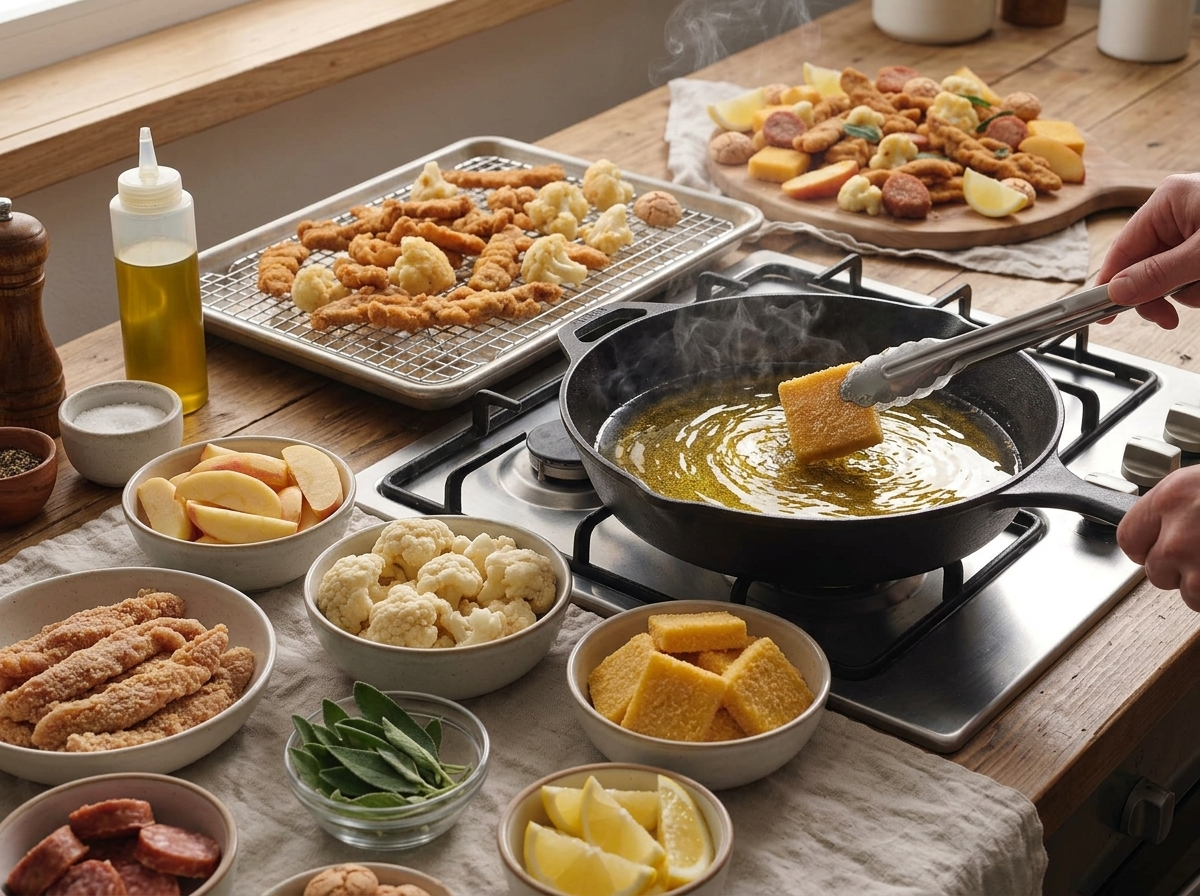
Tips for Success
- Pat every piece completely dry before dredging so the flour and egg wash grip instead of sliding off.
- Keep the oil at a steady 170C / 340F with a thermometer, checking it again between batches.
- Fry sweet items last, after the meat, so the oil doesn’t carry savory flavor into the apple and amaretti.
- Press breadcrumbs firmly onto the semolina squares, they’re delicate and the coating is what holds them together.
- Work in small batches and don’t crowd the pan, overcrowding drops the oil temperature and leaves the coating pale.
Variations
- Swap the veal for rabbit or chicken thigh, cut into the same 2.5 cm strips, for a milder everyday version.
- Add chicken livers or sweetbreads dipped only in flour for a more traditional, offal-forward Piedmontese platter.
- Skip the sausage and double the vegetables for a lighter, mostly-vegetable version of the fritto misto.
Storage and Reheating
Fritto misto alla piemontese is best eaten within minutes of frying, while the crust is still crisp and the semolina squares hold their shape. Reheating in a microwave or covered dish turns the crumb coating soft and rubbery, so I don’t recommend it.
What you can do ahead: make the semolina custard up to a day early and keep it chilled in its dish, uncut. You can also dredge the meat, vegetables, and sweet pieces a few hours before serving and hold them, uncovered, on a tray in the fridge.
Fry everything fresh right before you plan to eat, in the same order as the steps below, so nothing sits waiting under a heat lamp.
Serving Suggestions
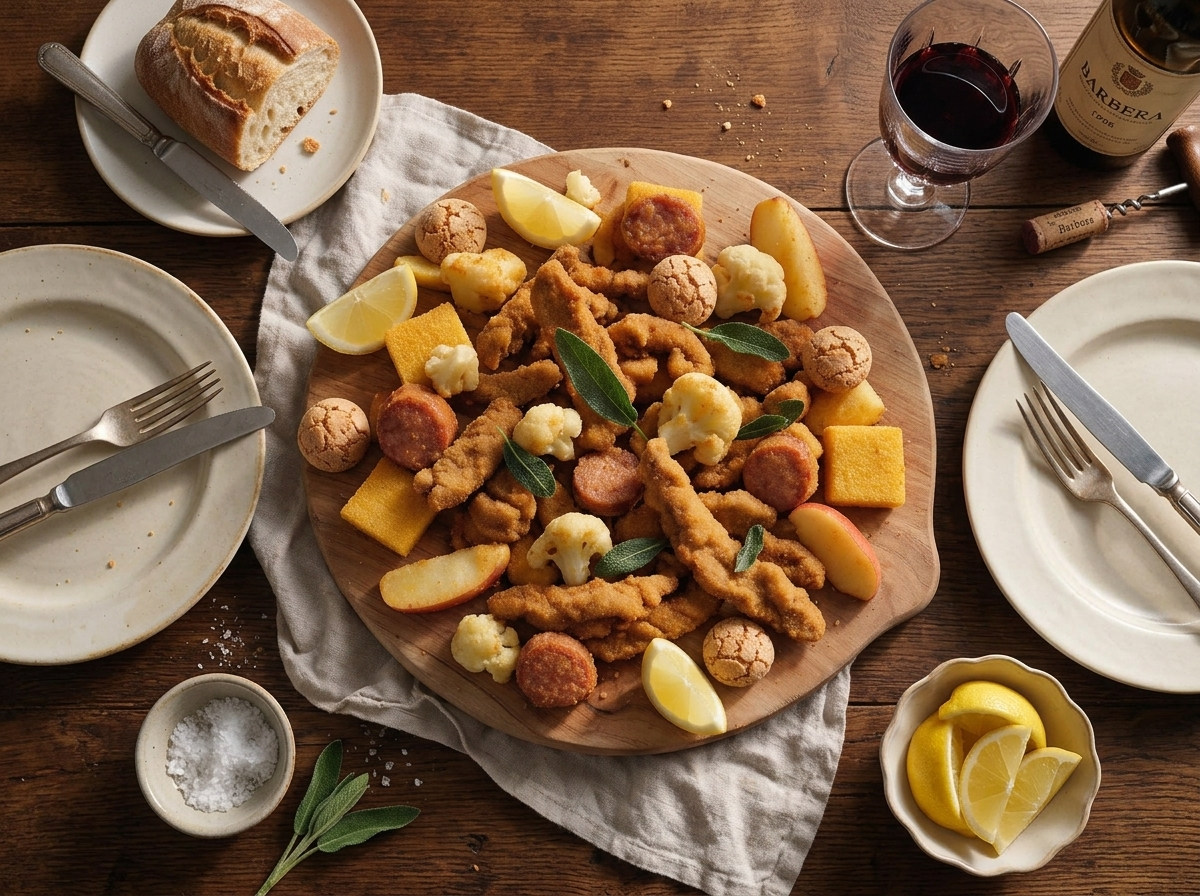
Serve fritto misto alla piemontese hot, straight off the rack, with lemon wedges on the side for the savory pieces. A simple green salad with a sharp vinaigrette cuts through the fried richness.
Pour a glass of Barbera d’Asti or a dry Arneis alongside, both common pairings with fried Piedmontese food.
For a full spread, add a small bowl of bagna cauda or a plate of giardiniera, the vinegar brightness works well against the sweet semolina and apple.
FAQ
Why is my fritto misto alla piemontese coating falling off in the oil?
Wet ingredients are the main cause, so pat every piece dry before dredging. Press the breadcrumbs on firmly after the egg wash, and don’t skip the flour layer since it helps the egg cling to smooth surfaces like zucchini and apple. Oil under 170C / 340F also lets the crust soak up oil and separate.
Can I use chicken instead of veal in this recipe?
Yes, boneless chicken thigh works well sliced into the same 2.5 cm strips. It fries at the same 170C / 340F and needs a similar few minutes per batch until golden and opaque with no pink. Rabbit is another traditional Piedmontese swap if your butcher carries it.
Can I prep fritto misto alla piemontese ahead of time?
You can prep ahead but shouldn’t fry ahead. Make the semolina squares up to a day early and keep them chilled, and dredge the meat and vegetables a few hours before and hold them on a tray in the fridge. Fry everything fresh right before serving since the crust turns soft on reheating.
What wine goes with fritto misto alla piemontese?
A light Piedmontese red like Barbera d’Asti cuts through the fried richness without overpowering the sweet semolina and apple. A dry white such as Arneis also works if you prefer something crisper. Pour something with enough acidity to reset your palate between bites.
Is fritto misto alla piemontese gluten free?
Not as written, since it uses wheat flour and breadcrumbs for the coating. You can swap in a gluten-free flour blend and gluten-free breadcrumbs with similar results, though the semolina squares need semolina, which contains gluten, so that component isn’t easily adapted.
What’s the difference between fritto misto alla piemontese and fritto misto di mare?
Fritto misto alla piemontese is a landlocked, meat-and-vegetable version built around veal, sausage, vegetables, and a sweet course of semolina and fruit. Fritto misto di mare is the coastal seafood version, using shrimp, squid, and small whole fish. Both share the same light flour-and-fry technique with different ingredients.