
Jump to Recipe
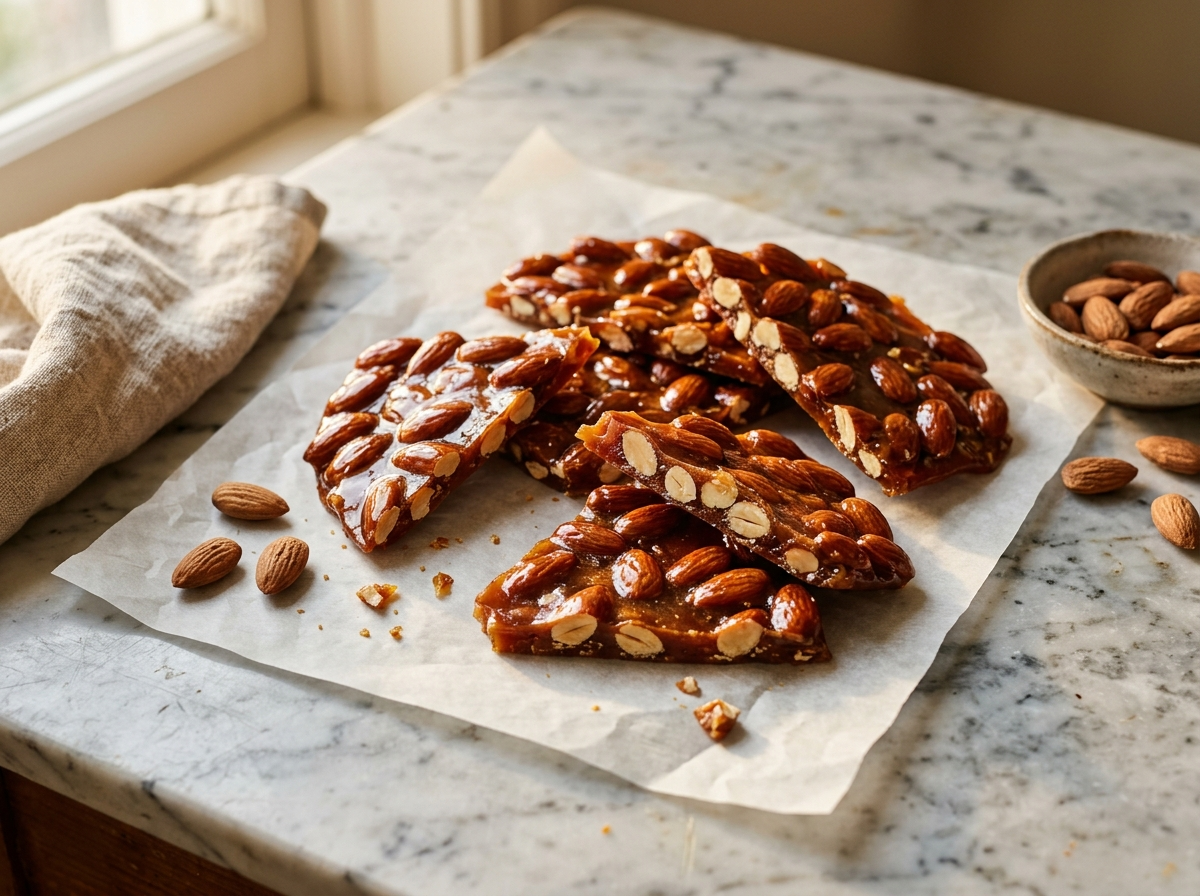
Croccante di mandorle is the Italian answer to almond brittle – two or three ingredients, no thermometer, and a result that’s thinner and more shattery than most American-style brittles.
It shows up at Christmas markets from Sicily to Piedmont, sold in rough slabs wrapped in wax paper. Street vendors make it on flat marble slabs, and it cools in minutes. You can do the same on a baking sheet lined with parchment.
The ratio is simple: equal weight of sugar and whole raw almonds, a squeeze of lemon to slow crystallization. That’s the whole recipe. What matters is patience at the stove and working quickly once the caramel is ready.
I make this in a single heavy-based pan. One batch takes about 20 minutes start to finish and yields enough for a generous gift box or a full dessert platter.
Why You’ll Love This Recipe
- Three ingredients, no candy thermometer required
- Cools in under 10 minutes on any flat surface
- Keeps crisp for two weeks in an airtight tin
- Classic Italian holiday gift that costs very little to make
Ingredient Notes
- Whole raw almonds: Use unblanched whole almonds for the most traditional texture and flavor. Blanched almonds work but give a paler, milder result. Do not use slivered or sliced almonds – they burn before the sugar caramelizes.
- Granulated white sugar: Plain white granulated sugar is the right choice here. Brown sugar adds moisture and can make the brittle sticky rather than snappy.
- Lemon juice: A small squeeze of fresh lemon juice (about 1 tsp) slows crystallization and keeps the caramel smooth. Bottled lemon juice works fine.
- Neutral oil or butter (for the surface): Brush your parchment or marble surface lightly with neutral oil or softened butter before pouring. This prevents sticking and gives you a few extra seconds to spread the brittle thin.
- Fine sea salt (optional): A light pinch of fine sea salt scattered on top just after pouring sharpens the almond flavor noticeably. Skip it for the most traditional version.
Croccante di Mandorle: Italian Almond Brittle
Ingredients
Method
- Place the almonds in a dry heavy-based saucepan over medium heat. Stir constantly for 3-4 minutes until the skins start to darken and the almonds smell nutty. Tip them onto a plate and set aside.
- Line a rimmed baking sheet with parchment paper and brush it lightly with neutral oil or softened butter. Set a second sheet of oiled parchment and a rolling pin nearby - you'll need both quickly once the caramel is done.
- Add the sugar, water, and lemon juice to the same heavy-based saucepan. Set over medium-low heat. Do not stir. Let the sugar dissolve and begin to bubble, swirling the pan gently once or twice if needed to even out the color.
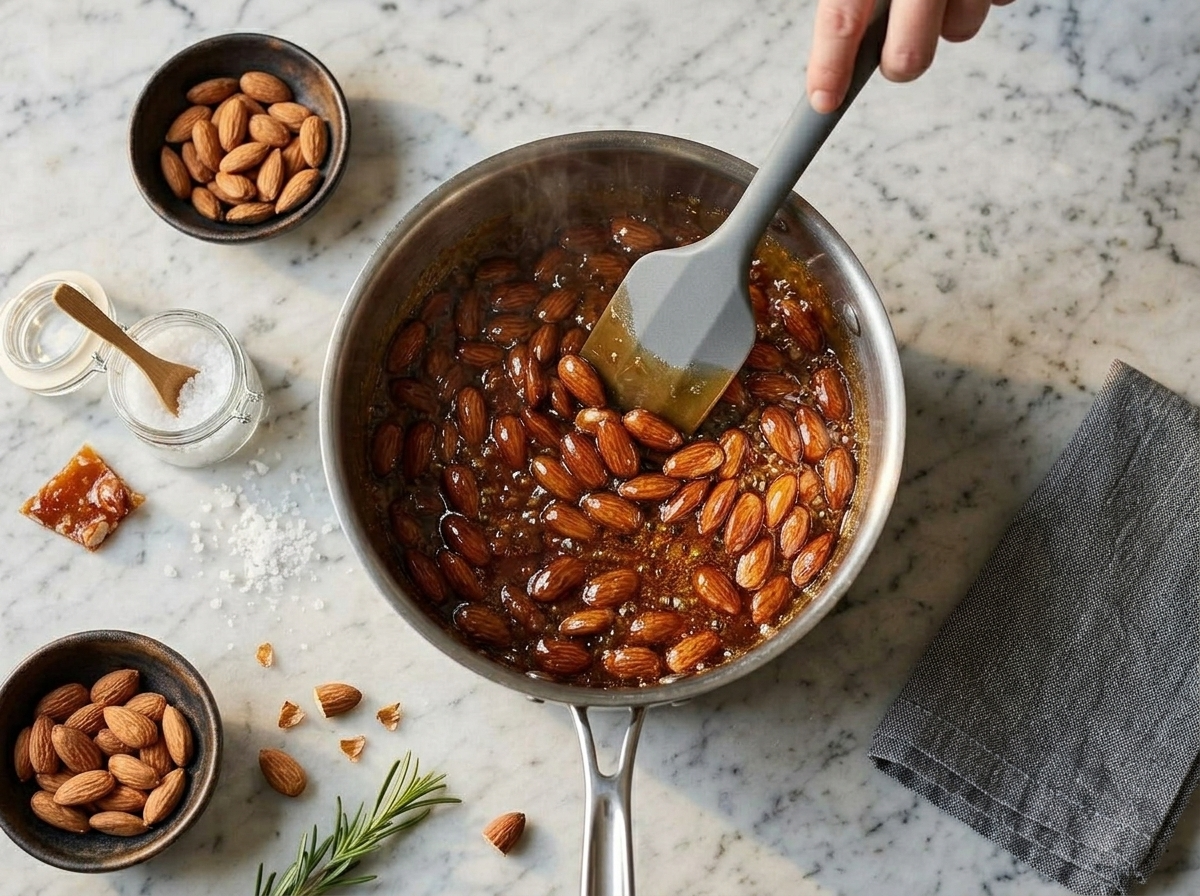
- Continue cooking, watching closely, until the caramel turns a deep amber - the color of dark tea or a copper coin. This takes about 10-14 minutes from when bubbling starts. If you have a thermometer, aim for 168-172 C / 335-340 F.
- Remove the pan from the heat the moment the caramel reaches that deep amber. It continues cooking from residual heat, so don't wait for it to darken further in the pan.
- Working quickly, add the toasted almonds to the caramel and stir with a silicone spatula until every almond is coated. The mixture will be thick and syrupy.
- Pour the almond-caramel mixture onto the center of the prepared parchment sheet. Scatter a pinch of fine sea salt on top if using.
- Lay the second sheet of oiled parchment on top and immediately use the rolling pin to press the brittle out to an even layer about 4-5 mm thick. Work fast - it begins to set within 60-90 seconds.
- After 2-3 minutes, when the slab is partially set but still slightly pliable, use a sharp knife to score it into rough rectangles or diamond shapes. Press firmly but don't saw back and forth.
- Leave the croccante to cool completely at room temperature for about 15 minutes until fully hard. Snap along the scored lines and transfer to an airtight tin lined with parchment.
Notes
Tips for Success
- Toast almonds in a dry pan over medium heat for 3-4 minutes until fragrant before adding to caramel – it deepens flavor significantly.
- Cook the sugar over medium-low heat without stirring until it melts completely and turns a deep amber, about 170 C on a thermometer.
- Have your oiled parchment sheet ready before you start the sugar – once the caramel is ready, you have about 60 seconds to work.
- Use a second sheet of oiled parchment on top and a rolling pin to press the brittle thin while still warm for an even, glass-like slab.
- Score the brittle with a sharp knife after 2-3 minutes of cooling while still slightly pliable – it will snap cleanly along those lines once cold.
Variations
- Sicilian sesame croccante: replace half the almonds with white sesame seeds for a nutty, more delicate version common in Palermo markets.
- Pistachio croccante: swap almonds for whole shelled Sicilian pistachios and add a pinch of cinnamon to the sugar before melting.
- Spiced almond brittle: add half a teaspoon of ground anise seed or fennel to the finished caramel before folding in the almonds.
Storage and Reheating
Store croccante di mandorle in an airtight tin or glass jar at room temperature, layered between sheets of parchment paper. It stays crisp and snappy for up to two weeks if kept away from humidity.
Do not refrigerate – the moisture will soften the caramel and make it sticky. If you live somewhere very humid, tuck a small silica gel packet in the tin.
Croccante does not reheat well and is not meant to. Serve it at room temperature, broken into rough shards directly from the tin.
Serving Suggestions
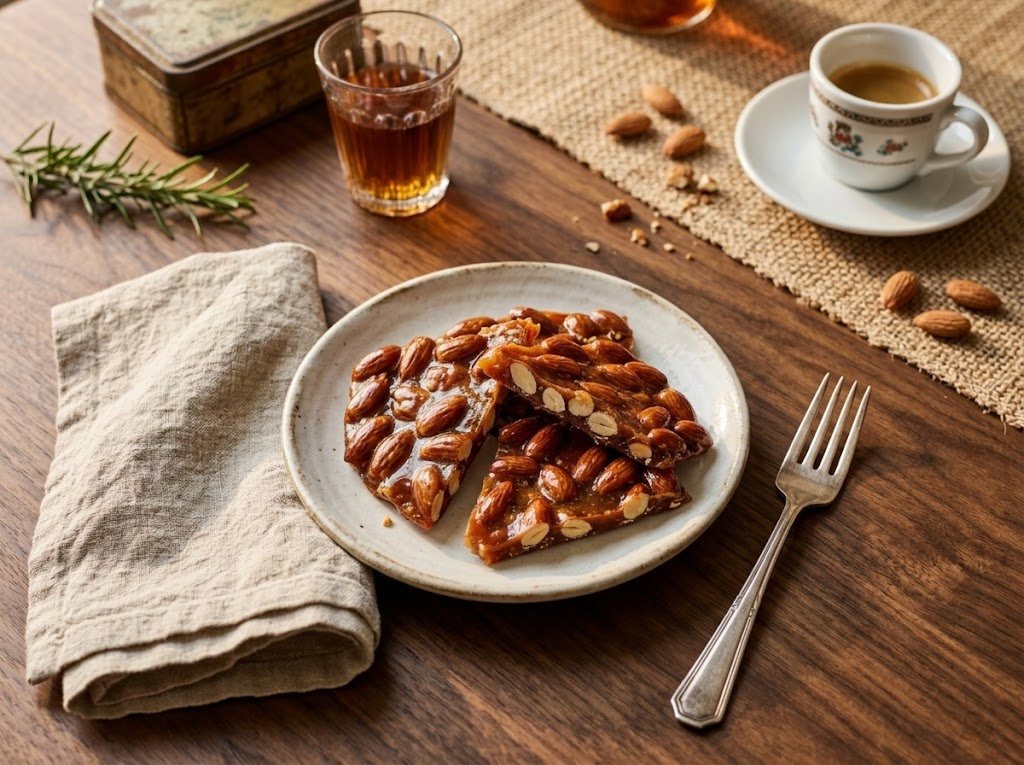
Break the slab into irregular shards and arrange on a wooden board alongside espresso or a small glass of Vin Santo for a simple end-of-meal sweet. It works equally well as part of a larger dessert spread next to fresh ricotta or a silky vegan panna cotta.
Croccante di mandorle makes a strong edible gift. Wrap shards in parchment, tie with kitchen twine, and pack in a small tin or cellophane bag. It’s a standard offering at Italian Christmas and Easter tables.
For a dessert plate, crush a few pieces coarsely and scatter over vanilla gelato or plain yogurt, or crumble over a slice of light Italian ricotta cheesecake. The contrast between cold, creamy, and brittle-crunchy is clean and satisfying.
FAQ
Why did my croccante di mandorle turn out chewy instead of snappy?
The caramel didn’t reach a high enough temperature, or the brittle absorbed moisture from humidity. Cook the sugar until it’s a deep amber (around 170 C) and store the finished brittle in an airtight tin away from any steam or damp.
Can I use honey instead of sugar to make croccante di mandorle?
You can, but honey has more moisture than sugar and burns at a lower temperature, so the result will be softer and stickier rather than glass-like. Traditional croccante relies on pure granulated sugar for its characteristic snap.
How do I know when the caramel for croccante is the right color?
You’re looking for a deep copper-amber, similar to a penny or dark tea. It should smell nutty and slightly bitter, not sweet. Pale golden caramel means the sugar hasn’t developed enough flavor and the brittle will taste flat.
Can I freeze croccante di mandorle to keep it longer?
Freezing isn’t recommended. When the brittle thaws, condensation forms on the surface and softens the caramel permanently. At room temperature in a sealed tin, it keeps well for two weeks without any quality loss.
What’s the difference between croccante di mandorle and torrone?
Croccante is pure caramelized sugar with nuts, cooked to a hard crack stage so it shatters cleanly. Torrone is a nougat made with egg whites and honey, which gives it a chewy, opaque texture – a completely different confection despite both being classic Italian nut sweets.
Is croccante di mandorle gluten-free?
Yes, the classic recipe contains only almonds, sugar, and lemon juice, all of which are naturally gluten-free, much like a gluten free focaccia bread made without any wheat flour. Just check that your almonds are processed in a facility free from cross-contamination if you’re cooking for someone with celiac disease.