
Jump to Recipe
Bigoli col ragu d’anatra is a Venetian pasta dish: thick, rough-textured bigoli tossed with a duck ragu that simmers for 90 minutes. The legs fall off the bone, and you shred them into a sauce built on soffritto, white wine, and a little tomato paste.
The texture defines the result. Duck gives you dark, tender meat, and the coarse surface of bigoli holds the sauce instead of letting it slide off.
The whole dish takes about 2 hours 50 minutes, but most of that is hands-off simmering. You’ll sear in two batches, build the soffritto, then leave the pot alone until it’s time to shred.
Practical note: this ragu tastes better on day two, so I often make it a day ahead.
Why You’ll Love This Recipe
- Mostly hands-off: 90 minutes of gentle simmering does the work
- Rendered duck fat builds a deep soffritto base
- Leftover ragu improves overnight and freezes for 3 months
- Four duck legs feed six people when paired with bigoli
Ingredient Notes
- duck legs: Frozen legs work fine, thawed in the fridge for 24 hours. Pat them very dry before searing so the skin browns instead of steaming.
- bigoli: Dried bigoli, often whole wheat, is sold in Italian delis and online. Whole-wheat spaghetti or pici are the closest substitutes.
- dry white wine: Use something you’d drink, such as Soave or Pinot Grigio. Skip oaky wines, which turn bitter when reduced.
- tomato paste: Two tablespoons add color and a rounded sweetness without making this a tomato sauce. Cook it until it darkens to brick red.
- Grana Padano: Parmigiano Reggiano works equally well. Grate it finely so it melts into the sauce instead of clumping.
- stock: Chicken stock is fine. Low-sodium is easier to control, since the ragu concentrates as it reduces.
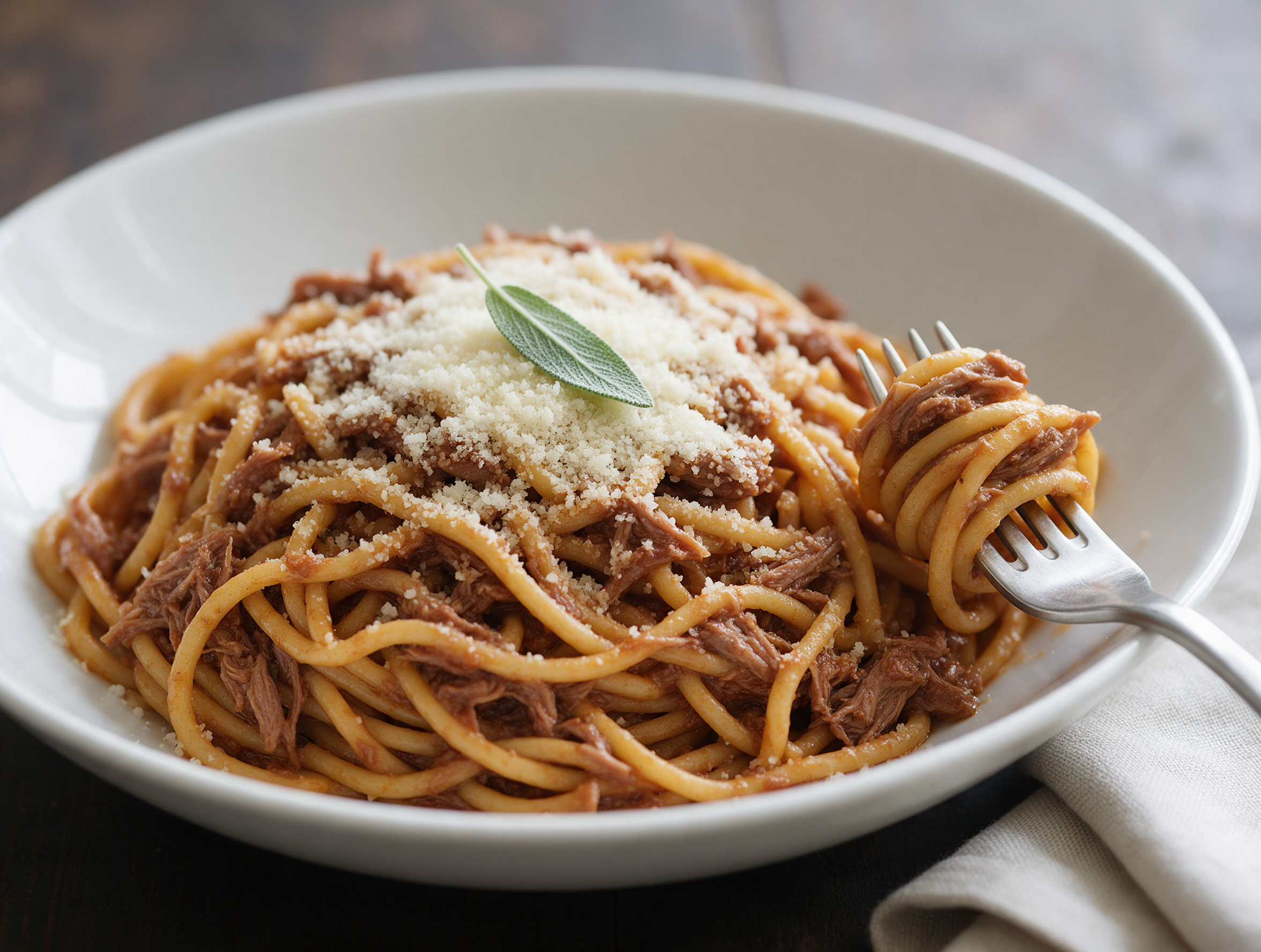
Bigoli col Ragu d’Anatra: Slow-Simmered Venetian Duck
Ingredients
Method
- Pat the duck legs dry and season all sides with 1 tsp of the salt and the pepper. Finely dice the onion, carrot, and celery, and slice the garlic.
- Set a 26 cm / 10-inch Dutch oven over medium heat. Sear 2 legs at a time, skin side down, for 8 to 10 minutes per batch, until the fat renders and the skin is deep gold. Move each batch to a plate.
- Pour off all but 3 tbsp of the fat into a heatproof jar and save it. Add the onion, carrot, celery, and the remaining 1/4 tsp salt, and cook over medium heat for 8 to 10 minutes, stirring, until soft and pale gold. Stir in the garlic for 1 minute, then the tomato paste for 2 minutes, until it darkens to brick red.
- Pour in the wine, scrape up the browned bits, and simmer for 4 to 5 minutes until reduced by half. Return the legs skin side up, add the stock, bay leaves, rosemary, and sage, and bring to a bare simmer. Cover with the lid slightly ajar and cook on the lowest heat for 90 minutes, until the meat pulls from the bone with little resistance.
- Move the legs to a board and let them cool for 10 minutes. Meanwhile, tilt the Dutch oven and skim the fat from the surface with a ladle, discard the bay leaves and rosemary stem, and set 5 L / 5 quarts of water on to boil in an 8-quart / 7.5 L pot. Skip the skim and the finished ragu turns greasy and slides off the pasta. Pull the meat from the bones, discard the skin and bones, and chop the meat into 1 cm / 1/2 inch pieces. Return it to the sauce, taste for salt, and simmer uncovered for 15 minutes, until the ragu coats the back of a spoon.
- While the ragu simmers, salt the boiling water with 2 tbsp coarse salt and cook the bigoli for 10 to 12 minutes, until 1 minute short of al dente. Scoop out 250 ml / 1 cup of pasta water, then drain. Add the pasta to the ragu with 100 ml / 1/3 cup of the pasta water and toss over medium heat for 1 to 2 minutes, until the sauce clings. Stir in the Grana Padano, loosen with more pasta water by the tablespoon if the sauce is tight, and serve immediately.
Notes
- Sear the legs in two batches so they brown instead of steaming.
- Keep the braise at a bare simmer, with one bubble every second or two.
- Taste for salt only after the ragu reduces, since the sauce concentrates.
- Reserve 250 ml of pasta water before draining the bigoli.
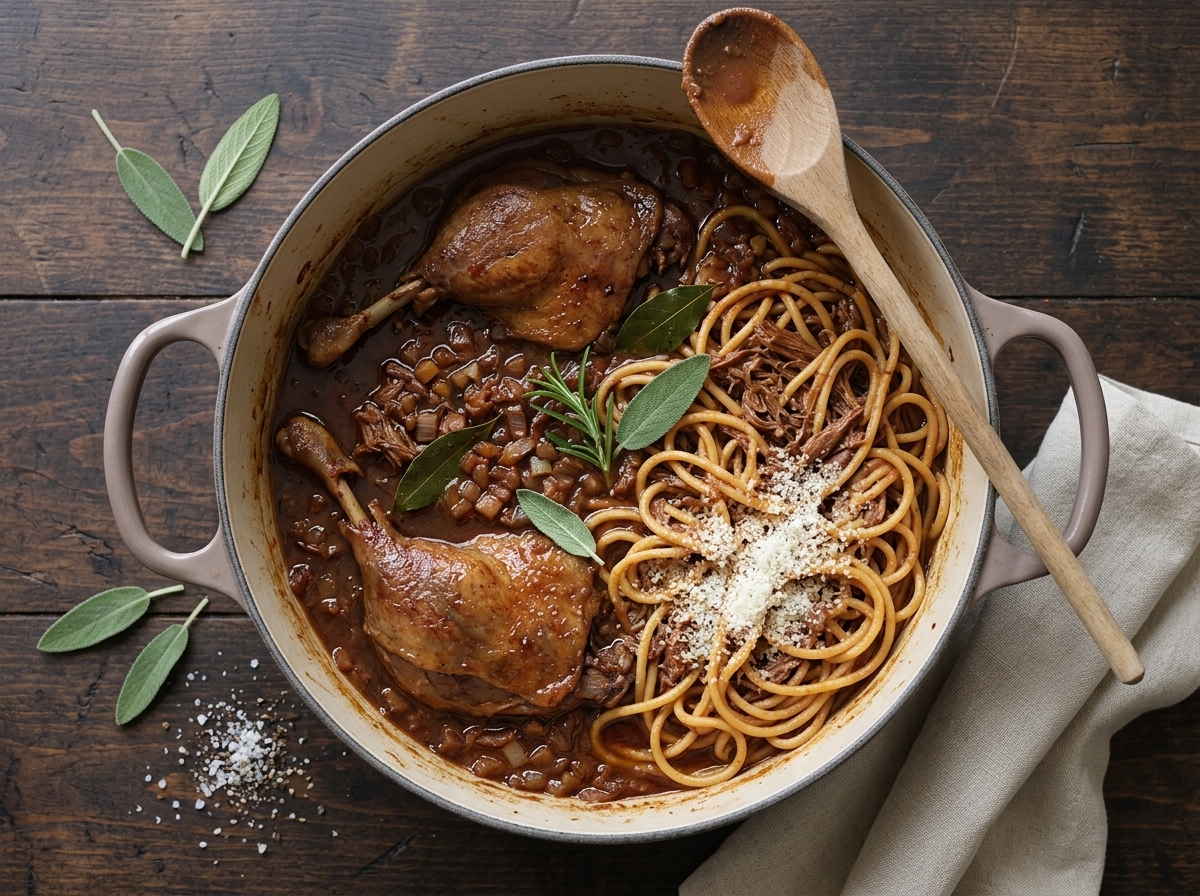
Tips for Success
- Sear the duck skin side down over medium heat for 8 to 10 minutes, until the fat renders and the skin is deep gold.
- Save the rendered duck fat in a jar. It keeps in the fridge for up to 3 months and makes excellent roast potatoes.
- Skim the surface fat with a ladle after the legs come out, tilting the pot so the fat pools at one side.
- Pull the bigoli 1 minute before the package time and finish it in the ragu with a splash of starchy water.
- Chop the shredded duck into 1 cm pieces instead of leaving long strands, so every forkful of bigoli gets meat.
Variations
- Stir in 150 g sliced cremini or porcini mushrooms, browned separately, during the final 15-minute simmer for a deeper, earthier ragu.
- Use 8 bone-in, skin-on chicken thighs in place of the duck and braise for 45 minutes, adding 1 tablespoon of olive oil to the soffritto.
- Leave out the tomato paste and add 2 extra sage leaves for a paler, more herb-forward ragu.
Storage and Reheating
Store the ragu in an airtight container in the fridge for 4 days, ideally separate from the pasta. Sauced bigoli keeps for 2 days, though the pasta keeps absorbing sauce and softens.
Reheat the ragu in a saucepan over low heat for 8 to 10 minutes with 2 to 3 tablespoons of water or stock, stirring until steaming hot. Reheat sauced pasta in a 26 cm / 10-inch skillet over medium-low heat for 4 to 5 minutes with a splash of water.
Freeze the ragu on its own for up to 3 months and thaw it overnight in the fridge. Cook fresh bigoli each time, since cooked pasta turns mushy after freezing.
Serving Suggestions
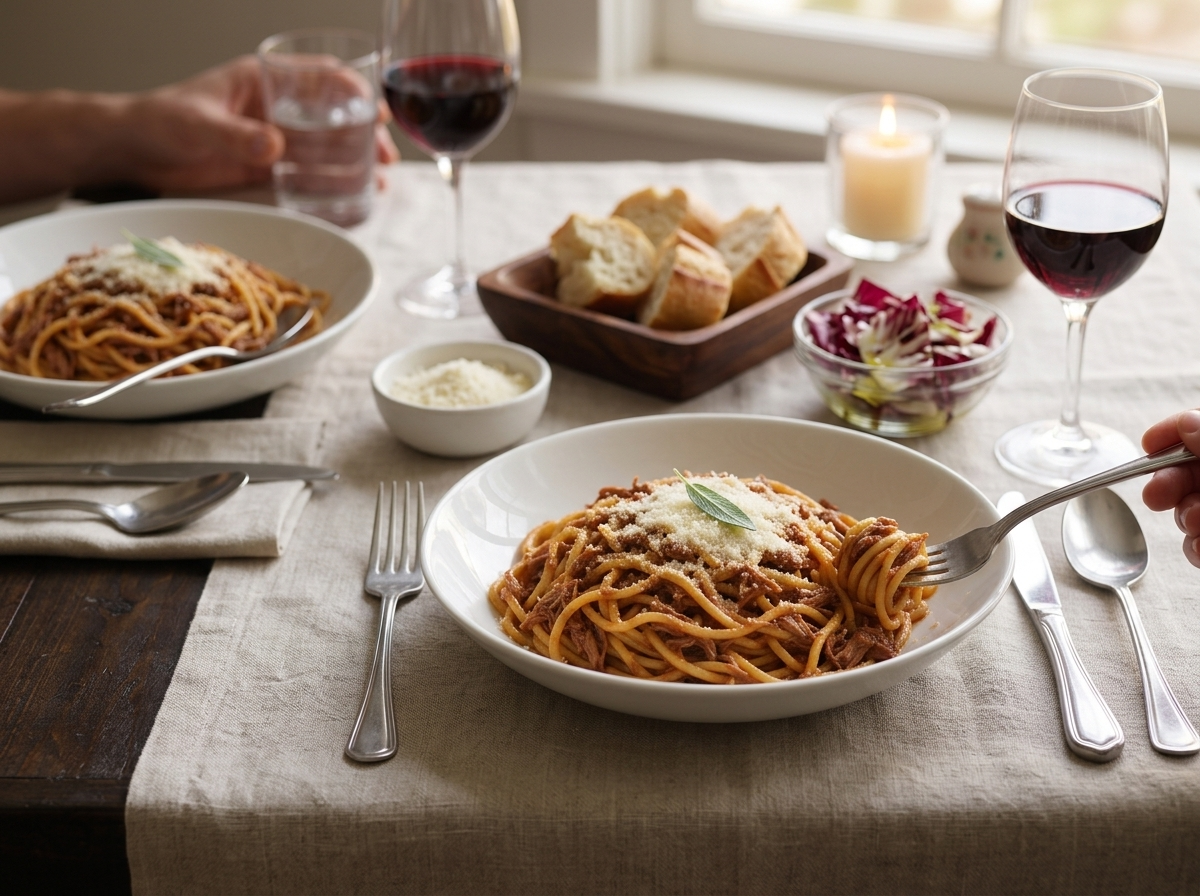
Serve the bigoli in warm shallow bowls with extra grated Grana Padano at the table. A smaller portion works as a primo, and a full bowl is a main course.
A bitter radicchio or arugula salad dressed with lemon juice and olive oil balances the richness. Put out crusty bread for the last of the sauce.
For a glass, pour a Valpolicella Classico or Bardolino, served slightly cool.
FAQ
Why is my duck ragu greasy and how do I fix it?
Duck legs release a lot of fat, and most of it ends up in the sauce unless you remove it twice. Pour off all but 3 tablespoons after searing, then skim the surface with a ladle once the braise is done. If the finished ragu still looks slick, chill it overnight and lift off the solid fat layer.
Can I use chicken thighs instead of duck legs in bigoli col ragu d’anatra?
Yes, use 8 bone-in, skin-on chicken thighs (about 1 kg / 2.2 lb) and braise them for 45 minutes instead of 90. The sauce will taste milder and less rich, so I’d add 1 tablespoon of olive oil to the soffritto since chicken renders far less fat.
Can I freeze duck ragu, and should I freeze it with the bigoli?
Freeze the ragu on its own for up to 3 months, and cook fresh pasta when you reheat it. Bigoli turns soft and mushy after freezing and thawing. Cool the sauce completely, portion it into 2-cup containers, and thaw overnight in the fridge.
What wine goes with duck ragu and bigoli?
A medium-bodied Veneto red like Valpolicella Classico is the natural match. Its bright acidity cuts through the duck fat without overpowering the herbs. Bardolino also works, and I’d serve either one slightly cool at about 16 C / 61 F.
How do I know when the duck legs in the ragu are done?
The legs are done when the meat pulls from the bone with a gentle nudge of a fork, usually after 90 minutes at a bare simmer. If the meat still grips the bone, cover the pot and give it another 15 minutes. Add a splash of water if the pot looks dry.
What is the difference between bigoli and spaghetti?
Bigoli is a thicker, rougher Venetian pasta, traditionally pressed through a hand-cranked press called a torchio or bigolaro. Spaghetti is thinner and smoother. The coarse surface of bigoli grips a chunky ragu, which is why whole-wheat bigoli and duck sauce is a long-standing Veneto pairing.