Jump to Recipe
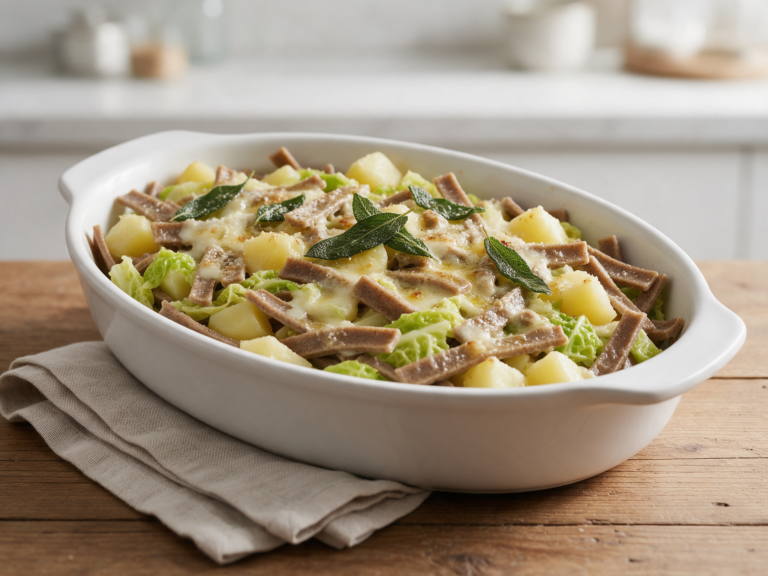
Pizzoccheri di Livigno is an Alpine pasta dish of buckwheat strips boiled with potatoes and savoy cabbage, layered with Casera cheese, and finished with garlic and sage butter. The cheese melts into the starch and becomes the sauce.
Livigno sits high in the Lombard Alps near the Swiss border, in the same province as Valtellina, where this dish has its roots. I make my version with two-thirds buckwheat flour and one-third wheat, so the strips keep their nutty taste but still hold together.
The texture defines the result: pasta with a slight bite, potatoes that crush under a fork, and cabbage that’s soft but still green.
Plan on about 80 minutes, most of it hands-off while the dough rests. The dough also keeps a day in the fridge, so you can roll it the next evening.
Why You’ll Love This Recipe
- Dough needs only two flours and water, no eggs
- Pasta, potatoes and cabbage cook together in one pot
- Cheese melts into the starch and makes its own sauce
- Leftovers reheat well in the oven the next day
Ingredient Notes
- buckwheat flour: Look for grano saraceno flour, which is dark and speckled with a nutty smell. It has no gluten, which is why the recipe also uses 100 g of all-purpose flour.
- Casera cheese: A semi-hard cow’s milk cheese from the Valtellina area that melts smoothly. Fontina is the closest widely available substitute, with a slightly milder taste.
- savoy cabbage: Its crinkled leaves hold the butter well. Swiss chard works too, and cooks faster.
- potatoes: Use waxy potatoes such as Yukon Gold so the cubes stay intact in the pot. Floury potatoes break down and cloud the water.
- dried pizzoccheri: Practical shortcut: use 350 g dried buckwheat pizzoccheri and skip the dough. Add them after the cabbage and cook for the time on the package.
- Parmigiano Reggiano: Grana Padano is a cheaper swap and works the same way in the layers.
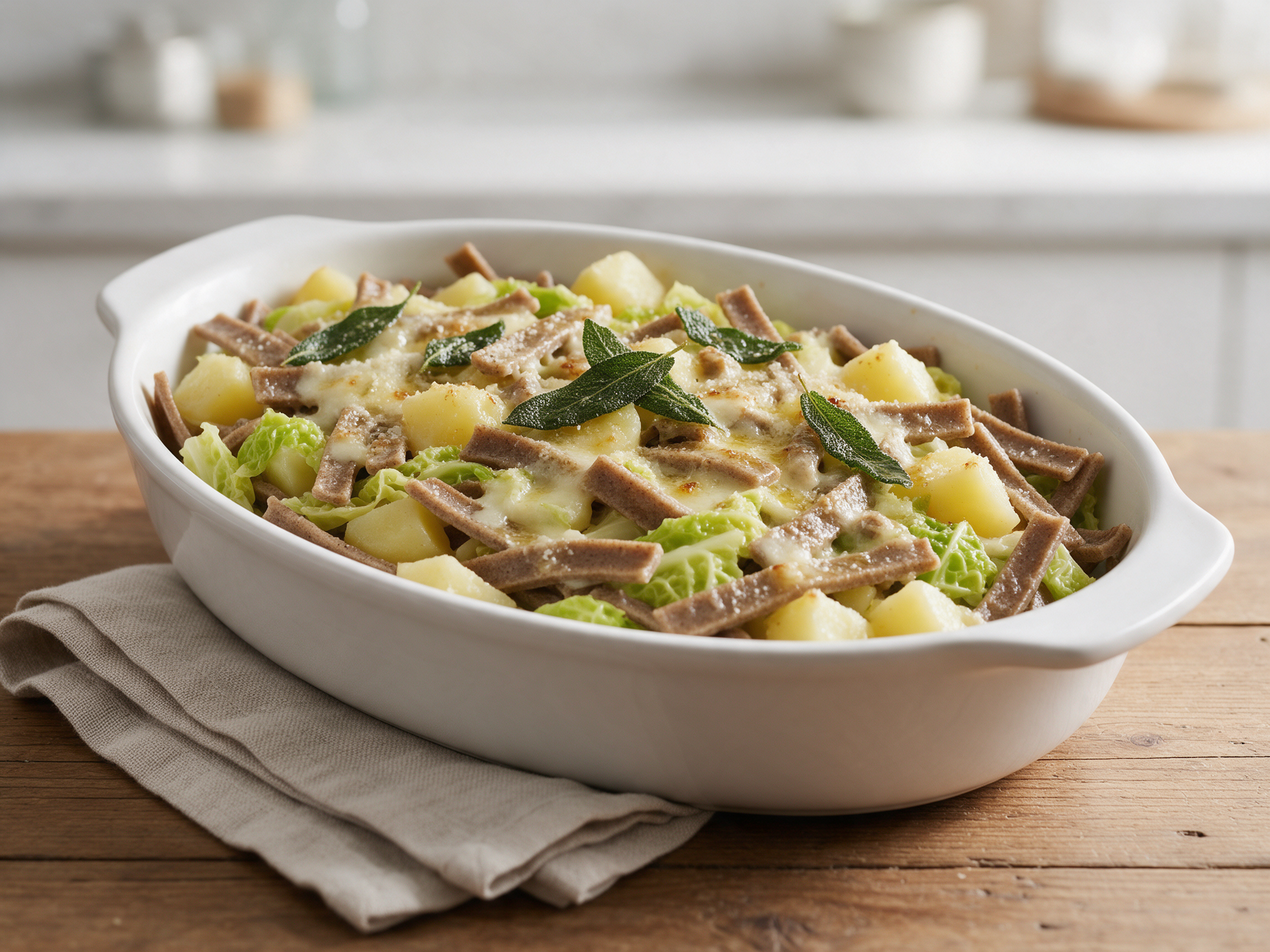
Pizzoccheri di Livigno with Potatoes, Cabbage and Casera
Ingredients
Method
- Whisk 200 g buckwheat flour, 100 g all-purpose flour and 1/2 tsp fine salt in a mixing bowl. Add 150 ml warm water and mix with a fork, then your hands, until shaggy. Knead on a lightly floured surface for 5 minutes until the dough is firm and smooth like modeling clay. If it crumbles, knead in more water 1 tsp at a time. Wrap and rest for 30 minutes.
- During the rest, peel the potatoes and cut them into 2 cm cubes. Trim the cabbage, remove the core, and cut it into 2 cm ribbons. Slice the Casera thinly and grate the Parmigiano. Bring 4 L / 4 quarts of water with 1 tbsp coarse salt to a boil in a 6-quart / 5.7 L pot, and heat the oven to 120 C / 250 F with a 23 x 33 cm / 9 x 13-inch baking dish inside.
- Divide the dough in two and roll each half on a floured surface to 3 mm thick. Cut each sheet into 7 cm wide bands, then slice the bands into 5 mm strips so each strip is about 7 cm long. Toss the strips with the 2 tbsp dusting flour and spread them out so they don't stick.
- Add the potatoes to the boiling water and cook for 8 minutes. Add the cabbage and cook 5 minutes more, until the cabbage is tender and a potato cube crushes easily against the side of the pot.
- While the cabbage cooks, melt 100 g butter in a 26 cm / 10-inch skillet over medium-low heat with 2 crushed garlic cloves and 8 sage leaves. Cook for 4 minutes until the butter foams, smells like hazelnuts, and the sage turns crisp. Take the skillet off the heat.
- Drop the pizzoccheri into the pot, stir gently, and cook 3 to 4 minutes until tender with a slight bite. Don't go past 4 minutes: the dough is mostly buckwheat, which has no gluten, so overcooked strips break apart and cloud the water.
- Ladle out 120 ml of the cooking water, then lift the pizzoccheri, potatoes and cabbage out with a spider or slotted spoon. Using oven mitts, take the hot baking dish from the oven and spread a third of the mixture in it, then a third of the Casera and Parmigiano. Repeat twice more for three layers.
- Pour the garlic and sage butter over the top and grind on black pepper. Splash in 2 to 3 tbsp of the reserved cooking water if it looks dry. Bake for 5 minutes until the Casera melts and turns stretchy, then serve at once.
Notes
- Rest the dough a full 30 minutes before rolling so it stretches without tearing.
- Cut strips about 7 cm long and 5 mm wide so they cook evenly.
- Salt the cooking water, since the potatoes and pasta take on most of the seasoning there.
- Warm the baking dish in the oven so the cheese starts melting on contact.
- Serve at once while the Casera is still stretchy.
Tips for Success
- Knead the dough a full 5 minutes and rest it 30 minutes, since buckwheat flour hydrates slowly and rolls without tearing after the rest.
- Cut the potatoes and cabbage to 2 cm pieces so they finish together, then stir gently once the pasta strips go in.
- Slice the Casera thin instead of cubing it so it melts into the layers within the 5 minutes in the oven.
- Cook the butter until it foams and smells like hazelnuts, about 4 minutes, then pull the skillet off the heat.
- Reserve 120 ml of cooking water before lifting out the pasta, and splash a few tablespoons over the layers if the dish looks dry.
Variations
- Swap the cabbage for 250 g Swiss chard, slicing the stems thin and adding it for the last 3 minutes before the pasta.
- Replace half the Casera with Bitto if you can find it, for a sharper, grassier melt through the layers.
- Render 80 g diced speck in the skillet for 3 minutes, then add the butter, garlic and sage for a smoky layer.
Storage and Reheating
Pizzoccheri di Livigno keeps in the fridge for 3 to 4 days in an airtight container. The cheese firms up when cold, so plan to reheat it rather than eat it straight from the fridge.
Reheat in a baking dish covered with foil at 160 C / 320 F for 15 to 20 minutes, with 2 tbsp milk or water drizzled over the top. A skillet over medium-low heat for 5 minutes with a splash of water also works, stirring gently so the strips don’t break.
For make-ahead, wrap the rested dough and keep it in the fridge for up to 24 hours. You can also freeze the cut, uncooked strips on a floured tray for 1 hour, then bag them for up to 2 months. I don’t freeze the assembled dish, because the potatoes turn grainy.
Serving Suggestions
Serve pizzoccheri straight from the baking dish at the table, while the Casera is still stretchy. It’s rich, so portions of about 300 g are plenty as a main course.
A bitter greens salad with lemon dressing cuts through the butter and cheese. For a starter, thin slices of bresaola with arugula and olive oil keep to the Valtellina theme.
Pour a Rosso di Valtellina, a Nebbiolo-based red with enough acidity to match the dish.
FAQ
Why is my pizzoccheri dough cracking when I roll it out?
Cracking means the dough is too dry or hasn’t rested long enough. Knead in water 1 teaspoon at a time until it feels firm like modeling clay, then rest it 30 minutes. Buckwheat flour absorbs water slowly, so the dough softens as it sits and rolls to 3 mm without tearing.
Can I use Swiss chard instead of savoy cabbage in pizzoccheri?
Yes, Swiss chard is the other green used in Valtellina-style pizzoccheri. Use 250 g, slice the stems thin, and add it for only 3 minutes before the pasta goes in, after cooking the potatoes 2 minutes longer. Chard cooks faster than savoy cabbage. The flavor is slightly earthier.
Can I freeze the cut pizzoccheri strips, and how do I cook them?
Yes, freeze the uncooked strips in a single layer on a floured tray for 1 hour, then bag them for up to 2 months. Cook straight from frozen, adding about 1 minute to the 3 to 4 minute boil time. Thawing first makes the strips sticky and they clump.
What wine goes with pizzoccheri di Livigno?
A Rosso di Valtellina is the natural match. It’s a Nebbiolo-based red from the same province, and its acidity cuts through the butter and cheese. If you’d rather skip wine, a bitter greens salad with lemon dressing does the same job on the plate.
What is the difference between pizzoccheri di Livigno and pizzoccheri della Valtellina?
Both are buckwheat strips with potatoes, greens, cheese and sage butter. The Valtellina name has a protected IGP with set rules, while a Livigno-style version leaves room to adjust the cheese and greens. Mine uses two-thirds buckwheat flour, which rolls easily, and Casera, which is simple to find.
Is pizzoccheri di Livigno gluten free since it uses buckwheat?
No, this version isn’t gluten free because the dough includes 100 g of wheat flour. Buckwheat itself is gluten free, but a dough made only from it tears easily. For a gluten-free plate, use certified gluten-free dried buckwheat pasta and follow its package time.