Ingredients
Method
Mix and Knead
- Dissolve the yeast and honey in the warm water and let stand 5 minutes, until foamy.
- In a large bowl, whisk together the rye flour, bread flour, and salt. Stir in the fennel seeds if using.
- Pour in the yeast mixture and stir with a wooden spoon until a sticky, shaggy dough forms. It doesn't need to be smooth.
- Knead by hand on a lightly floured counter for 5-6 minutes. Rye dough stays tacky and won't turn elastic like wheat dough; that's normal.
First Rise
- Shape the dough into a rough ball, place it in a lightly oiled bowl, cover, and let rise at room temperature (about 24 C / 75 F) for 60 minutes, until puffed but not doubled.
Shape and Second Rise
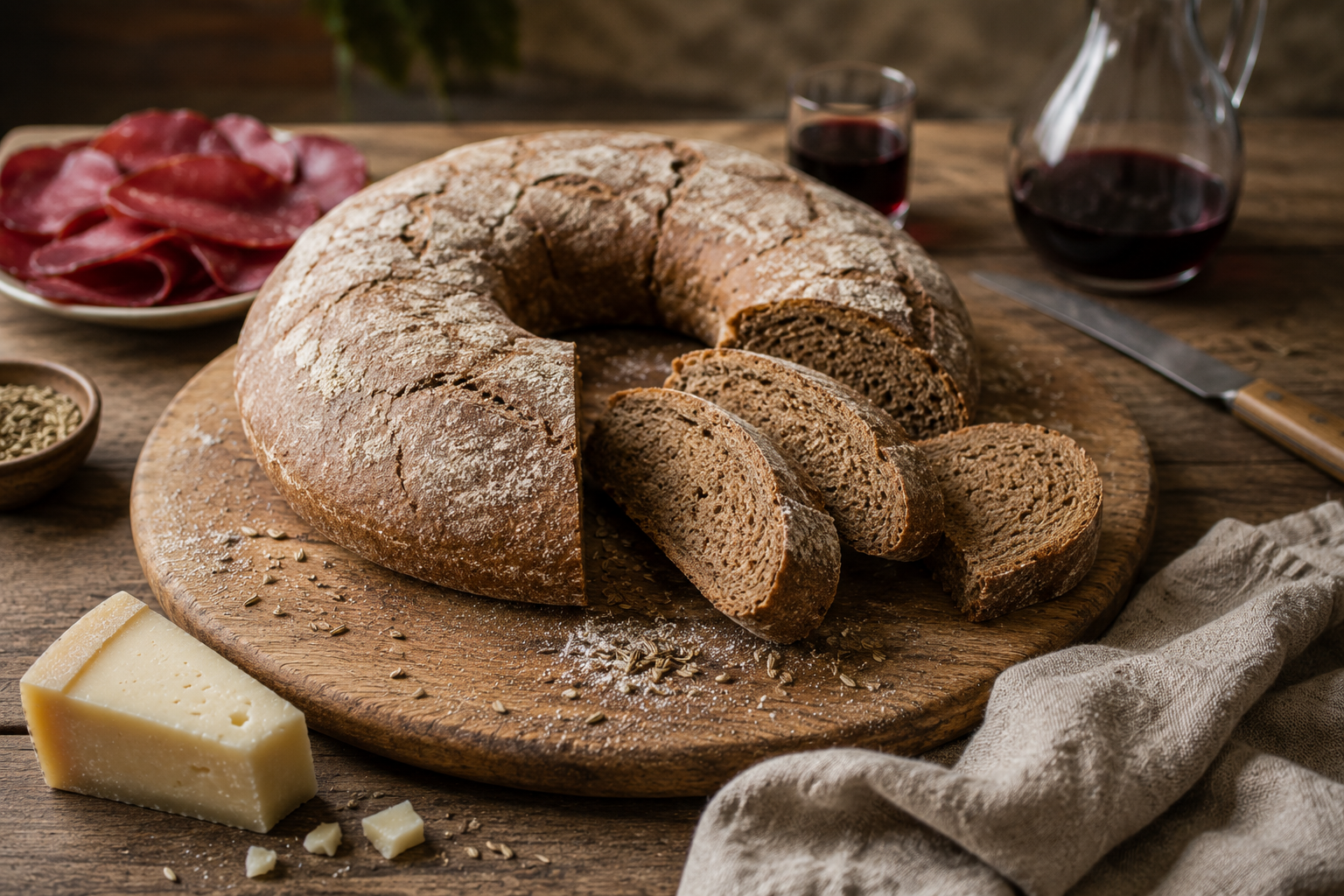
- Turn the dough onto a generously floured work surface. With damp or lightly floured hands, shape it into a thick, low ring about 18–20 cm wide, with an opening about 7–8 cm wide in the center. Make the opening fairly generous, since it will narrow as the dough proofs and bakes.
- Transfer the ring to parchment paper, cover loosely, and let rise for about 45 minutes.
Bake
- Heat the oven to 220 C / 428 F with a baking stone or heavy sheet pan inside.
- Score the top of the ring with a sharp knife or lame. Using the parchment paper, carefully slide the bread onto the hot baking stone or sheet pan.
- Bake 15 minutes at 220 C / 428 F, then lower the heat to 200 C / 390 F and bake another 30 minutes, until the crust is deep brown and the internal temperature reads 96 C / 205 F.
- Cool on a wire rack for at least 1 hour before slicing. Cutting it warm makes the crumb gummy.
Notes
- Weigh flour for accurate hydration; rye flour compresses more than wheat flour.
- Dough stays sticky and slack; resist adding extra flour during kneading.
- Score the loaf just before baking so the cuts open cleanly.
- Cool completely before slicing; warm rye bread turns gummy fast.