Ingredients
Method
Make the spinach pasta dough
- Wash the spinach and cook it in a dry pan over medium heat for 2-3 minutes until fully wilted. Transfer to a clean cloth and squeeze firmly until completely dry. You should have about 60 g of pressed spinach.
- Finely chop or blend the pressed spinach into a smooth paste.
- Mound the flour on a clean work surface. Make a well in the center and add the eggs, spinach paste, and a pinch of salt. Beat the eggs gently with a fork, gradually drawing in the flour from the inner wall of the well.
- Once the dough comes together, knead firmly for 8-10 minutes until smooth and slightly elastic. The dough should be firm but not sticky. If it clings to the surface, add flour a teaspoon at a time.
- Wrap the dough tightly in cling film and rest at room temperature for 30 minutes.
Cook the ragù bolognese
- Heat the olive oil and butter together in a large heavy-bottomed saucepan over medium heat. Add the onion, celery, and carrot and cook, stirring regularly, for 10-12 minutes until the vegetables are soft and pale gold.
- Increase the heat to medium-high. Add the ground beef and pork. Break the meat up with a wooden spoon and cook for 8-10 minutes until no pink remains and the meat begins to brown lightly on the base of the pan.
- Pour in the white wine and stir, scraping any browned bits from the base. Cook for 3-4 minutes until the wine has mostly evaporated.
- Stir in the tomato paste and cook for 2 minutes. Add the milk and stir until absorbed, about 3 minutes.
- Pour in the warm stock, add the bay leaves, season with salt and pepper, and reduce the heat to low. Simmer partially covered for 1.5 to 2 hours, stirring every 20-30 minutes, until the ragù is thick and the liquid has reduced. Remove the bay leaves and taste for seasoning.
Make the béchamel
- Melt the butter in a medium saucepan over medium heat. Add the flour all at once and stir constantly for 2 minutes until the mixture is pale and smells slightly nutty.
- Add the warm milk gradually, whisking continuously to prevent lumps. Continue whisking over medium heat for 8-10 minutes until the sauce is thick enough to coat the back of a wooden spoon.
- Season with salt, white pepper, and freshly grated nutmeg. Remove from heat and press a piece of cling film directly onto the surface to prevent a skin from forming.
Roll the pasta sheets
- Divide the rested dough into 4 portions. Keep unused portions covered. Flatten one portion with your hand and feed it through the pasta machine at the widest setting (1). Fold it in thirds and feed through again. Repeat twice.
- Progress through the settings, rolling once per setting, until you reach setting 5 or 6. The sheet should be thin enough to show your hand through it when held up to light.
- Cut sheets to fit your 30 x 20 cm baking dish with a slight overhang. Lay finished sheets flat on a lightly floured surface or hang them over a rod. Repeat with the remaining dough.
- Bring a large pot of salted water to the boil. Blanch the pasta sheets in batches for 30 seconds each, then transfer to a bowl of cold water for 10 seconds and lay flat on clean kitchen towels.
Assemble and bake
- Heat the oven to 190 C / 375 F.
- Spread a thin layer of béchamel across the base of the baking dish. Lay the first pasta sheet over the béchamel, trimming any overlap.
- Spread an even layer of ragù over the pasta, followed by a layer of béchamel, and a scattering of grated Parmigiano. Repeat the layering - pasta, ragù, béchamel, Parmigiano - building 5 to 6 layers in total.
- Finish the top layer with the remaining béchamel, a generous grating of Parmigiano, and dots of butter scattered evenly across the surface.
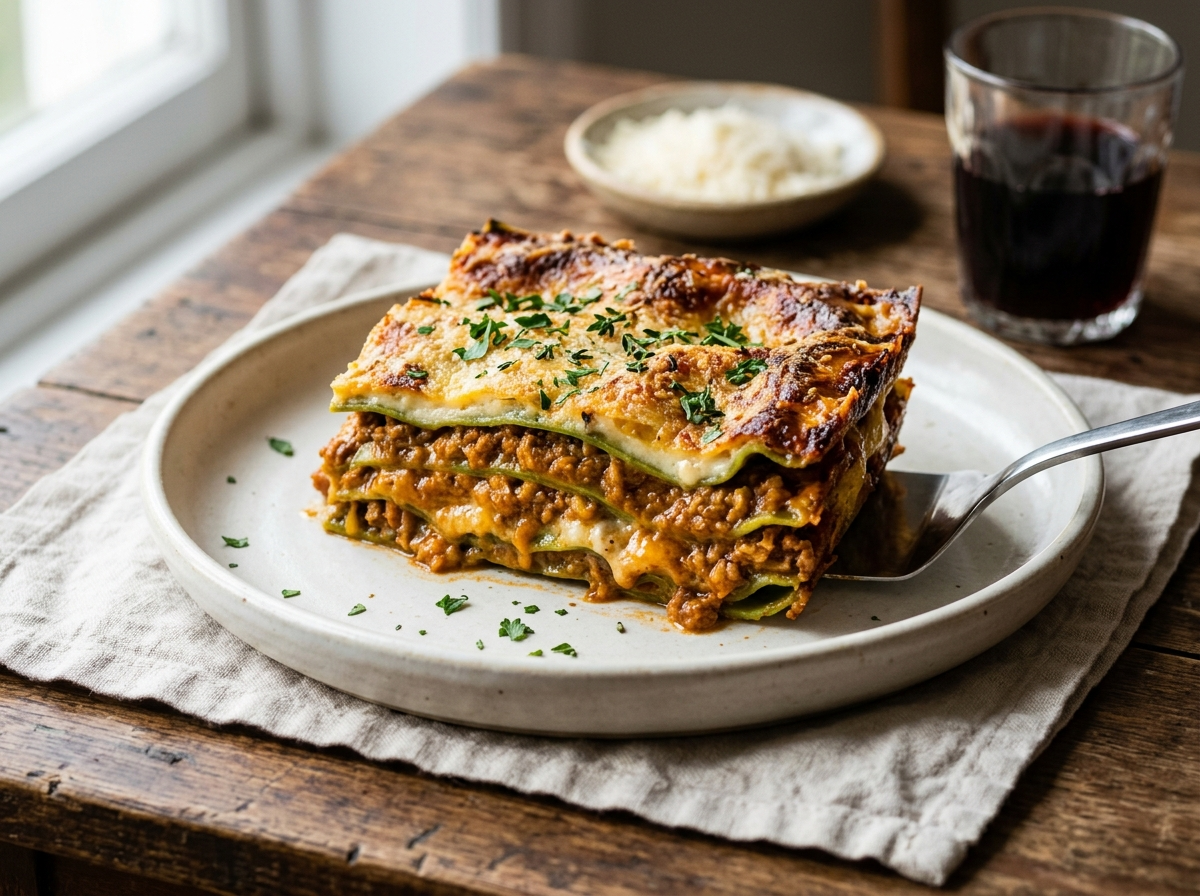
- Cover tightly with foil and bake for 30 minutes. Remove the foil and bake for a further 15 minutes until the top is golden and bubbling at the edges.
- Remove from the oven and rest uncovered for 15 minutes before cutting and serving. The layers will settle and slices will hold their shape.
Notes
The ragù can be made up to 3 days ahead and refrigerated, or frozen for up to 2 months. A fully assembled, unbaked lasagne keeps in the fridge overnight and bakes from cold with an extra 10 minutes under foil.