Ingredients
Method
Prep the cucumbers and brine
- Wash the cucumbers under cold water and scrub off any blossom dust. Trim a thin slice off the blossom end of each one, the end opposite the stem, since it holds an enzyme that softens pickles during a long ferment.
- Weigh 1.5 L / 6 cups of non-chlorinated water into a bowl and stir in 52 g sea salt until fully dissolved. This gives a 3.5% brine, strong enough to favor lactobacillus over spoilage bacteria.
Pack the crock
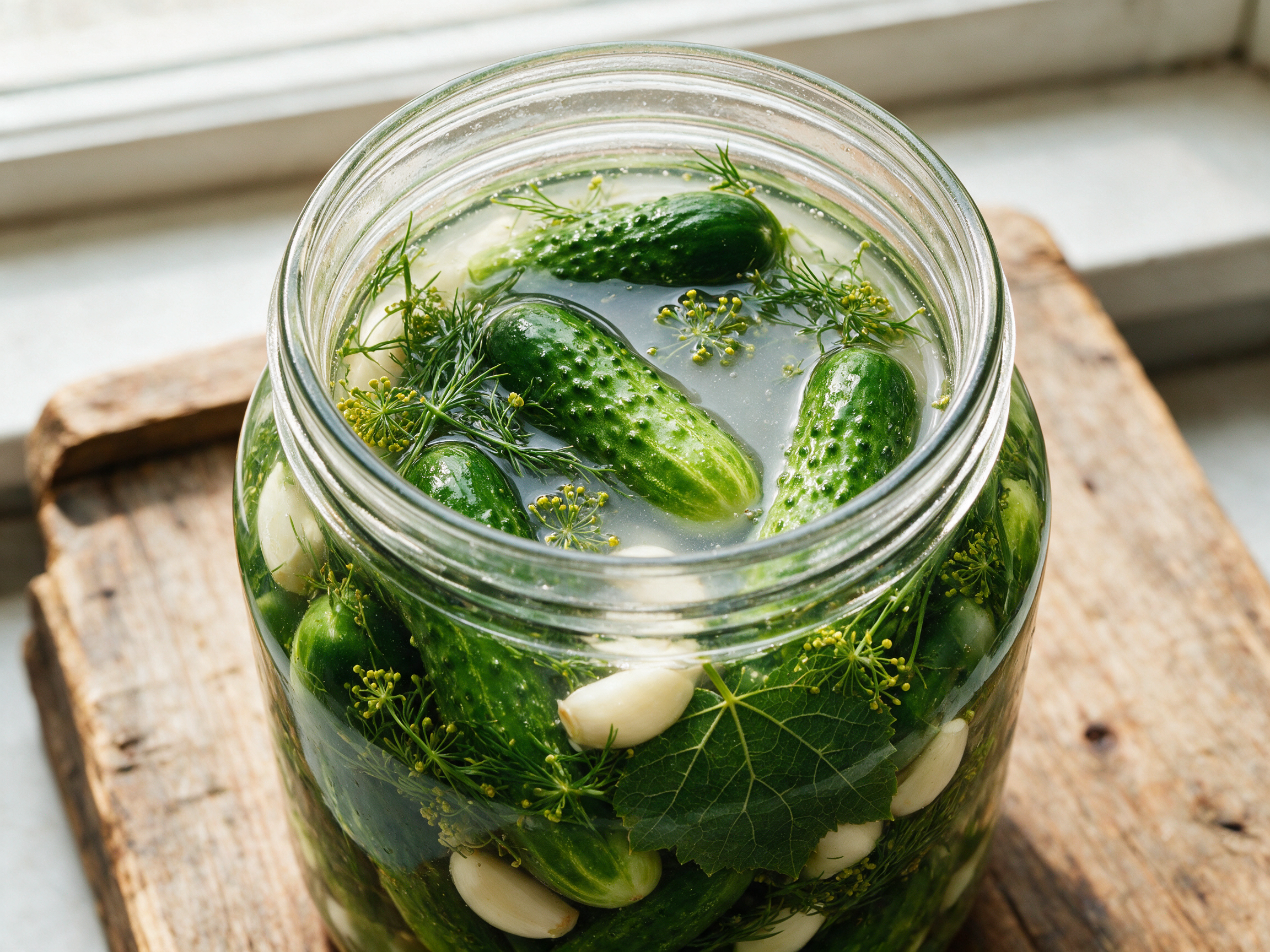
- Lay 2 grape leaves and half the garlic, dill, peppercorns, mustard seeds, bay leaves, and juniper berries in the bottom of a 2-liter / 2-quart fermentation crock or wide-mouth jar.
- Pack the cucumbers into the crock as tightly as you can without crushing them, standing smaller ones upright and laying larger ones on top.
- Scatter the remaining garlic, dill, spices, and chili flakes over the cucumbers, then tuck the remaining grape leaves on top as a final layer.
Brine, weight, and ferment
- Pour the brine over the cucumbers until fully covered, leaving about 2.5 cm / 1 inch of headspace.
- Set a fermentation weight, or a small plate topped with a water-filled bag, directly on the cucumbers so every piece stays under the brine line. Any cucumber that floats above the surface will mold within a day or two.
- Cover the crock loosely with a clean kitchen towel or cheesecloth secured with a rubber band. Set it on the counter out of direct sunlight, at 18 to 21 C / 65 to 70 F.
- Check daily and skim off any thin white film with a spoon, that's harmless kahm yeast. Discard the batch only if you see fuzzy pink, black, or green mold.
- Start tasting on day 5. The pickles are ready when the brine turns cloudy and the cucumbers taste tangy and sour, with a dull olive-green color rather than bright green, usually by day 7 to 10.
- Once fermented to taste, move the crock, or transfer everything to jars, to the fridge, keeping the cucumbers fully submerged in their brine. Slice or serve whole.
Notes
- Non-chlorinated water matters, since chlorine can slow or stall fermentation entirely.
- A crock with a water-seal lid works well, but a weighted jar is fine too.
- White kahm yeast on the surface is harmless, just skim it and keep fermenting.
- Colder rooms slow fermentation, warmer rooms speed it up by a few days.